Tacho

PabloPicasso

Well-Known Member
Joined
12 Feb 2010
Messages
2,898
Visit site
Vol o MD2010 alternator is outputting 12 to16 volts on the W terminal.

The Tacho only shows revs up to 1500 or so no matter what the engine does.

Seems to charge ok

Is the alternator toast?
 
The 12 to 16v output is possibly correct given that I presume you are measuring with a digital multimeter on AC or Dc range. It is just to hard to measure the varying voltage pulses without an oscilloscope. If the alternator appears to be charging ok. Try charge current or charge voltage with max load you can put on electrics.
If the rev counter is in the form of a mechanical analogue meter then most likely it is the movement itself which has become fouled. If it were me I would be dismantling the meter itself and look for swarf between moving coil and magnets. But in any case opened up you should be able move the pointer easily though range. ol'will
 
Thanks for that reply. I'll check the load charging voltage next time I'm aboard.

I don't know how difficult it will be to get to the tachometer itself. I do have a tacho left over from a previous project. Perhaps I can connect it up to the w terminal and see how it been behaves.
 
Vol o MD2010 alternator is outputting 12 to16 volts on the W terminal.

The Tacho only shows revs up to 1500 or so no matter what the engine does.

Seems to charge ok

Is the alternator toast?
is that AC or DC voltage. the tacho should have an AC voltage. The voltage is not as important as the frequency as the Tacho works on the pulses. As said above you need a scope or at least a frequency meter to check that. e.g you could expect 3,600 RPM = 60Hz.
There are meters available on line.
 
That sounds like rather a high voltage measured on the W terminal compared to what I saw with my multimeter set to AC which was around 7.0v - 8.6v

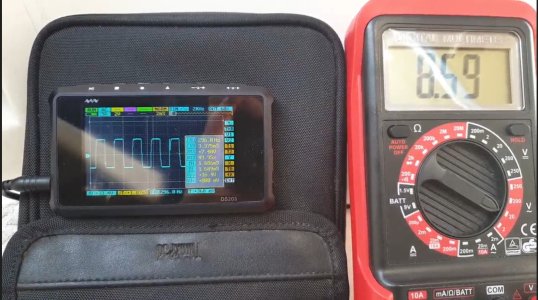
My video on Onedrive (link below) shows the voltage variation at various engine speeds side by side with the oscilloscope view of the same connection..

https://1drv.ms/ Tacho signal as seen on DSO203 oscilloscope

if you're near Southsea, you're welcome to try out the oscilloscope.

Screenshot_20250503-123904_Samsung Internet.jpg

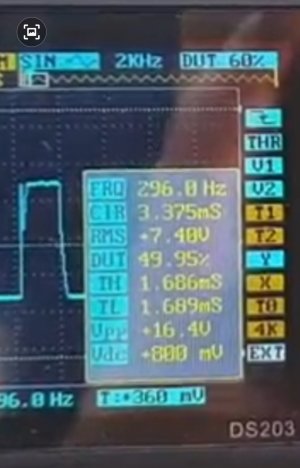
And a close up of the oscilloscope, you can see the AC RMS voltage, the peak to peak voltage as well as the frequency.

Screenshot_20250503-123950_Gallery.jpg
 
Last edited:
is that AC or DC voltage. the tacho should have an AC voltage. The voltage is not as important as the frequency as the Tacho works on the pulses. As said above you need a scope or at least a frequency meter to check that. e.g you could expect 3,600 RPM = 60Hz.
There are meters available on line.
The alternator output pulse frequency is not the same as the engine rpm. There is a scaling factor which depends on the windings of the alternator and the relative sizes of the alternator and crankshaft pulleys. However if you see a steadily increasing frequency with engine speed then the alternator is probably fine and the fault is with the tacho meter.
 
The alternator output pulse frequency is not the same as the engine rpm. There is a scaling factor which depends on the windings of the alternator and the relative sizes of the alternator and crankshaft pulleys. However if you see a steadily increasing frequency with engine speed then the alternator is probably fine and the fault is with the tacho meter.
I know. I was referring to alternator speed. On a standard alt. 3000 RPM = 50Hz 3600 RPM = 60 Hz. as you say engine speed will be different due to pulley ratio but easily worked out, in either direction.
As I also said search engine browse will reveal lots of cheap frequency meters.
Edit. He could of course just have a slipping belt?:unsure:;)
 
Last edited:
I fitted another (el cheapo ebay) tacho today and it reads fine. So the problem is most likely with the tacho in the volvo panel, or its wiring.

I might just extend the cables on the ebay special and mount it in a convenient location where I can see it from the helm.
 
Last edited:
Top