Tabernacle

Clint

Active Member
Joined
26 Mar 2014
Messages
52
Location
Guildford
Visit site
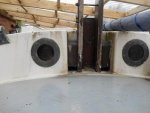
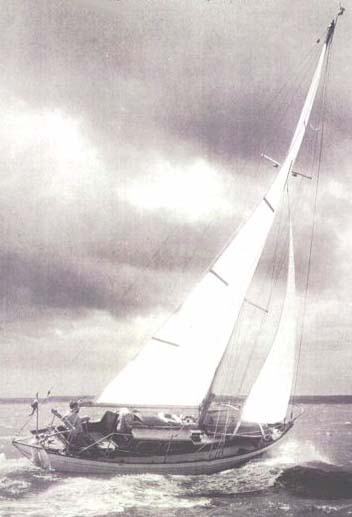
I have finally gotten round to taking a good look at the mast tabernacle of my little Winklebrig, it seems to be made of 20mm teak, that is only held together by 8, 25 mm brass screws. The wood is showing very visible signs of cracking, and needs replacing, I made a replacement out of meranti, and 50 mm stainless screws, but now I'm worried about stresses. I don't want to be left without a mast if there is a weak spot in the wood. So I thought about having it fabricated out of metal, what would be best, aluminium, or galvanised steel?(the entire boat is GRP) (I would like to use 316 stainless but that is probably more expensive than the entire boat.) What thickness would I need, I am assuming that because it would be made of metal, I could halve the thickness, correct? The large pieces of wood on the side are just spacers, and are only screwed onto the tabernacle itself, and nothing else, the tabernacle itself is bolted directly to the boat.

Clint
 

Attachments

  • 37.jpg
    37.jpg
    14.2 KB · Views: 0
Clint,

how about a stainless tabernacle ?

Shouldn't cost more than a galvanised steel job, the thing is, whereabouts is your boat, just roughly ?

I can recommend Chris at Chichester marina, despite the location he gives an excellent value service - 01243 511273

No connection other than happy customer.
 
Last edited:
Can't see any problem The tabenacle merely provides a base for the mast to sit on. When upright the mast should sit on it's foot, the pivot shouldn't take any weight. The rigging holds the mast in position so the tabernacle is purely to stop the foot moving about.
 
Thanks for the tip. She's a trailer sailor, and at the moment she is on her trailer in our drive, I only bought her in May and she is undergoing a major refurb. I have practically stripped her bare. I am in Guildford and have only been to Chichester Marina very briefly on a visit to Force 4. I have removed the tabernacle, so I could always take it to him, and see what he says.
 
Thanks for the info, I have a powerboat background, so real boats are still a bit of a mystery to me. I had the chance to sail on a Bavaria 40 2 years ago, and I was converted. As I can't afford a Bavaria, I saw a little 20 foot Winklebrig trailer sailor, and fell in love with her, and I bought her for £500. She is now undergoing a major refit, so she is in bits and pieces in our drive and my workshop.
 
Can't see any problem The tabenacle merely provides a base for the mast to sit on. When upright the mast should sit on it's foot, the pivot shouldn't take any weight. The rigging holds the mast in position so the tabernacle is purely to stop the foot moving about.

Which is fine until you come to lower the mast. I agree that the pivot shouldn't take any weight as the block and tackle rigged should account for this. But then you need some sort of support on the tabernacle to stop it from twisting excruciatingly after the mast reaches the 45 degree angle in it's descent.

In my case the supports are s/s rods linked to eyelets on each side of the tabernacle and thence to the aft shroud chainplates.

A few weeks ago I decided not to use the supports - with almost disastrous consequences when the wind caught the mast. I did not make the same mistake when raising it.

Not my ideas, just many years of Dutch/Scandinavian experience and technology.
 
Oh, for heaven's sake. You could lift the mast by hand . It's a 16 ft boat with a (short) gaff rig mast.


555.jpg
 
Last edited:
It's not lifting the mast that I'm worried about, it's the tabernacle breaking away or doing other things. I'd prefer to have it made of steel, less bloody wood to maintain too! For a fibreglass boat she has a lot of wood.
 
Hey, thanks for that. I was referring to your statement:

"The tabenacle (sic) merely provides a base for the mast to sit on"

Which is bollux.
Sorry you think that. The tabernacle should only provide a fulcrum for lowering/raising the mast. In normal use the mast should rest on it's foot. The mast weighs less than nothing.
 
It's not lifting the mast that I'm worried about, it's the tabernacle breaking away or doing other things. I'd prefer to have it made of steel, less bloody wood to maintain too! For a fibreglass boat she has a lot of wood.
Sounds like you bought the wrong boat.
 
Sorry you think that. The tabernacle should only provide a fulcrum for lowering/raising the mast. In normal use the mast should rest on it's foot. The mast weighs less than nothing.

So the actual thickness of the material is really irrelevant, as long as it is capable of supporting the mast as it lowers and raises, I am beginning to understand it all now.
 
Even my aluminium mast weighs next to nothing. Myself and my 7 stone missus could carry it a mile. However, that counts for nothing when it is in a 45 degree position and the wind blows it out of true.

The base of the mast, even with the pivot bolt in place, turns alarmingly. So much so that the stainless steel tabernacle is deformed to a degree where you think it can never reform.

This happened to me, two weeks ago. The force of the mast taken by the wind snapped the tackle from the grip of the Dutch Surveyor who was assisting me. It threw him over the guardwires, on to the pontoon where he was knocked unconscious. I was 'guiding' the mast at the tabernacle and ended up releasing it at the final moment as I could not take the weight. The mast crashed against the pushpit, hit the water knocking off the anchor light and VDO wind sensor.

It was not funny.

That is when I realised that there is more to a tabernacle than looking pretty and providing just a 'base for the mast to sit on'.
 
Any mast on any boat has a significant weight, be it simple material weight, the strain on the windward standing rigging when heeling more than 1 degree, or the compression load from the sails and rigging when they're tensioned in use,( nb mainsheet ) usually requiring a compression post or similar structure in yachts; Lakesailor knows this and is just apparently in a mood at the moment.
 
I love her and "woodn't" change her for anything, especially now that I have started to treat the wood like the previous owner should have, she's a beautiful little boat.
 
Any mast on any boat has a significant weight, be it simple material weight, the strain on the windward standing rigging when heeling more than 1 degree, or the compression load from the sails and rigging when they're tensioned in use,( nb mainsheet ) usually requiring a compression post or similar structure in yachts; Lakesailor knows this and is just apparently in a mood at the moment.

Don't I know it.

The reason I lowered the mast was because the compression post was 'sinking'. It was sinking because the 'core' on which it was placed was actually solid mahogany which had rotted over many years of freshwater running down the inside of the mast.

Anyway, having dug out the **** I then replaced it all with a shoe box sized series of West Epoxy layers. The end result was very satisfying. I faired it, painted it and replaced the compression post and raised the mast.

The next day I discovered the fecker was sinking again! Why? None of us here (some extremely better qualified than I) know. Perhaps it is air in the epoxy, exothermic heating (the amibient temp here was about 35 degrees), perhaps the last layer had insufficient hardener - we just don't know.

Anyway, the whole thing has to be re-done, and I have ordered a s/s plate to sit at the base. A pain in the arse, but clearly a pain in the arse due to the SIGNIFICANT loads placed on the compression post through that diddly little mast thingy.

So, LS, come out here and give us the benefit of your wisdom. I might even pay for your flight. :)
 
Don't I know it.

. It was sinking because the 'core' on which it was placed was actually solid mahogany which had rotted over many years of freshwater running down the inside of the mast.

Mine is made of either teak, or mahogany, which is also starting to crack and do other strange things, that's why I want to change it for something a bit more substantial, and even though the wooden mast is not that heavy, you do feel it when you lift it, I haven't even tried raising it yet, I have only picked it up to put it on trestles so that I can strip all the old varnish off it.
 
Sorry. You are all misunderstanding how masts and rigging work. The compression post is a red herring. That is nothing to do with the tabernacle issue.

My clinker dinghy was a bermudan rig and had a 20 ft wooden mast. I could step it by hand whilst leaning over the gunwhale. If the wooden mast on a 16 ft gaff rigged boat is more awkward than that I will be very surprised.
Lowering the mast should require no tackle. You can stand in the cockpit and lower it by hand.

It is a 16ft boat. With a gaff rig.
How can you compare this with a long mast on a 25ft yacht?

Virtue2.jpg

This was the mast foot on my Seahawk which provided a pivot for raising and lowering a 20 ft mast, single-handed when I trailer-sailed it. How difficult can it be?


Mastfoot2.jpg
 
Don't I know it.

. It was sinking because the 'core' on which it was placed was actually solid mahogany which had rotted over many years of freshwater running down the inside of the mast.

Mine is made of either teak, or mahogany, which is also starting to crack and do other strange things, that's why I want to change it for something a bit more substantial, and even though the wooden mast is not that heavy, you do feel it when you lift it, I haven't even tried raising it yet, I have only picked it up to put it on trestles so that I can strip all the old varnish off it.

Careful we are not talking at cross purposes. I am referring to the area beneath the grp cabin sole and the keel. This, substantial, area is to support the base of the compression post and the solution - back in 1983 - was to put a girt big hunk of hardwood in there. It worked - for a while, then rotted. This is nothing to do with a tabernacle.
 
Sorry. You are all misunderstanding how masts and rigging work. The compression post is a red herring. That is nothing to do with the tabernacle issue.

I am not talking about my Vertue. I am talking about my tabernacle stepped LM26 which is kept on the Algarve!

With the compression post sinking the mast weight plus the rig pressure would deform the coachroof to such a point that it would crack and require major, major surgery to the balsa core sandwich.

At least that is what my Dutch surveyor told me. Perhaps you know better?

Besides, as you know, we have moved on from the Op discussion; remember:

"The tabenacle merely provides a base for the mast to sit on"

Which is what I am querying.
 
Last edited:
Top