Surge prediction

Yes, pleased for everybody – and I expect many are still sleeping the sleep of the just!

I pulled up the 2 day tidal record for Lowestoft for 5/6 December 2013 here:
http://www.ntslf.org/data/realtime?port=Lowestoft&from=20131205&span=4

and compared it with last night here:
http://www.ntslf.org/data/realtime?port=Lowestoft&from=20170113&span=4

The contrast is considerable: despite the preceding low being much higher this time (ca. 2.0 m vs. ca. 0.7m in 2013) the rise was a lot less and the eventual high about 0.9m less. The preceding low being so high made the Lowestoft curve look very scary this time, as Javelin noted at about 7pm.

It seems that the high winds feared (and noted in the EA warnings, as pvb pointed out) not materializing was an important factor: ‘The Environment Agency said things were not as bad as predicted "because the combined surge and high tides aren't happening at the same time, as a result of wind".’ http://www.bbc.co.uk/news/uk-england-38619611
 
A long night for some & Javelin with too much Sherry in the trifle :)
Im sure most marina / boat yd staff had a long evening making boats safe watching the tide over high water.
Twice before i have gone down to the boat,even losing pay to do so one time ( duty of care not just rely on Ins ) . this time i was confident as we have all new higher piles.
Just noticed that it was Friday the 13th too

Harwich Gauge the past 24 hrs


HARWICH HARBOUR DEPTH GAUGE 13>14/01/2017
 
Last edited:
I do not have time to look through all these posts and apologise if the following is trying to teach grannies to suck the proverbial eggs. It is a post that I put on another thread for info.

Predicting North Sea tidal surge flooding is a case, primarily, of getting the timing of the surge precisely correct with respect to the high tide. Wind direction is critical. The wind should be more or less parallel to the coast. The surge driven by the wind will then turn due to Coriolois onto the coast. Counter-intuitively a wind more directly onto the coast may well increase wave height but not the surge.

From my time in the then Central Forecast Office, I can assure you that warnings will never be issued lightly. There is no point in crying wolf. On the other hand, missing a surge flood is in nobody's interest.
 
From my time in the then Central Forecast Office, I can assure you that warnings will never be issued lightly. There is no point in crying wolf. On the other hand, missing a surge flood is in nobody's interest.

I'm sure warnings are not issued lightly. However, in post 74, at about 6pm yesterday, I remarked that I was bewildered by some of the information these "agencies" were putting out. The Environment Agency's "severe flooding" warning for the Clacton/Jaywick area said the wind was forecast to be force 7 at the midnight HW. The BBC Weather forecast said the wind would be 15mph at midnight. Now that sort of difference in a wind strength forecast surely needs investigating?
 
Last edited:
Well to recap, here at Fambridge we had an early high water during the day yesterday peaking at about the predicted height but a good half an hour early both arriving and departing

And last night the tide rose much earlier from a very high low water floating us off the mud more than an hour and a half earlier than I'd expect for a 5.6m spring tide

High water arrived about twenty minutes early and there was a long stand before it ebbed again.It was maybe a foot to eighteen inches higher than predicted (judged by eye against the nearest pile in the dark!)

Had the surge peak coincided with high water rather than, near enough, low water, it could have been very different as it also could have been if the gale hadn't moved offshore (it was still blowing F9 out in the middle of the North Sea in the early hours according to shipping assisting with the mayday out there)
 
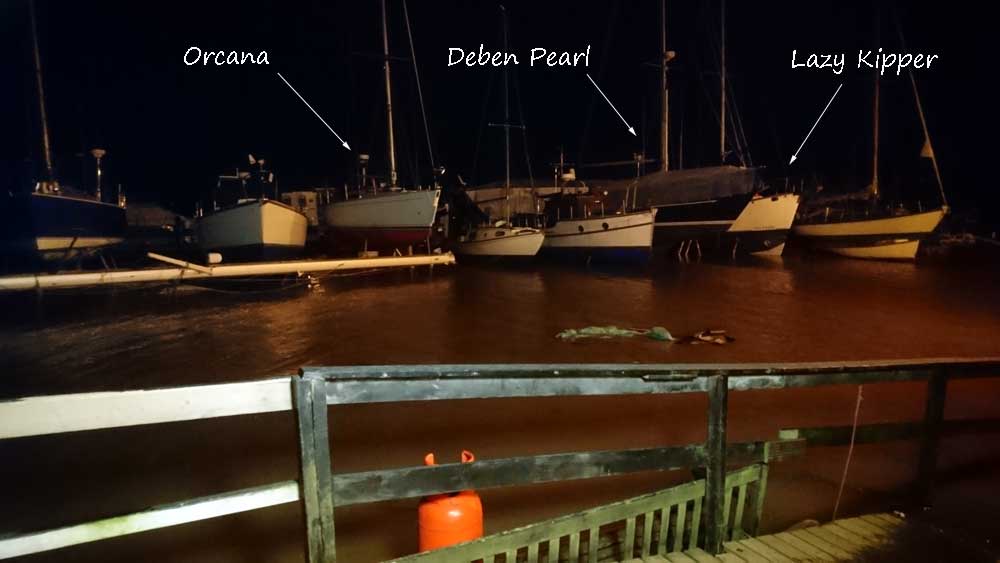
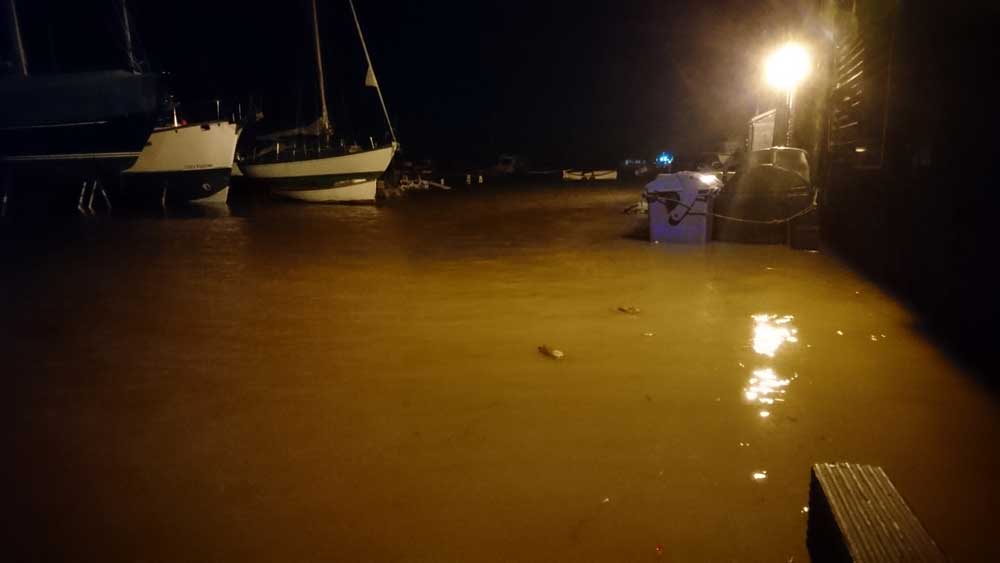
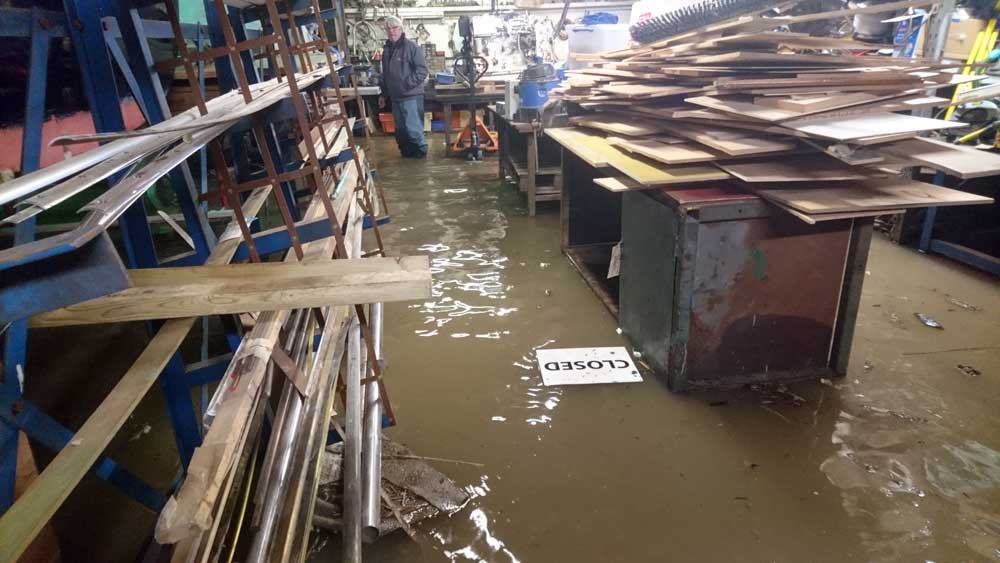
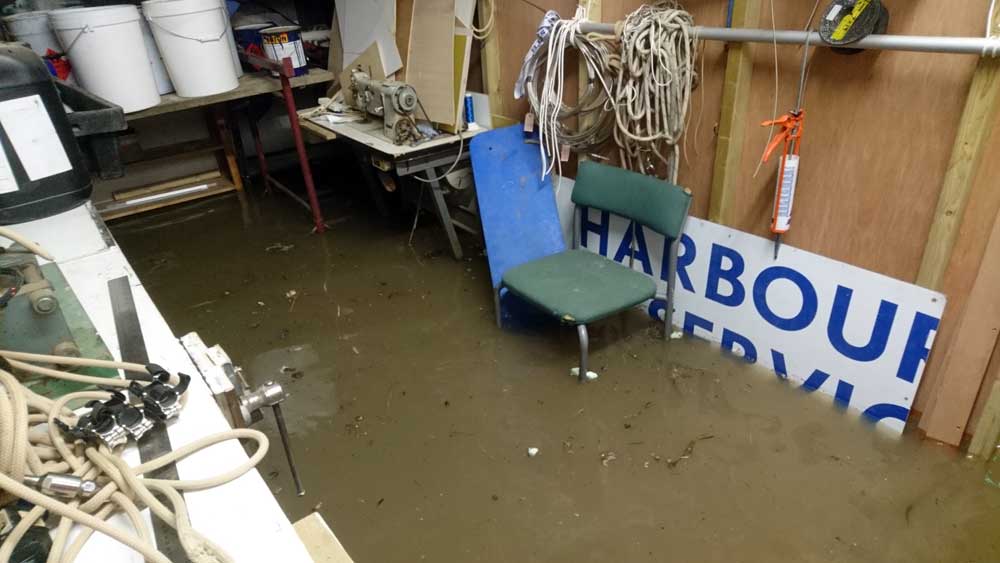
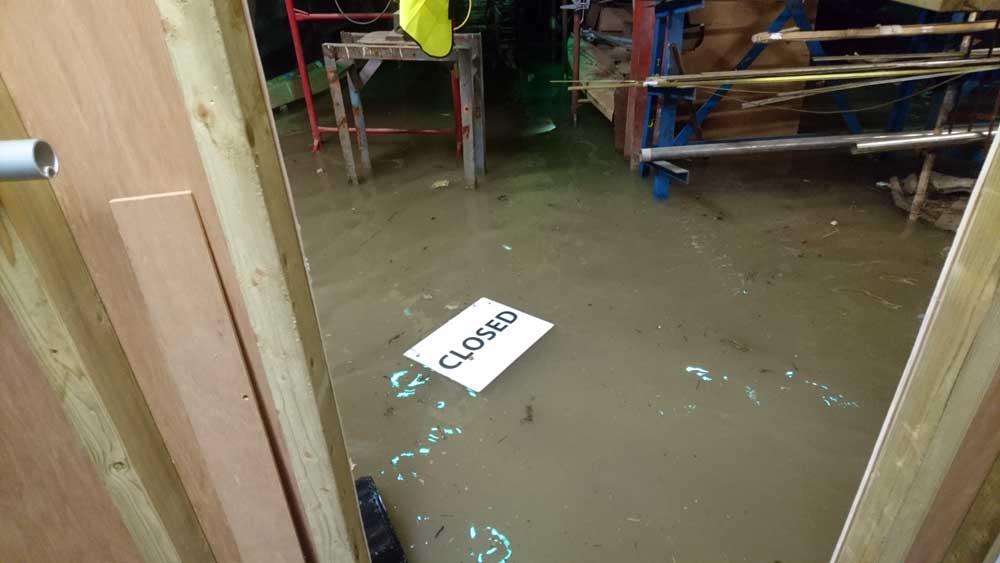
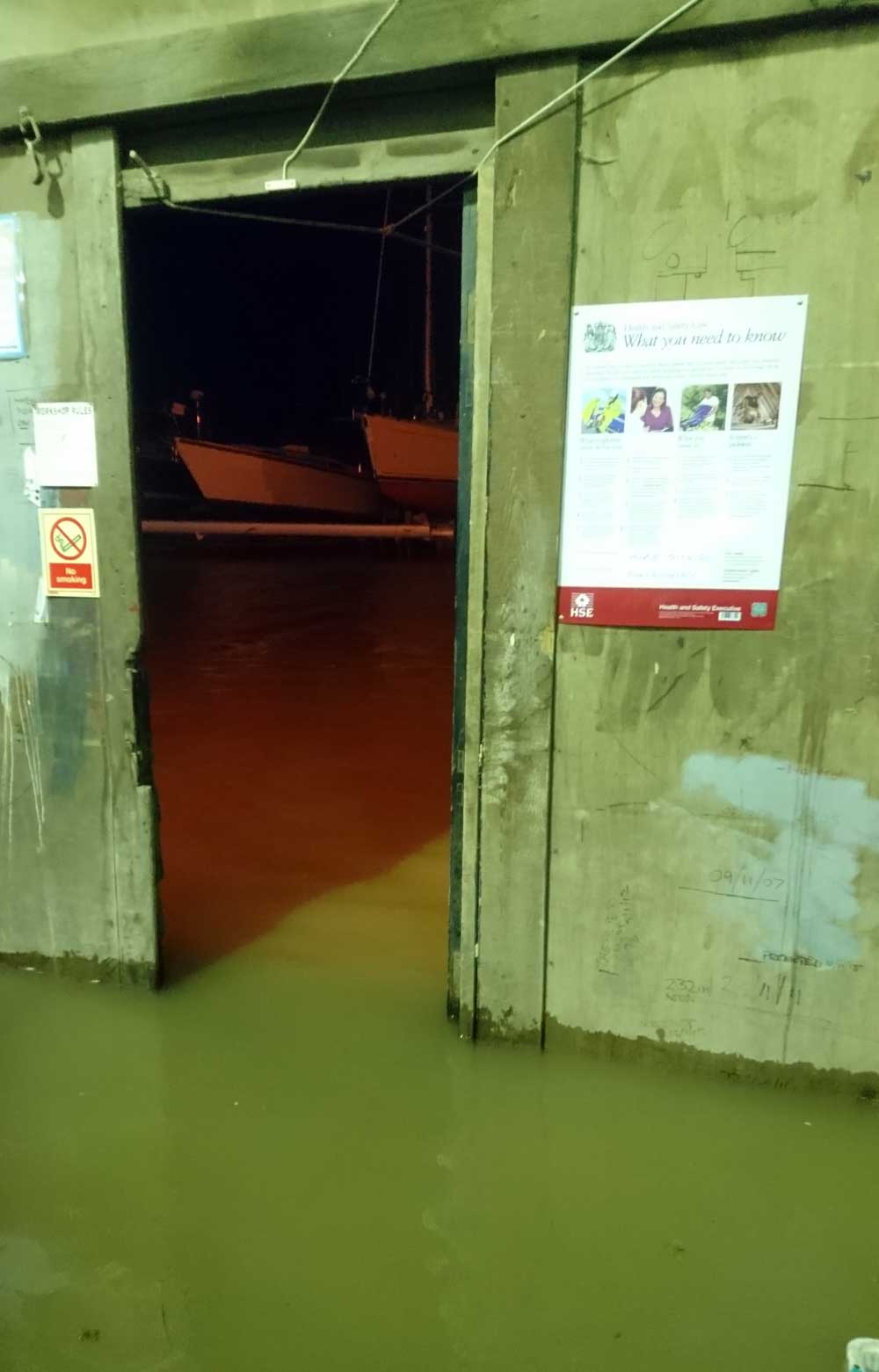
Took some photos on my phone last night at the yard.
I've marked known forumites boats in shot,
it was too deep to go out and take photos of the others.

Flood_001.jpg

Flood_002.jpg

Flood_003.jpg

Flood_004.jpg

Flood_005.jpg

Flood_007.jpg


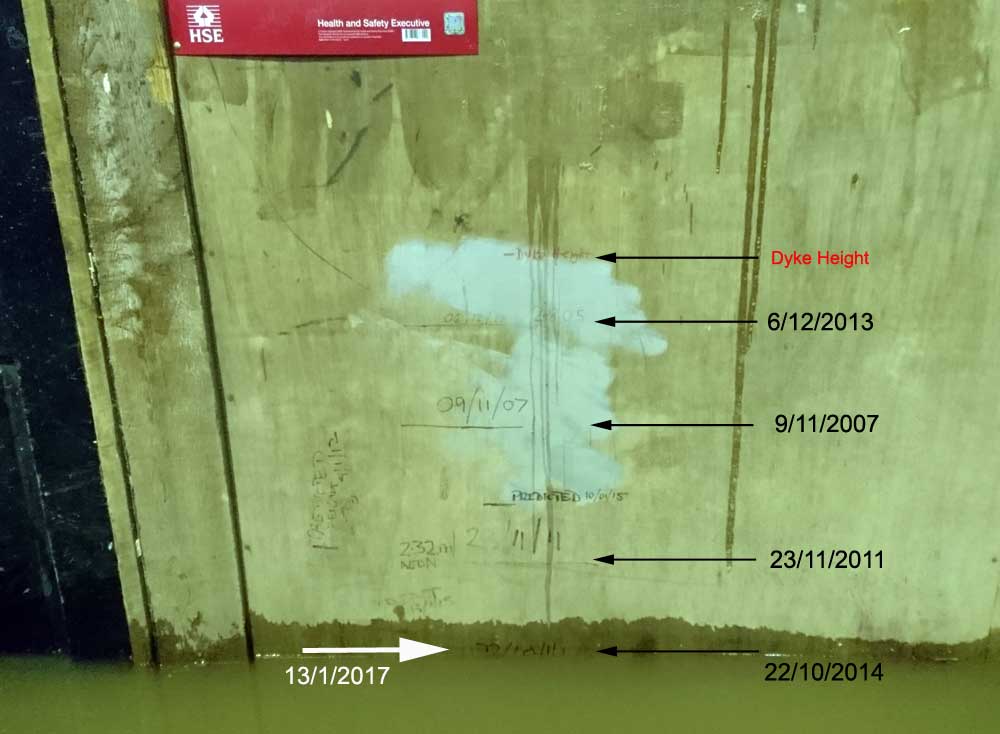
On the back of the door we mark the floods and you can see the bigger ones.
There's about 5 you cant see below the water level of last night.
Flood_006.jpg
 
Hope there was not too much damage Javelin - great photos.

The wall tidal gauge is very interesting as a record of this and previous years.

It will be worth more than a Banksy :rolleyes:
 
But that can't be right Javelin, apparently it was a none event and the authorities were crying wolf! :/

We've had four warnings in the last month.
All four warning predictions were for us to flood the workshops.

All four were between 0.5 to 0.7m below predictions with last night being the only one to effect us.
Last night prediction was up around the 2007 mark so we knew we were going to get wet.

You can pretty much lose a day getting ready for a flood, lifting gear, equipment and moving plant etc.
An accurate prediction is very useful as it tells you how high to lift stuff, re-chock boats etc.

So in a month we have lost 4 days production for 20 guys which is expensive and actually only had one flood.

Prior to the 2013 flood predictions were much tighter with an average accuracy of around +/- 0.1m
For whatever reason the accuracy seems to have moved to +0.6m

The danger being next time we look at it and think, Na they always predict over, we'll be fine.
 
I do not have time to look through all these posts and apologise if the following is trying to teach grannies to suck the proverbial eggs. It is a post that I put on another thread for info.

Predicting North Sea tidal surge flooding is a case, primarily, of getting the timing of the surge precisely correct with respect to the high tide. Wind direction is critical. The wind should be more or less parallel to the coast. The surge driven by the wind will then turn due to Coriolois onto the coast. Counter-intuitively a wind more directly onto the coast may well increase wave height but not the surge.

From my time in the then Central Forecast Office, I can assure you that warnings will never be issued lightly. There is no point in crying wolf. On the other hand, missing a surge flood is in nobody's interest.

Can you tell me if the high tide and the surge progress down the coast at the same speed.

If they do, then if they are out of synch at say Lowestoft they will still be by the time they reach West Mersea two hours later.

This would save me having to stay up until the small hours next time this occurs.
 
Good grief Jav, if the prediction had been right I reckon we'd have floated - real and proper, we only draw 1.4m and that picture has the water close to the bottom of the thruster. Thanks to you and the guys at HMS I know we were safe though. To anyone who hasn't come across the team at HMS in Southwold they are well worth meeting if you've work that needs doing.
 
Sometimes having a draft of 2m comes in useful on the East Coast even when laid up ashore!
A very big thank you to HMS who are quite simply brilliant. Down tomorrow to see what is happening. Great photos Mike .
 
Last edited:
The high tide travels down the coast at a well predicted speed. Thousands of days of measurements allow very accurate tide charts.
The surge speed varies totally: wind strength (and as you know, this is never constant!), wind direction (a few degrees different can mean it hits or clears a headland), difference in pressure between north and south, actual pressure in the north and the south.
This time around, the surge seemed to be much steeper and more sudden than in 2013. But the peak (for our area in Essex) was nearer low tide than high tide. Trying to predict the speed of the surge, 48 hours in advance, is impossible. 10% difference and the surge could have been at the same time as the high tide - with dramatically different consequences.
 
The high tide travels down the coast at a well predicted speed. Thousands of days of measurements allow very accurate tide charts.
The surge speed varies totally: wind strength (and as you know, this is never constant!), wind direction (a few degrees different can mean it hits or clears a headland), difference in pressure between north and south, actual pressure in the north and the south.
This time around, the surge seemed to be much steeper and more sudden than in 2013. But the peak (for our area in Essex) was nearer low tide than high tide. Trying to predict the speed of the surge, 48 hours in advance, is impossible. 10% difference and the surge could have been at the same time as the high tide - with dramatically different consequences.

I note this but the NTLSF prediction for Harwich ( some numbres of hours old) was uncannily accurate
 
The met office in 2014 received the nod from the Government for a £97,000,000 investment in a new 'Super Computer' and they claim on their website (http://www.metoffice.gov.uk/news/in-depth/supercomputers) that
"Because of improved science and increased computing power, today's four-day forecasts are as accurate as one-day forecasts were 30 years ago. Forecast accuracy should continue to increase as technology advances."

I haven't necessarily seen that myself in practice, which is why I tend to use commercial weather sites, particularly Dutch, German and French based sites. Sometimes, and I apologize for the Cliche, it might be better if they just looked out of the window......
 
The met office in 2014 received the nod from the Government for a £97,000,000 investment in a new 'Super Computer' and they claim on their website (http://www.metoffice.gov.uk/news/in-depth/supercomputers) that
"Because of improved science and increased computing power, today's four-day forecasts are as accurate as one-day forecasts were 30 years ago. Forecast accuracy should continue to increase as technology advances."

I haven't necessarily seen that myself in practice, which is why I tend to use commercial weather sites, particularly Dutch, German and French based sites. Sometimes, and I apologize for the Cliche, it might be better if they just looked out of the window......


From https://www.meteogroup.com/about-meteogroup

With over 100 meteorologists, a department dedicated to research and development and investment in the five weather models recognised as being the most accurate in the world: ECMWF, UKMO, GFS, HIRLAM and WRF, we are able to provide the most precise forecasts in the market.

I am probably a little behind the times, but I am not aware the Meteogroup puts any effort or money into any of these models. Like all private Met services they can only ride on the backs of the big boys.

Thus the BBC forecast will not improve - exce2pt, perhaps, in the presentation. The Met Office will remain as the official Met service and provide warnings etc.
 
Top