
Surface Pressure Forecast - warm or cold winds?

tmh900

Well-Known Member
Joined
22 Nov 2006
Messages
233
Location
Surrey
Visit site
Stupid question of the day...

When using only surface pressure forecast to roughly determine winds at sea, how do we determine (roughly) whether the wind will be warm or cold?

I would have previously used the generalisation that wind with north in it will be colder than a wind with south in it. However, the comment in the analysis at the base of this picture - i.e. S or SW winds originating from Greenland - suggests there is more to it. A wind from Greenland wil be cold(ish)???
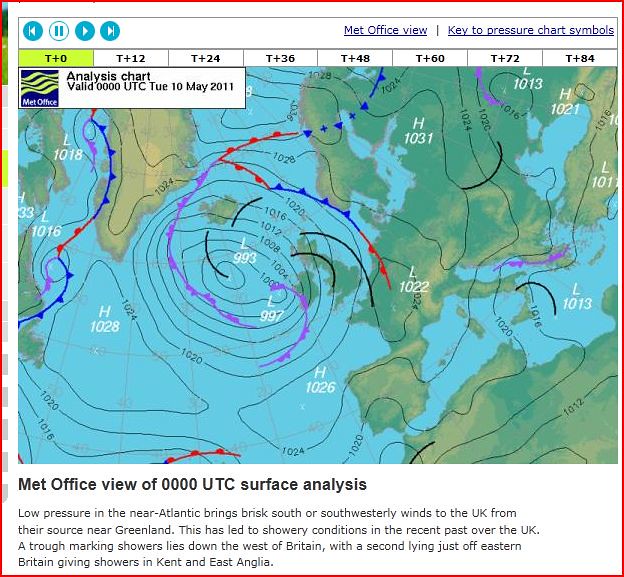


Is there a way to estimate rouhly wind temperature?
 
I was taught to follow the isobars round to where the wind would be originating from and that's the sort of temperature and humidity to expect.

So on your chart, Ireland and Wales will get cold wet wind from Iceland but southern England would get warmer and wet wind from the Azores high.

All roughly speaking of course, 'cos it's weather and has a mind of its own.
 
I was taught to follow the isobars round to where the wind would be originating from and that's the sort of temperature and humidity to expect.

So on your chart, Ireland and Wales will get cold wet wind from Iceland but southern England would get warmer and wet wind from the Azores high.

So how far do the winds from Greenland get around the low pressure system before they are overtaken by warmer winds?:confused:

Thanks for the reply BTW.
 
You also need to look at a 'cross-section' of the wind that is passing overhead..

Between a warm and a cold front for example you will find a section of warmer wind.. It is like a swirl of warmer air lying over the top of the cooler air.. although if the cold front has caught up with warm front then the warm air will no longer occur (or be felt) at ground level.. This is known as an occluded front and you will only feel the cooler air (the warm segment will be over the top of the cooler air only and not reach ground level)...

Hope this gives you something to think about..
 
ok.. looking at the map shown for example... (although it's a bit messy)

There is a small warm front making it's way SW around the low pressure over France. It is a warm swirl of wind so I would expect temperatures in Denmark and then in Belgium to rise as it passes over.. (in the anticlockwise swirl of light winds that surround the low)

The fronts to the west of Ireland are all occluded meaning the warmer swirls of air (and there are about 2-3 of these in fact are all higher leverl swirls.... i.e. the warm air will not be felt at ground level. It looks like any cooler air (in the cool fronts) has caught the warm fronts and with the warm air being lighter than the cold, the warm has been pushed to higher altitudes.

There is another warm front (followed by a cool front) forming over Newfoundland which is how the fronts start.. the warmer section of air will be between the warm and the cold front as it passes overhead...

In real life.. When we next get a low pressure head over us from the west check out the temperature.. If the center of the low is over Scotland, check out the wind direction as it changes in Surrey. You will find the wind starts from the SW.. becomes Westerly and much warmer then will tend to come from the NW and be cooler again.
 
Last edited:
Many thanks Martin_J.

What I am thining now is that generalisation that wind with north in it will be colder than a wind with south in it may only apply in the absence of depressions.
 
Yes.. as a generalisation.

Northerly you may hear called 'arctic' and anything with Easterly in as 'Siberian'. The first comes from the cool Arctic and latter from the cool Siberian land mass... It is interesting though reading about how fronts form.. how they occlude and also what clouds appear at each point on the front. By learning about the cloud types you will also be able to 'see' the front coming.. Then by the termperature differences you will 'feel' it as it passes..
 
However, the comment in the analysis at the base of this picture - i.e. S or SW winds originating from Greenland - suggests there is more to it. A wind from Greenland wil be cold(ish)???
...
Is there a way to estimate roughly wind temperature?

The comment uses the word "brisk" which is somewhat ambiguous - does it mean "cold" or just "windy"? From the spacing of the isobars, my feeling it's the latter. One can't look at a surface analysis and determine if it will be cold. "Cold" also has several connotations - what's cold to you, might be warm to me. One could assume a relatively cold wind from the passage of a cold front - although the airmass behind the front is colder than the airmass ahead of the front, the air temps and consequently, the winds might still feel warm.

You shouldn't assume that all wind from Greenland will be cold - this has to do more with continental versus maritime effects. Air over land will heat or cool more dramatically than air over the ocean, so a land-breeze from Greenland in the summer will be relatively warm, whereas in the winter it will be relatively cool.

Even within an airmass (a continent-sized mass of air that's relatively uniform in temperature and moisture content) spot temps can vary widely due to local heating, orographic effects, moderating influences. The best way to determine if the wind is likely to be cold, is to check a temperature chart for the actual temperature upwind of your location.
 
The comment uses the word "brisk" which is somewhat ambiguous - does it mean "cold" or just "windy"? .....
You shouldn't assume that all wind from Greenland will be cold.....

Many thanks for that Cruiser2B. I assumed that winds from Greenland would be cold (not just from the 'brisk' term), but good to know that may not be the case.

I am still unsure when the generalisation about wind temperature from a certain direction can be used - e.g. with the an easterly, this may be due to a low pressure to the south of the UK and therefore the winds may not be coming from Siberia?
 
I'd summarise it as anything north or north east very cold, anything east cold, anything west warm, anything south warmer.

That's just not reliably the case, although it would usually be so in winter. The recent mild, sunny spring in the UK was caused by lows tracking well south of their usual path, bringing to the British Isles mild, dry easterlies/ south-easterlies from the European land mass. At this time of year, that means warm and dry. Dry air is both more easily warmed (or cooled) and has less wind chill effect. The same phenomenon occurred with the unusually mild, sunny April four years ago. And winds from Siberia are not necessarily cold: it's a very warm place in summer.

Much depends, both in absolute and 'feel' terms, on the moisture content of the prevailing air mass. What's described above as 'Arctic' air etc, is usually categorised as Polar Maritime or Polar Continental (the latter dry, the former moist). The air mass behind cold fronts is usually Polar Maritime in origin: cool, and feeling even cooler. It's often also characterised by lot of vertical instability, leading to showers and gusty winds. It will feel cooler than it actually is because of wind chill effects.
 
That's just not reliably the case, although it would usually be so in winter. The recent mild, sunny spring in the UK was caused by lows tracking well south of their usual path, bringing to the British Isles mild, dry easterlies/ south-easterlies from the European land mass. At this time of year, that means warm and dry. Dry air is both more easily warmed (or cooled) and has less wind chill effect. The same phenomenon occurred with the unusually mild, sunny April four years ago. And winds from Siberia are not necessarily cold: it's a very warm place in summer.

Much depends, both in absolute and 'feel' terms, on the moisture content of the prevailing air mass. What's described above as 'Arctic' air etc, is usually categorised as Polar Maritime or Polar Continental (the latter dry, the former moist). The air mass behind cold fronts is usually Polar Maritime in origin: cool, and feeling even cooler. It's often also characterised by lot of vertical instability, leading to showers and gusty winds. It will feel cooler than it actually is because of wind chill effects.

Temperature difference between the air behind a cold front & the warm air it is catching up, is reported at being at least 15*C.

The instability at the cold front/warm air 'interface' is because the faster moving cold front punches into the warm air, quickly forcing it upward, causing a thermal shock with extreme precipitation compared to the more gently moving warm front/cold air interface, where this meeting is more of a gentle stroke.
 
Temperature difference between the air behind a cold front & the warm air it is catching up, is reported at being at least 15*C.

The instability at the cold front/warm air 'interface' is because the faster moving cold front punches into the warm air, quickly forcing it upward, causing a thermal shock with extreme precipitation compared to the more gently moving warm front/cold air interface, where this meeting is more of a gentle stroke.

At least 15 degrees C? I don't think so, nor would anyone's daily experience bear this out. It ranges from next to nothing in a weak frontal system to around the number you suggest. Don't alarm the OP too much :)

The 'forcing upwards' bit is a gross simplification of the process, but works well enough for a broad grasp of what's going on. Perhaps the easiest misunderstanding for the layman derives from the typical cross-section drawings of frontal systems. The vertical scale is invariably grossly exaggerated. The slope is nearer 1 in 80 than the 1:4 or so usually depicted (although the cold front is steeper than the warm), so the effects on the ground are felt for much longer than the diagrams might suggest.
 
I'm not an expert, but---!

At least 15 degrees C? I don't think so, nor would anyone's daily experience bear this out. It ranges from next to nothing in a weak frontal system to around the number you suggest. Don't alarm the OP too much :)

The 'forcing upwards' bit is a gross simplification of the process, but works well enough for a broad grasp of what's going on. Perhaps the easiest misunderstanding for the layman derives from the typical cross-section drawings of frontal systems. The vertical scale is invariably grossly exaggerated. The slope is nearer 1 in 80 than the 1:4 or so usually depicted (although the cold front is steeper than the warm), so the effects on the ground are felt for much longer than the diagrams might suggest.


This site might help the OP

http://www.scalloway.org.uk/weat4.htm


This site indicates temperature differences - in degrees F

http://www.climateandweather.net/world_weather/weather_fronts.htm
 
tmh900 you NEED to come to Weather School! This is a topic we cover.

Okay (and this is not to sound patronising, so apologies if I do), first up, look to see where the wind is coming from. You are correct to think that anything that is coming from the northern half of the compass is likely to be cold, anything from the southern half will feel warmer.

Now, that doesn't mean that this always works. That's where following back along the isobar to assess where the airmass originated is useful. You see, it may be that a westerly wind could have cold or warm origins, and the only way to work this out is to follow the isobar all the way back and see where the air is coming from.

The time of year can make a difference too, especially in easterlies. The polar continental airmass is cold in winter (no surprise there) but can be warm i the summer months. It all depends on the origin of the air.

Remember too that warm air can hold more moisture than cold air, although you may not always see this. Warm air from the southwest brings the cloud and rain associated with a Tropical maritime airmass etc. etc..

Anyway, must stop now because my anorak is getting too warm ;)

Hope that helps,
Simon
 
This site indicates temperature differences - in degrees F

http://www.climateandweather.net/world_weather/weather_fronts.htm

I believe you've misread this part:

There is usually an obvious temperature change from one side of a cold front to the other. It has been known that temperatures east of a cold front could be approximately 55 degrees Fahrenheit while a short distance behind the cold front, the temperature can go down to 38 degrees. An abrupt temperature change over a short distance is a good indicator that a front is located somewhere in between.

They're giving an example, not stating an absolute - the temp is not always 55°F ahead of a cold front, nor is it always 38° behind.
 
I believe you've misread this part:


They're giving an example, not stating an absolute - the temp is not always 55°F ahead of a cold front, nor is it always 38° behind.

Pedant! :rolleyes:

Did I say that it was 'exactly 55 degrees?

My original statement, was a difference of about 15C, which = 59F.
"Temperature difference between the air behind a cold front & the warm air it is catching up, is reported at being at least 15*C."

"Is reported"!

Prove there is no temperature difference please! :p

Perhaps Simon can enlighten us.
 
Last edited:
Top