Suppression of RF inference - how?

tillergirl

Well-Known Member
Joined
5 Nov 2002
Messages
8,782
Location
West Mersea
Visit site
Further about the Neco Automatic Pilot, my problem is RF inference twix the Speed transducer cable and the Drive Unit of the Automatic Pilot: the transducer cable runs right past the Drive Unit. Physical separation is, frankly, impossible for a variety of reasons. I should explain that the Neco is an Automatic Pilot not an 'Autopilot' i.e. it is old (but operational) technology. The manual instructs an earth should be attached to the Drive Unit (which the previous owner had not connected) but the manual says the earth is "mainly for reasons of electrolysis prevention rather than for RF suppression. The transducer cable and the Drive Unit are conflicting - as the Drive Unit operates the Speed is recorded as 3.5kts and it may be vice versa interfering with the course.

Given that I can't relocate the transducer cable how can I suppress the interference please?
 
If you can change the cable there are quite a few options.
Coax
twisted pair
transformer balance and star/quad microphone cable.

Would need quite a lot more info about the electronics to offer a full answer...
 
Not sure I can provide all the detail but here goes:

Speed transducer - a Navman Multi instrument with sealed connectors both end. I assume the transducer uses a Hall effect. The cable uses a Fuji Plug and Socket to connect the speed and temperature data. The instructions are to 'keep away from alternator (it is) or other noise generating electrical cable'. The Neco Drive Unit has two power sources, one to the Drive Unit, the other to connect power to the Control Unit. Two multi core cable feed from the Drive Unit to the Control Unit. The Drive Unit comprises a 1/8HP electric motor which turns a sprocket with chain to the ship's wheel. A substantial bit of kit. The Drive Unit also includes two relays. The manual gives advice to plan the run of power cables to avoid all pilot inter unit and power cables should be run in separate looms (done) and as far away as possible from other cables (failed - both the transducer and the instrument head end of the cable are molded on so cannot be removed either end to relocate the cable. As far as I can see it is impossible to feed the cable back through the bulkhead and find another location. I shall send a grandson upside down into the bilges to see if I am wrong but it is unlikely. Quite how the cable has been originally fed through the bulkhead is a mystery! Not sure I can add anything more.
 
Not sure I can provide all the detail but here goes:

Speed transducer - a Navman Multi instrument with sealed connectors both end. I assume the transducer uses a Hall effect. The cable uses a Fuji Plug and Socket to connect the speed and temperature data. The instructions are to 'keep away from alternator (it is) or other noise generating electrical cable'. The Neco Drive Unit has two power sources, one to the Drive Unit, the other to connect power to the Control Unit. Two multi core cable feed from the Drive Unit to the Control Unit. The Drive Unit comprises a 1/8HP electric motor which turns a sprocket with chain to the ship's wheel. A substantial bit of kit. The Drive Unit also includes two relays. The manual gives advice to plan the run of power cables to avoid all pilot inter unit and power cables should be run in separate looms (done) and as far away as possible from other cables (failed - both the transducer and the instrument head end of the cable are molded on so cannot be removed either end to relocate the cable. As far as I can see it is impossible to feed the cable back through the bulkhead and find another location. I shall send a grandson upside down into the bilges to see if I am wrong but it is unlikely. Quite how the cable has been originally fed through the bulkhead is a mystery! Not sure I can add anything more.


OK, I couldn't understand how a power cable would be generating any interference by induction, especially in a DC circuit but the description makes more sense now. Has this interference always been the case or has this started happening more recently? I ask because the the electric motor should be suppressed by way of a capacitor across the brushes (I'm guessing it's not brushless given it's age). Those capacitors often break down over the years and you start getting RF interference generated by the motor feeding back through the power cable sometimes.

If you google something like "DC motor RF suppression" you'll see all sorts of suggestions of varying technical detail but basically you should have a capacitor of around 10-50nF connecting the brushes to the metal casing of the motor or perhaps across the brushes. If you can get grandson to see that capacitor and, better yet, get the size of it (in absolutely tiny writing on the capacitor itself somewhere) then replacing them would be my first step. When you replace the capacitor don't skimp on the voltage rating - at least 100V would be my guidance. A word of warning - I could be right on the cause but there's no guarantee that replacing the capacitors will fix it. Finding the source is the first battle in the war - then you have to actually suppress it.

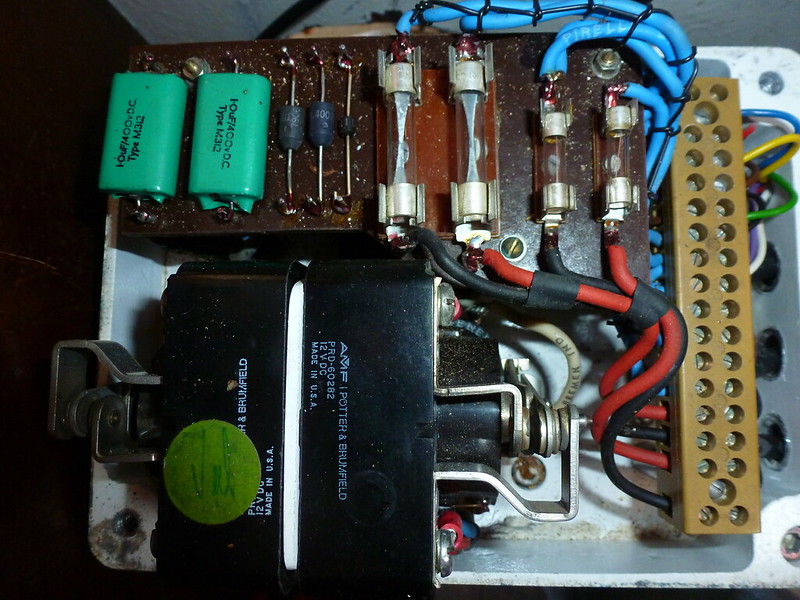
OK, just found this https://www.marine-plus.com/estore/neco-drive_srv_gal/ - assuming this is the right system then check those two green capacitors and anything else that looks not right on that board with the fuses on in the third row of pictures.

I found the manual on-line as well but it doesn't seem to give the capacitance of the the items. http://clubnauticat.dk/wp-content/uploads/2015/11/Autopilot-NECO-komplet-Manual.pdf. Obviously if I've got the wrong autopilot just ignore me...
 
Last edited:
'Has this interference always been the case or has this started happening more recently?' No idea. the Automatic Pilot had been "de-wired" by the previous owner who had not used it.
'I ask because the electric motor should be suppressed by way of a capacitor across the brushes (I'm guessing it's not brushless given it's age).' Agree it is likely to have brushes. The Internal Wiring Diagram of the Drive Unit has a note "68 OHM 10 Watt wirewound resistor used only on 24 volt units' - it is the 12 volt unit. but this is nowhere in line with the Armature directly - if that is relevant. The wiring part of the Armature doesn't indicate anything.
OK, just found this https://www.marine-plus.com/estore/neco-drive_srv_gal/ - assuming this is the right system then check those two green capacitors and anything else that looks not right on that board with the fuses on in the third row of pictures. Well done. That's the Unit. I had not traced anything on the web. Yes, I have the two green capacitors and the fuses and all is in perfect condition - untouched. My manual has some additional wiring diagrams hence my reference above. I think the green capacitors are PL4007 - it is marked 2 x PL4007 and then something marked 2 x 1hF (the 'h'. is upside down) or is the 2 x PL4007s transistors and the 2 x1hF the capacitors. But as I said there is no suggestion of any issue. I will take a photo on Monday (Mother's Day, I am not allowed out!).

Definitively that's the 'Automatic Pilot' - nothing as lightweight as an 'AutoPilot'! :)
 
First I am sorry but I do not grasp the difference between an Automatic Pilot and and Autopilot; the latter word appears just to be a contraction - for lazy tongued people like me! - of the former.

Then back to serious things.
I am not totally sure but I understand that the two green condensers and two of the diodes inside the Relay Box are not meant to suppress the noise produced by the motor brushes but to suppress the spark (and RF noise) produced by the relay contacts when they open. If this is so, they act as noise suppressors only for the short time when the motor stops turning.
I have found that in some Neco Drives there are indeed another two condensers very close to the brush assembly, inside the motor, but they are not mentioned in the original manual.

The problem of RF interference found by tillergirl, given the strict boundary conditions, might be not easy to be solved; if everything else fails one thing I would try is to twist the cables which interact and/or to shield with a grounded braided hose of tinned copper the "dirty" Neco power cable.

Daniel
 
Oh just a failed joke! I was thinking it denotes that 'Automatic' means 'pre-chip' whereas 'AutoPilot' has a chip.

I wired up the earth in accordance with instructions. Then tried again. The same I'm afraid. I watched the process. The bleep only sounds when the depth reading gives a reading and the depth reading only momentarily appears once the Pilot has completely finished the cycle following the trim adjustment. In other words, if the trim is set at zero, all is fine. Turning up the trim causes the Pilot to adjust and once the Pilot finishes and stops, the depth display momentarily appears and bleeps. (I had erroneously reported it was the speed transducer. So the depth co-ax cable will be receiving interference)

But I fear the earth didn't improve matters. I have a picture of the Relay Box which I will post later.
 
Last edited:
I have a different guess worth investigating. It is important that a possible voltage drop caused by the power line that feeds the Neco motor is not felt by other sensitive instruments like your depth meter.
As stated before, you should check that the Neco power line is attached to a good and independent terminal at the boat main switchboard. Check that the line is going to a couple of good "buses" linked by thick cables to the battery bank; such buses should be able to support several amps (at least 20-30A) without displaying any voltage drop. If they do, either there are problems in the wiring or in the battery bank.
Of course there will be thermal switches/fuses wherever needed, but this is another question.

Daniel
 
Daniel

I have re-wired the whole boat as some parts were good, some were bad and other parts - like the Neco, were not connected. I have paid attention to follow best practice - apart from the location of the transducer cables which I inherited. I had mistaken the bleep for the Speed transducer for the Depth. Whilst I knew I could not relocate the Speed transducer cable, it might be possible to move the depth cable. Both run right past the drive unit.

The feeds to the Neco Drive Unit are separated as required and each is completely separated from anything else. The bus bar has ample capacity... and I have new thermal breakers. Each Neco circuit has separate breakers. I think I have set up the electrics ok.
 
Is there normally a metal cover on the relay Box? If so is it well secured with a good electrical connection to the base.
Can you run the system and see if the noise coinsides with operation of the relay?
Take a look at the relay contacts. If they are badly worn and pitted they will generate sparks which equate to electrical interference . You might be able to change the contacts on the relay or the relay itself.
A long shot but worth at try,,
Kinsale 373
 
Is there normally a metal cover on the relay Box? If so is it well secured with a good electrical connection to the base.
Can you run the system and see if the noise coincides with operation of the relay?
Take a look at the relay contacts. If they are badly worn and pitted they will generate sparks which equate to electrical interference . You might be able to change the contacts on the relay or the relay itself.
A long shot but worth at try,,
Kinsale 373
Yes there is a metal lid with a rubber seal but the electrical continuity is secured by the two metal bolts which keep the lid fixed.
Indeed the relays may produce RF noise but inside the Relay Box there are diodes and condensers to mitigate it. Moreover, the motor has got condensers coupled to the brushes.
As stated before, the only possible source of severe noise from the Neco is one of its two power lines, namely the high amp "dirty" line which feeds the motor.

Daniel
 
Last edited:
Thanks Kinsale.

Yes there is a metal cover (substantial) but an exchange of emails with Daniel, it ought to have a rubber seal/gasket. The exchange with Daniel has also added some detail:

"The only possible disturbing agents are in the Drive Unit:
1) the relays; sparks which produce RF
2) the motor brushes; sparks which produce RF
3) the whole motor; high current which produces voltage drops
and magnetic fields in the power lines."

It all seems a little odd that the interference manifests itself after any movement has stopped. Perhaps it is the relay disengaging? (I know nothing about that sort of detail of electrics). Oh the relays not warn at all. I suspect finding a compatible relay will be a challenge.

I am thinking it might be better to test with the boat afloat (the depth transducer isn't registering of course at the moment).
 
Re: Suppression of RF interference - how?

...snip
I suspect finding a compatible relay will be a challenge.
...snip
Wrong suspicion! :)
A commercial relay as the original is still available. A quick search of the following code on the internet will tell you how to get it:
PRD-5DY0-12

This does not mean that I am suggesting to replace the relays but to tell all Neco users: "before giving up on hope to fix the old autopilot, please ask me; you may be surprised!"

Daniel
 
Re: Suppression of RF interference - how?

Is it possible to change the motor brushes? You can get a big back-emf spike when the power disconnects at the end of the cycle. Worn brushes can generate more interference so if they can be replaced it is worth trying.
 
Re: Suppression of RF interference - how?

Is it possible to change the motor brushes? You can get a big back-emf spike when the power disconnects at the end of the cycle. Worn brushes can generate more interference so if they can be replaced it is worth trying.

Worn brushes has never been an issue with all the Neco motors I came in touch (quite a few) mainly because the total number of turns they make during their life is very limited.
Occasionally the brush surface can get an irregular shape (small cracks) which may indeed produce sparks; in this case a gentle sanding to restore a good matching between the surface of the brush and the rotating commutator is enough.

Daniel
 
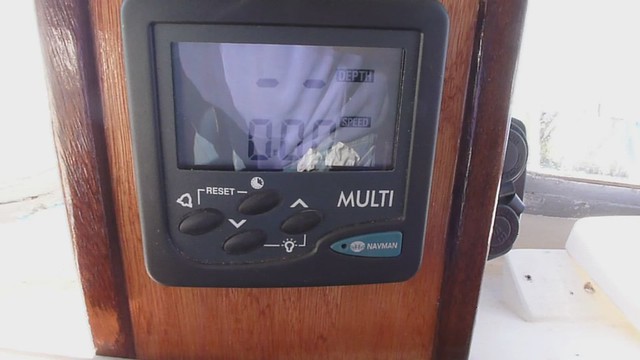
The video suggests the display is changing mode, likely caused by serious spikes on the supply rail rather than just noise on the speed sensor input?

I would fit a ferrite choke to the power input to the instrument.
Suitable ferrites are often found on old PC cables.

It sounds like the power wiring of the pilot is spread around more than one breaker. To minimise interference, it is best to keep the wiring compact, minimise area of loops where changing currents flow. Have dedicated return wire twisted with the drive wires, and take it back to the -ve bus bar or battery.
Likewise the sensitivity of the victim circuit can be reduced by improved by running the return close to the supply.
As a test, try powering the sounder/log from a separate 12V battery, that should help diagnose whether it's conducted or induced interference.
 
The video suggests the display is changing mode, likely caused by serious spikes on the supply rail rather than just noise on the speed sensor input?

...snip

This is very close to my guess. The only difference is that I believe the true cause is a "power sag", which, according to the dictionary, defines the opposite of a power surge.

Possible culprit: poor wire connections or tired battery.

Daniel
 
Top