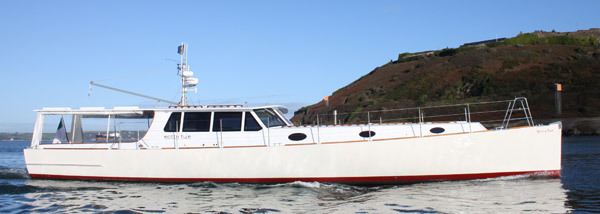
Super-Lightweight displacement boats Vs. old fashioned heavyweights.

OK fair enough but 14kts with 300hp in a 56ft boat sounds a tad optimistic to say the least but I would keep an open mind on that


Yes you're right, the accommodation in the Fleming 55 is tight, mainly in the saloon area which is small compared to similar length planing boats. However that is mainly due to the fact that the Fleming is designed as a proper passagemaker with wide sidedecks that you can walk down in complete safety. If the PassagemakerLite has similar sidedecks, its going to feel very pinched in the saloon indeed and you're going to need a very accommodating SWMBO to put up with that! Yes, if you compare, say, a Nordhavn 55, that has a slightly bigger saloon than the Fleming 55, although it still feels small, but Nordhavn achieve that with asymettric decks; in other words, there is no sidedeck on the port side


I tend to think that anyone who could afford to build a one off 56ft boat like this is not going to be over concerned by fuel consumption, especially when the trade off is potentially less accommodation and possibly more rolling in a beam sea. In any case, long range D boats are able to take advantage of cheaper fuel locations. For example, if you had a Nordhavn 55 in the Med, you'd fill up once a season in Gibraltar or Montenegro at low prices and not think again about refuelling until the end of the season.
Still the PassagemakerLite is an interesting concept for the future because one thing is for sure and that is that fuel prices are only going one way and thats upwards

Totally agree with what you've said.
But.....a passage maker by definition is designed to travel large distances in. Now in my experience most boats are used as floating caravans, because the owner simply can't afford the fuel. In fact on average most leisure users only do about 100hrs per year.

Guessing that the majority of 40' and above planing boats do about 1 mpg at 15 kts, there is a case for the passagemaker lite at 3 mpg/10 kts. 300hrs use instead of 100 hrs.

So here's the choice.
Day trips in a planing 40'....couple hours up the coast, return = 60 gals @ €7 =€420 a day in fuel.
Passagemaker- lite 56', 60 nm at 3mpg, 20 gals that makes €140 a day in fuel.........quite a difference!!!!:eek:
 
Last edited:
Totally agree with what you've said.
But.....a passage maker by definition is designed to travel large distances in. Now in my experience most boats are used as floating caravans, because the owner simply can't afford the fuel. In fact on average most leisure users only do about 100hrs per year.

Guessing that the majority of 40' and above planing boats do about 1 mpg at 15 kts, there is a case for the passagemaker lite at 3 mpg/10 kts. 300hrs use instead of 100 hrs.

So here's the choice.
Day trips in a planing 40'....couple hours up the coast, return = 60 gals @ €7 =€420 a day in fuel.
Paggagemaker- lite, 60 nm at 3mpg, 20 gals that makes €140 a day in fuel.........quite a difference!!!!:eek:
Its surprising how frugal planing boats can be at D speeds. My 53 footer is doing 2.5nmpg @ 9kts but I always have the option of course of blatting along at 25kts. But it's not comparing like with like. Of course most planing boats are just floating caravans, used for relatively short distances for at most 2-3 weeks and the total annual fuel use is generally quite modest even at 1nmpg. A passagemaking boat is a different animal altogether, generally bought for cruising long distances where speed is less important. But I would still argue that whilst fuel consumption is an issue, it's fuel range which is more important because that's what decides whether you can get to those cheaper fuelling locations
 
Its surprising how frugal planing boats can be at D speeds. My 53 footer is doing 2.5nmpg @ 9kts but I always have the option of course of blatting along at 25kts. But it's not comparing like with like. Of course most planing boats are just floating caravans, used for relatively short distances for at most 2-3 weeks and the total annual fuel use is generally quite modest even at 1nmpg. A passagemaking boat is a different animal altogether, generally bought for cruising long distances where speed is less important. But I would still argue that whilst fuel consumption is an issue, it's fuel range which is more important because that's what decides whether you can get to those cheaper fuelling locations

The range on the passagemaker-lite:

The payoff for lighter displacement and a longer waterline is more speed with the same or less power. For example, the Nordhavn 46 crosses oceans at a speed/length ratio of about 1.2, which translates to 7.4 knots. The PL 46 design has a speed/length ratio of 1.2 and travels at 8 knots. And, for the PL 56, it is 8.8 knots. On a long voyage, such as the 2,200 nautical miles from southern California to Hawaii, this can make a difference of days. Two thousand two hundred miles at 7.4 knots is 297 hours, while at 8 knots it is 275 hours, and at 8.8 knots it is 250 hours. The PL 56 would take about two days less than the Nordhavn 46 on the same passage.

I'm no boat designer, but here's my opinion for what's it's worth:
Planing boats:
Poolting along in a big planing boat with twin 500hp engines at tick over does the engines no good.
Planing boats need massive power to get over the hump.
Big engines cost a fortune maintain and run.
Replacing a broken engine in an old cheap to buy planing boat would cost more than the secondhand boat purchase price

Displ. Boat:
Too slow, you'll need crew to keep a look out, even short trips take for ever, can't run for shelter.


Passagemaker-lite concept.

It's not a s/d hull, it's a displ. Hull, so no hump at 14 kts
It's a fast dipl. Hull, so max 14 kts which puts it up there with semi-d hulls.
Small engines unlike S/D Boats

Drawbacks:
Slim hull will roll more
What about shallow draft of 1.2 mtrs and seakeeping?

To obtain greater speed from the short and fat trawlers, builders are going to ever-larger engines. But, it's expensive to push long, high-displacement hulls fast. It is also true that as displacement/length ratios drop, speed/length can increase. Short heavy boats with a displacement/length of 350 will be limited to a speed/length ratio of about 1.4, maximum. My longer, lighter designs will run up to a speed/length ratio of 1.6 and beyond. This is possible with modest power; the PL 56 will achieve 12 knots with a pair of 105-hp engines; twin 150-hp engines push it up over 14 knots.

How did the Nelson designs compare? Weren't they slim hulls too? Did they roll much?
 
Last edited:
Nigel Irens' Molly Ban.
http://www.youtube.com/watch?v=EltG5I-xMk4

molly-ban-thames-trad-queens-pageant.jpg


Rangeboat 39 (Armor Boats - the builders - are now no more)

trybrid-the-boat_html_m4c8b74e5.jpg

10 knots at 5,7 litres per hour.

Elektra electric launch.
http://www.youtube.com/watch?v=ZUuxhcg9RRE

Electric_Powerboat_photo.jpg
 
Imagine a nice beamy displacement Long Range Trawler - draw the boat in the length and let the beam reduce.
with the increase in length you will of course gain speed, and with less beam you will need less power.
BUT to compare it with another LR trawler of the same length is something different.
You will have less room, less stability, less capacity to load stores (and to stay onboard for long time you really need the capacity, or would you cruise for long without food or your beer, wine or whatever you like to drink)

???
 
Imagine a nice beamy displacement Long Range Trawler - draw the boat in the length and let the beam reduce.
with the increase in length you will of course gain speed, and with less beam you will need less power.
BUT to compare it with another LR trawler of the same length is something different.
You will have less room, less stability, less capacity to load stores (and to stay onboard for long time you really need the capacity, or would you cruise for long without food or your beer, wine or whatever you like to drink)

???

For Every engineering solution there's a compromise.

The question: can you afford €700 or more for every 100 miles on a traditional trawler?

Or:
Slimmed down design with 3 times better fuel consumtion, but tight accommodation and low payload.

You pays your money and makes your choice.......
 
Poolting along in a big planing boat with twin 500hp engines at tick over does the engines no good.
Planing boats need massive power to get over the hump.
Big engines cost a fortune maintain and run.
Replacing a broken engine in an old cheap to buy planing boat would cost more than the secondhand boat purchase price
Can't argue with most of that only to say that modern electronically controlled diesel engines can perfectly happily run at low rpm continuously although of course, all engines benefit from being put under load regularly


It's not a s/d hull, it's a displ. Hull, so no hump at 14 kts
It's a fast dipl. Hull, so max 14 kts which puts it up there with semi-d hulls.
Small engines unlike S/D Boats
If the max is 14kts, then you're not going to run it at 14kts continuously so the fast cruising speed is going to be in the 10-12kt range. Something like the Fleming 55 has a top speed of 19kts so it's fast cruising speed is going to be around 14-16kts. Other SD boats like Aquastars have top speeds well above 20kts. The PassagemakerLite is not really in the SD speed range although it is fast for a D boat. It's sort of in between


How did the Nelson designs compare? Weren't they slim hulls too? Did they roll much?
Oh yes! Which is why companies like Aquastar and Seaward designed very similar hulls but with significantly wider beams
 
Can't argue with most of that only to say that modern electronically controlled diesel engines can perfectly happily run at low rpm continuously although of course, all engines benefit from being put under load regularly


If the max is 14kts, then you're not going to run it at 14kts continuously so the fast cruising speed is going to be in the 10-12kt range. Something like the Fleming 55 has a top speed of 19kts so it's fast cruising speed is going to be around 14-16kts. Other SD boats like Aquastars have top speeds well above 20kts. The PassagemakerLite is not really in the SD speed range although it is fast for a D boat. It's sort of in between


Oh yes! Which is why companies like Aquastar and Seaward designed very similar hulls but with significantly wider beams


That's a pretty good explanation of the concept...really a hybrid.
It doesn't lift out of the water at S/d cruise speed, it just ploughs through the water like a true Displ. Hull, but because it's slimmer it has less drag.

How does weight affect the performance of the design? It doesn't lift out of the water surely?

Although the Nelsons had large engines, definitly a S/D in the traditional sense, they also had slim hulls.
As you say the Hardy's, seaward's and aquastars increased the beam for better accommodation.

So would a traditional Nelson with twin 150 hp cruise at 10 kts/3 mpg...max out at 14 kts..?
That would be the way to go, with guaranteed good seakeeping.

Or:
A catamaran......expensive mooring fees......:mad:
 
Last edited:
So would a traditional Nelson with twin 150 hp cruise at 10 kts/3 mpg...max out at 14 kts..?
That would be the way to go, with guaranteed good seakeeping.

Or:
A catamaran......mooring fees.:mad:
The Nelsons were built like brick s**thouses so I think probably not. A motorcat is a good idea because, having 2 slender hulls, they do give economical cruising in the low teens but, as you say, the cost of parking them probably wipes out any fuel saving
 
I think the case for a lot of owners is not so much the cost of fuel rather time. When time is valuable the idea of a along long range cruiser goes out the window.
 
The Nelsons were built like brick s**thouses so I think probably not. A motorcat is a good idea because, having 2 slender hulls, they do give economical cruising in the low teens but, as you say, the cost of parking them probably wipes out any fuel saving

At first i though this might end up as a circular argument.....it nearly has.

The slim super light hull that can cruise well past the traditional speed/ length ratio of 1.34 to a ratio of 1.6, to give 14 kts max that is still in displ. Mode makes sense.

There's a massive difference between a Privateer 52' displ. Hull that cruises at 7 kts, maxs out at 8.5 kts on twin 150hp engines, and the Passagemaker- lite which can nearly double those figures.

I think the concept has real merit.
 
Last edited:
For Every engineering solution there's a compromise.

The question: can you afford €700 or more for every 100 miles on a traditional trawler?

Or:
Slimmed down design with 3 times better fuel consumtion, but tight accommodation and low payload.

You pays your money and makes your choice.......


Its like comparing pears with appels.

You are very much focused on the benefits of the slim design, but are a little blind on the pitfals.

Principly I fully agree with you that the saving is worth a lot, but what I say is that the 55ft slim design does not give the same capacity as the boats you compare with.

OK, not many will go transatlantic, but to do a Transatlantic passage you need a boat capable of ard 2500 nm. Both design can in theory do that, but load the light design with stores, water and fuel for 14 days, and the boat is suddenly too heavy for the speed/consumption you calculate. Take the boat from UK to Greece, and you can take fuel/stores/water etc every 2-3 days. Then your calculation is right.
 
Its like comparing pears with appels.

You are very much focused on the benefits of the slim design, but are a little blind on the pitfals.

Principly I fully agree with you that the saving is worth a lot, but what I say is that the 55ft slim design does not give the same capacity as the boats you compare with.

OK, not many will go transatlantic, but to do a Transatlantic passage you need a boat capable of ard 2500 nm. Both design can in theory do that, but load the light design with stores, water and fuel for 14 days, and the boat is suddenly too heavy for the speed/consumption you calculate. Take the boat from UK to Greece, and you can take fuel/stores/water etc every 2-3 days. Then your calculation is right.


They are quoting a fuel capacity of 1200 us gal at 7.15 lbs =8500 lbs or nearly 4 tons!!!!

I've got a feeling the cad computer software is 'glass half full, rather than.....' , on a sunny day with a following wind running with the tide.....
 
They are quoting a fuel capacity of 1200 us gal at 7.15 lbs =8500 lbs or nearly 4 tons!!!!

I've got a feeling the cad computer software is 'glass half full, rather than.....' , on a sunny day with a following wind running with the tide.....

Yes, absolutely....All speed/power/consumption figures must be run at some fixed displacement and wetted surface. Which is what makes it so difficult to compare apples with apples. Because I'm giving figures from a mathematical model it's run, "Bare hull (no appendages), clean bottom, no current no wind". In the case of the Fleming I'll bet she's over the published displacement (perhaps closer to 35 tons), may or may not have some fuzz growing on her bottom, perhaps has stabilizers fitted, was running upwind, etc.....The only place you can compare apples with apples is in a test tank....and that too is controversial....

51000 pounds is an educated guess at what an outfitted for sea, half-load condition PL56 might weigh. Half-Load means half liquids, half stores, half crew....it's half right but also half wrong, perhaps a happy medium....The PL48 that has been built(though is still incomplete) shows that this weight is achievable. But it takes discipline to achieve and maintain moderate weight. And as you state, these boats don't really put in enough hours underway to worry much about it.

Tad Roberts
 
Last edited:
Yes, absolutely....All speed/power/consumption figures must be run at some fixed displacement and wetted surface. Which is what makes it so difficult to compare apples with apples. Because I'm giving figures from a mathematical model it's run, "Bare hull (no appendages), clean bottom, no current no wind". In the case of the Fleming I'll bet she's over the published displacement (perhaps closer to 35 tons), may or may not have some fuzz growing on her bottom, perhaps has stabilizers fitted, was running upwind, etc.....The only place you can compare apples with apples is in a test tank....and that too is controversial....

51000 pounds is an educated guess at what an outfitted for sea, half-load condition PL56 might weigh. Half-Load means half liquids, half stores, half crew....it's half right but also half wrong, perhaps a happy medium....The PL48 that has been built(though is still incomplete) shows that this weight is achievable. But it takes discipline to achieve and maintain moderate weight. And as you state, these boats don't really put in enough hours underway to worry much about it.

Hi Tadr,

Are you the designer of these boats?
 
Yes, sorry I couldn't reply sooner...spot of bother getting in. But I'll try to answer your questions.....

Congratulations on some lovely designs. Really Like some of your retro boats.

Do your have a performance graph for the 46 and 56 passagemaker-lite series?
Just wondering how it does at say 7kts to 10kts, and in the higher 10-14kts with the twin 150's.
 
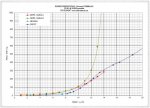
Power VS speed for PL 46 and 56 at stated displacement.

PL46power.jpgPL56power.jpg

Note the Gerr method B goes straight up as you expect with a traditional full displacement curve. That method is not applicable. Also note the Groot and Gerr A are rather similar in the 10-14 knot range, which is somewhat believable.
 
Last edited:
Top