Sunken yacht in Solent

as well as
Alright, then, proper :)

I think colregs make a lot more sense when you forget trying to interpret it as a set of instructions, and think of it as a way of apportioning liability.

Are you keeping a "proper" lookout? That's only ever going to be tested if you have a collision - and in that case is a judge going to agree that your lookout contributed to it?
 
Alright, then, proper :)

I think colregs make a lot more sense when you forget trying to interpret it as a set of instructions, and think of it as a way of apportioning liability.

Are you keeping a "proper" lookout? That's only ever going to be tested if you have a collision - and in that case is a judge going to agree that your lookout contributed to it?

See post 292 (2nd half).
 
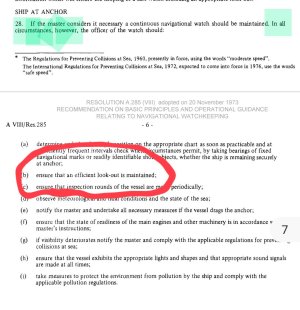
How about Roberto’s documents. Which say you must keep a watch if anchored in open water. That certainly implies you don’t need to in your favourite sheltered overnight spot.

It makes no mention of the IRPCS at all, and it says if you choose not to keep a watch you still have to keep a lookout.
 

Attachments

  • Screenshot_20250918_204711_Adobe Acrobat~3.jpg
    Screenshot_20250918_204711_Adobe Acrobat~3.jpg
    188.5 KB · Views: 4
Last edited:
It makes no mention of the IRPCS at all.
No. It says it’s guidance for masters, emanating from the IMO. It most certainly infers that even substantial ships can be in an anchorage without someone continually on the bridge with their binos. If you’ve got an anchor alarm and AIS CPA alarm you could sometimes do without that if not ‘at sea’. According to the IMO.
 
No. It says it’s guidance for masters, emanating from the IMO. It most certainly infers that even substantial ships can be in an anchorage without someone continually on the bridge with their binos. If you’ve got an anchor alarm and AIS CPA alarm you could sometimes do without that if not ‘at sea’. According to the IMO.

EDIT: Ylop found you still have to keep a lookout :
But his 2nd links says (at 28b) that regardless of a navigational watch they must keep a lookout.


Pretty sure that IMO guidance is in addition to the IRPCS, not instead of.

Also the fact that that guidance only applies to a subset of anchorages doesn't mean there is no STCW guidance for other anchorages. Maybe anchorages nearer shore have even more stringent STCW guidance.

But yeah, if the IMO or any other authority say somewhere that Rule 5 only applies when underway, I'd count that as pretty good evidence.
 

Attachments

  • Screenshot_20250918_204711_Adobe Acrobat~3.jpg
    Screenshot_20250918_204711_Adobe Acrobat~3.jpg
    188.5 KB · Views: 4
Last edited:
Pretty sure that IMO guidance is in addition to the IRPCS, not instead of.

Also the fact that that guidance only applies to a subset of anchorages doesn't mean there is no STCW guidance for other anchorages. Maybe anchorages nearer shore have even more stringent STCW guidance.

But yeah, if the IMO or any other authority say somewhere that Rule 5 only applies when underway, I'd count that as pretty good evidence.
STCW says "If the master considers it necessary, a continuous navigational watch shall be maintained at
anchor"
 
STCW says "If the master considers it necessary, a continuous navigational watch shall be maintained at
anchor"


..and when you read down, whether you have a navigational watch or not, you still need a lookout, as Rule 5 also requires.
 

Attachments

  • Screenshot_20250918_204711_Adobe Acrobat~3.jpg
    Screenshot_20250918_204711_Adobe Acrobat~3.jpg
    188.5 KB · Views: 4
Last edited:
Alright, then, proper :)
Yes, that's a much more interesting word, and capable of more degrees of interpretation. I wonder whether that's what capnsensible was groping towards when he talked of "or more intermittent checks, depends on the prevailing circumstances and conditions"?

As someone who occasionally makes extended single handed passages, I am always on the lookout for arguments I can twist, to claim that scanning the horizon and instruments once every 15 minutes while offshore counts as "maintaining a proper lookout". Alas, I suspect that's wishful thinking.

But the reality, as I believe the inestimable capn agrees, is that we all make our own decisions on appropriate seamanship, depending on the conditions at the time. Whether those decisions are always in strict accordance to the letter of the IRPCS is a somewhat more secondary matter.
 
The bit where it says: "Every vessel shall at all times maintain a proper look-out by sight and hearing as well as by all available means appropriate in the prevailing circumstances and conditions so as to make a full appraisal of the situation and of the risk of collision."
"appropriate in the prevailing circumstances"

Not complicated really, is it?
 
Ok so sometimes I will beach the boat on a falling tide.
So what dayshapes do I need to put up to avoid a collision and display the the boat has limited ability to manoeuvre?
Do I still need to keep a watch out at all times?
 
Ok so sometimes I will beach the boat on a falling tide.
So what dayshapes do I need to put up to avoid a collision and display the the boat has limited ability to manoeuvre?
Do I still need to keep a watch out at all times?
I think you are aground. Limited ability to manoeuvre isn't a term within the IRPCS. Three black balls in a vertical line, although if less than 12m not necessary. Keep a watch if you like, but being aground I doubt you'll be bothered by too many other vessels.
 
Yes, that's a much more interesting word, and capable of more degrees of interpretation. I wonder whether that's what capnsensible was groping towards when he talked of "or more intermittent checks, depends on the prevailing circumstances and conditions"?

As someone who occasionally makes extended single handed passages, I am always on the lookout for arguments I can twist, to claim that scanning the horizon and instruments once every 15 minutes while offshore counts as "maintaining a proper lookout". Alas, I suspect that's wishful thinking.

But the reality, as I believe the inestimable capn agrees, is that we all make our own decisions on appropriate seamanship, depending on the conditions at the time. Whether those decisions are always in strict accordance to the letter of the IRPCS is a somewhat more secondary matter.
I get why you make single handed passages.
 
I think you are aground. Limited ability to manoeuvre isn't a term within the IRPCS. Three black balls in a vertical line, although if less than 12m not necessary. Keep a watch if you like, but being aground I doubt you'll be bothered by too many other vessels.
When I was taught about day shapes, the instructor said to think of it as a combination of an anchor ball and the two NUC balls.
 
"appropriate in the prevailing circumstances"

Not complicated really, is it?
Discussed already at #297

"Every vessel shall at all times maintain a proper look-out by sight and hearing as well as by all available means appropriate in the prevailing circumstances and conditions so as to make a full appraisal of the situation and of the risk of collision."

is correctly parsed as:

Every vessel shall at all times maintain a proper look-out
* by sight
* and hearing
* as well as by all available means appropriate in the prevailing circumstances and conditions
so as to make a full appraisal of the situation and of the risk of collision

The phrase "appropriate in the prevailing circumstances" does not apply to sight or hearing, but to other means.
 
Top