Nige123
New Member
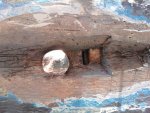
As per pic, found a weeping leak which when traced led to the excavated mess - "main" through hole roughly 2" x 1". Seems someone didn't bore the hole accurately for the bolt that goes up to the engine bearer - evidently had two goes as the hole was elliptical and filled with gunk on the overcut side (white lead?) before the inevitable happened and rot started. It was a threaded bolt as well... Rest of the plank is sound on all sides - 3/4" mahogany - just looks off-colour as the wood has absorbed 80 odd years of some black primer / tar mixture (realised this was the case some years ago when scraping the lot in hope of a varnished hull).
Question is, what's the best way of fixing this without scarphing in a new length of planking? (Which I don't want to do unless last resort as the rest of the plank is fine, rot has been caught / wood treated, and to get the bolt out I need to remove the engine & gearbox etc etc). The boat is only used on inland waterways and this is a flat run of planking so it's not going to be stressed unduly in a seaway for instance; it has a very quiet life!
I thought about using a hole saw to enlarge the hole to the right of the bolt and then epoxy in a mahogany plug ensuring grain in same direction, coating the inside (i.e. bilge face only) with a couple of coats of Danboline then encapsulate with lot with epoxy on the outside. The sistered ribs inside will stop it being pushed through and there's an engine bearer on top of them so any butt blocks etc. are out of the question. Can make up some epoxy filler to bring the planking around the hole up to surface level and minded to epoxy in the bolt above the gunk that is sound; with a bolt that size the plank / engine bearer relationship is fixed irrespective and I can't think how else to fill the odd gaps.
Does this sound workable? Has anyone a better suggestion?
Many thanks.
Question is, what's the best way of fixing this without scarphing in a new length of planking? (Which I don't want to do unless last resort as the rest of the plank is fine, rot has been caught / wood treated, and to get the bolt out I need to remove the engine & gearbox etc etc). The boat is only used on inland waterways and this is a flat run of planking so it's not going to be stressed unduly in a seaway for instance; it has a very quiet life!
I thought about using a hole saw to enlarge the hole to the right of the bolt and then epoxy in a mahogany plug ensuring grain in same direction, coating the inside (i.e. bilge face only) with a couple of coats of Danboline then encapsulate with lot with epoxy on the outside. The sistered ribs inside will stop it being pushed through and there's an engine bearer on top of them so any butt blocks etc. are out of the question. Can make up some epoxy filler to bring the planking around the hole up to surface level and minded to epoxy in the bolt above the gunk that is sound; with a bolt that size the plank / engine bearer relationship is fixed irrespective and I can't think how else to fill the odd gaps.
Does this sound workable? Has anyone a better suggestion?
Many thanks.