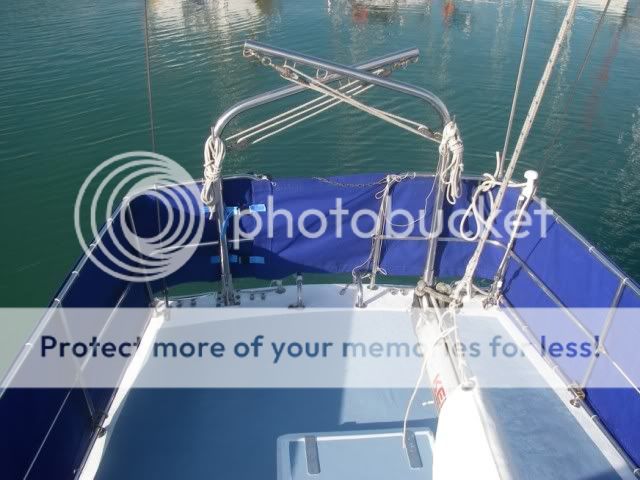
Stupid Question: Should I fit davits to my 32ft motorsailer?

'Fear' doesn't really come into it, I was basing my assertions on personal experience and that of people I know; common sense is a factor too for an experienced sailor, I expect you take more precautions in every way than you realise, Uber.

Try reading the late great Adlard Coles' experience of towing a dinghy across Lyme Bay in early editions of 'Heavy Weather Sailing' - his problems started long before the heavy weather.

Both dinghies I have towed have been relatively light GRP ones with highish freeboards - I suspect that a heavy, low traditional wooden dinghy would be quite a different proposition.

As for precautions - yes, some. A good springy painter is essential, and I used to tow the Jouster's dinghy on 20m of braided nylon in bouncy conditions. It's also essential to have the towing eye low on the dinghy and, on a small yacht particularly, to attach the painter as high up as possible: on the Jouster I would swap the painter to the high side every time I tacked when things got hairy.
 
I put one on ours but hardly use it.If dinghy is up right it fills up it fills with water, on its side you can't see behind and in a following sea its a pain.
Our airdeck Avon has a drain in the transom which we leave open when the dinghy is on its davits. If there is any rain left in it, you just lower the dinghy slightly at the aft end.
 
You do not say what make your motorsailer is, but Unless you want to be talked about Davits on a Motor sailer is a definite No No.

What do you really want the dingy for, really how often will you use it?, sell the dingy and get a liferaft if your worried about sinking! or an inflatable if you desperate to keep one, or leave the dingy on your mooring if you have a buoy mooring.

Hi Mike

Not sure why davits are a no no on a M/S. I guess with removable davits I have the best of both worlds. I agree about the costs, mine would have been several hundred pounds a year to stay fixed.

I think the dinghy itself is more of an issue.

I don't think towing is a good idea - with any sort of sea running its going to be risky, and climbing down into any sort of dinghy is a risk (as I know all too well) but much more so into a rigid.

I would go with the idea of selling the dinghy and buying a decent inflatable. Most M/S can take an inflatable on the wheelhouse roof, I know its windage but on something like a CW its not going to make much difference, and of course he could still fit it in the davits if he wants
 
I also tow my grp dingy but normally only on short w/e trips to sheltered anchorages (Swanage / Studland / Brownsea Is).

I use twin equal length painters, one to each stern quarter, it stops the dingy zigzagging, compensates for whichever tack and gives belt and bracers attachment.

That's a neat idea. If my new boat had stern quarters I'd try it!
 
We had davits on our 27ft cat which was 11ft at the stern so not much wider than say a Colvic Watson 32's overall 9+ft beam. ]

Hi Muddy Paws & Beadle

I can imagine davits on a Cat as they are wide at the stern but 'yodave' does not say what motorsailer he has, few motor sailers under 35' have a really wide stern as to many 35' modern yachts that do.

However fitting davits especially on any Colvic Watson is not wise as having a 'Canoe' stern design, mounting the davits due to the deck design space is not so easy, and more important, being a canoe stern the dingy does not have any flat surface to rest against.

Mike
 
Mine work well for me.
IMGP3348.jpg
 
I have removable davits on the stern of my 32 Barbary Ketch, when we first had her I thought htey were great and made her a proper ship, I could order crew to "ready the sea boat for launching" and all that, but after one particular tangle berthing in St Peter port they came off, It helps to be abe to fend off the stern! I tow an inflatable for short trips and hoist it onto the foredeck with the genoa halyard for lond trips
 
I've been towing rigid dinghies for years and have only once had a problem - when nasty seas round the Oa fell into the dinghy and swamped it. Even that was relatively easily solved by towing alongside for the nasty bit.

Dunno about those rubber things, but apart from the drag, towing a well designed rigid dink isn't nearly as bad as people seem to fear.

Ditto - I've only had one incident when towing a dinghy when entering the Deben some years ago - It was a bit windy and rolly and the dinghy surfed right onto the top of the rudder post making a hole in the grp. Repaired the hole and I still have the dinghy, and still towing!
 
I wish I had davits but my boat's stern is too narrow, I get fed up with inflating and deflating the dinghy (even with a LVM pump) and it doesn't easily stow in a locker so ends up either rolled up on the foredeck or on a bunk.

I find that towing the dinghy definitely reduces speed, and in the past I have ended up having to land a surfing small pram dinghy into the cockpit in bad weather also if anchored with wind against tide a dinghy tied astern becomes a pain though it can be tied alongside in settled conditions.
 
Thank you very much to all those who replied.

There seems to be a BIG difference in opinion. Perhaps my stupid question wasn't as stupid as I thought that it was when I posted it.

Although I might revisit this at the end of the season, for the moment I have decided not to fit davits. Mainly because of the strain that this will put on the rear deck / roof of my aft cabin ...and because the stern of my boat is narrow compared to more modern yachts.

My decision was made after reading through your comments, so thanks once again to each and every contributor.
 
Thank you very much to all those who replied.
There seems to be a BIG difference in opinion. Perhaps my stupid question wasn't as stupid as I thought that it was when I posted it.
Although I might revisit this at the end of the season, for the moment I have decided not to fit davits. Mainly because of the strain that this will put on the rear deck / roof of my aft cabin ...and because the stern of my boat is narrow compared to more modern yachts.
My decision was made after reading through your comments, so thanks once again to each and every contributor.

And Thank YOU for your feedback. Too often I and others have responded to some question (no, yours was not stupid at all), never to hear from the OP at all.
 
Towing a dinghy

This is a bit long winded but covers towing all different kinds of dinghies over the last 50 years.

We towed an wooden Orkney built clinker dinghy for years behind my fathers converted lifeboat without ever having a problem. However, we did develop some techniques to reduce yaw and stop the dinghy riding up on our stern when there was a heavy following sea,

We always used two painters about 4 m long with one secured to each quarter bollard. Being a lifeboat with a pointed stern, the two bollards were only about 1 m apart but did provide a stabilising effect on the dinghy. However the longer you make the painter, the less will be this effect.

The other technique we used was to fit a 5 to 6 m length of ¼” chain to the stern of the dinghy. This was left with the bitter end of the chain up to the bow so we could pull the dinghy up close and flick the chain into the water if things got a bit difficult. This had the effect of stopping the dinghy riding down a wave and crashing into the rudder. If we knew that things were going to be challenging, the chain would be in the water before we set off. One point to make here is that the chain was secured with a light cord which would break if for any reason the chain were to snag (which it never did)

We did try a longer single painter to begin with (with no chain) but found this to be a worry as the dinghy would yaw from side to side and would snatch as the painter slackened and tightened again. We tried a 5 lb “Angel” about half way down the painter which stopped the snatch. However we ended up with our shorter double painter with the option of the drogue chain as being our best set up for that dinghy

Although we never had any problem with the dinghy broaching or running up on the stern, a lot of this was due to the impeccable manners of wooden clinker built Orkney dinghies. They sat in the water rather than on it and they had a 2 inch deep keel which increased to about 8 inches at the stern. The bow was slightly flared out and had a high “Nordic” type bow. (just for information, the dinghy was 9’ 6” and built from 5” wide marine plywood planks)

We then changed boats and the new one had a black Avon Redcrest inflatable. That was just one disaster after another. It would take off in a breeze, turn somersaults and end up as a drogue with the rear fabric seat acting like a parachute. Another time in Loch Goil it was ripped from the stern when the pad was torn from the bow. Sadly we got it back as I hated that thing.

Changed boats again and we ended up with a Tepco 9’ GRP dingy. We tried all the same techniques we had tried with the Orkney dinghy but they were not quite as effective as had been with our wooden dinghy.

Changed boats yet again with our new dinghy being a Seago Airdek (spelling?) which has an inflatable keel and a wooden transom. Jury is out on this one at the moment but definitely needs two painters to ensure it runs in a straight line. Would not like to tow it with a cross wind as I am sure it would turn over. I did some tests to try and find the optimum length of painter as I was positive that I could reduce the drag by bringing it up close to the stern but the season came to an unexpected end with some concern over our main Diesel engine so will spend some time getting to grips with what is the optimum for this dinghy when I launch in the spring. (if it ever stops snowing)
 
Thank you

@ Jcorstorphine... Thanks for such a detailed response. Not sure I'll opt for your chain solution at this stage, but I think the idea of having two painters, [as I think another contributor touched on too] sounds like a good 'un ...so I'll be giving that a go up and down the Forth in a month or two.

Bringing my 'new' dinghy back home tomorrow to do some repair & upgrading before the start of the season [not long now]. I've decided to tow it when required, but in addition buy a small, cheap inflatable to keep aboard for emergencies [not serious emergencies, we have a liferaft for that].

Thanks once again to you and all other contributors!

David
 
Top