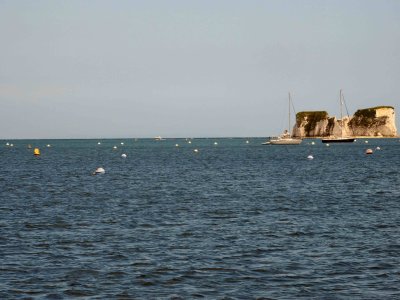
Studland - MMO Management protocols for the MCZ in place from 17th December

Only the 5t moorings left tonight. Will be interesting to see how many of those now seemingly coming from the West get creative about their displacement. The HR which was motoring around has finally given up and dropped their hook just outside the VNAZ

It would be helpful if the smaller boats picked up one of them up rather than use the heavier moorings…
 
I anchored in Studland about a week ago and stayed overnight. Was just inshore of the eco-mooring zone, which was full of mainly day-trippers when I arrived. Anchor dug in first time and remained secure.

On weighing anchor the next morning I brought up a fair amount of conventional seaweed (and just a little seagrass): this was because it was tangled up with a whole mess of lost florescent fishing-line which had also snagged itself on my hook and several meters of chain.

I can report that there is now less plastic in the English Channel.
 
We were at Studland early this weekend and it was very busy including anchored boats in the VNAZ.
Being a cat we always used to go in close, look for a clear sandy spot and drop the anchor.
Noticed that there are still loads of sandy spots so it would seem that the seagrass isn't spreading very quickly!
Also notice that the pub moorings arn't eco moorings so wonder how the grass is doing around them??
 
Latest reports say the eelgrass is ;recovering' with evidence of new growth. Success! It's all worth it..... its recovering at last!

Funny thing is its been doing that since the mid 1950's, when there was just a small patch less than 100sq metres when it first started to reappear, in spite of continuous heavy use as an anchorage over 50 years. Even in the time I was involved there was a clear continuation of growth. I have photos of extensive new growth from 10 years ago - before it was 'protected'.

We did our own underwater video survey in 2016 and found nothing but acres of healthy seagrass, as measured by standard metrics used worldwide for assessing seagrass health - seemingly the 'damage' is only visible to the chosen few?
 
Last edited:
I’m rather conflicted about the moorings tbh, clearly they (and the associated VNAZ) have been set up under a false pretence but I find them rather useful and they are about half the cost of, say, Yarmouth outer buoys.
Anchoring is even cheaper. My boat floats in less that a meter of water so even the closest eco buoys are to far out as far as I'm concerned.

I agree with @oldharry . The "grass" has spread over the years (last 45) I've been visiting Studland without the meddling of various groups with their own agendas.
 
I’m rather conflicted about the moorings tbh, clearly they (and the associated VNAZ) have been set up under a false pretence but I find them rather useful and they are about half the cost of, say, Yarmouth outer buoys.
I entirely agree. Eelgrass and Seagrass in general is not nice stuff to anchor in as it can very effectively prevent the anchor from setting properly, or even at all. Over many years I have several times had to redeploy my hook and more than once, several attempts, befroe I could get it to set in the elgrass bed at Studland. The stuff bunches up and fills the tines or blades of the anchor making it impossible for it to dig in to the seabed. Its the a righ pita to clear it, while your boat is merrily drifting out through the anchorage!

I mounted a good 'Fishfinder' type echo sounder with a display that even in a cheap one can clearly profile the seabed on a scrolling screen. Its quite easy to recognize the distinctive profile of a Seagrass meadow. That made it much easier to find open seabed. But it also provided first hand evidence that where there were open spaces in previous years they were now infersted with eelgrass and no longer suitable for anchoring. But that's not the regarded as 'evidence' that the seagrass was actually expanding. So now, surprise surprise, they find it is quietly doing what it has been doing all along. Except they havent seen it before so it provides 'evidence' that the 'protection' is working.

I never saw any elephants in my garden near Portsmouth since I started wearing my elephant hat, either! :unsure: :)

So yes, having moorings provided does make alife a bit easier in some ways, even if we have to pay for what was free before.
 
Unfortunately, on the many days a year that they are not in use, those 100 odd eco-moorings totally destroy the view out to sea from the land. They are an incredible eyesore.
Wow. It is hard to see how a few small mooring buoys could “totally destroy the view” of any location. Must be an extremely dull view if your eye is drawn to buoys at sea level.
Me think some doth protest too much.
 
I entirely agree. Eelgrass and Seagrass in general is not nice stuff to anchor in as it can very effectively prevent the anchor from setting properly, or even at all. Over many years I have several times had to redeploy my hook and more than once, several attempts, befroe I could get it to set in the elgrass bed at Studland. The stuff bunches up and fills the tines or blades of the anchor making it impossible for it to dig in to the seabed. Its the a righ pita to clear it, while your boat is merrily drifting out through the anchorage!

I mounted a good 'Fishfinder' type echo sounder with a display that even in a cheap one can clearly profile the seabed on a scrolling screen. Its quite easy to recognize the distinctive profile of a Seagrass meadow. That made it much easier to find open seabed. But it also provided first hand evidence that where there were open spaces in previous years they were now infersted with eelgrass and no longer suitable for anchoring. But that's not the regarded as 'evidence' that the seagrass was actually expanding. So now, surprise surprise, they find it is quietly doing what it has been doing all along. Except they havent seen it before so it provides 'evidence' that the 'protection' is working.

I never saw any elephants in my garden near Portsmouth since I started wearing my elephant hat, either! :unsure: :)

So yes, having moorings provided does make alife a bit easier in some ways, even if we have to pay for what was free before.

Spot on, never tire of saying how it is.

The tide of activist motivated chicanery seems to be turning. and when the BBC sits down a scientist to tell us the facts, I think less and less people are taking it at face value.

.
 
Tell me the view wouldn't be improved without the mooring buoys...

View attachment 198466
There are many locations and angles with lovely views in this area …… but this angle clearly never was one of them.

Even then, certainly the buoys don’t “totally destroy the view” in this example - perhaps “marginally detract from” would be a more balanced perspective.
But surely moorings, marinas and other boating facilities have much bigger visual impacts in much of the rest of the Poole and Solent areas.
There are a lot of issues about the Studland stuff - which oldharry makes an excellent case about, including the apparent lack of any scientific basis for the assertions on the seagrass growth and impacts of anchoring. But the visual impact of a few moorings (when the South coast has these almost everywhere else) seems to be missing the real issue.
 
...
But surely moorings, marinas and other boating facilities have much bigger visual impacts in much of the rest of the Poole and Solent areas.
There are a lot of issues about the Studland stuff - which oldharry makes an excellent case about, including the apparent lack of any scientific basis for the assertions on the seagrass growth and impacts of anchoring. But the visual impact of a few moorings (when the South coast has these almost everywhere else) seems to be missing the real issue.

The real issue is, as you say, what OldHarry and others have been talking about for many years. Up until a few years back Studland Bay was just an empty bay but that was the whole point, you weren't in among the marinas and mooring fields of the Solent. You could anchor anywhere you could find a patch of sand, the bay was unsullied. Now, because of the so called 'nature lovers' we have this very visible rash on the face of the bay.
I'm sure you will consider me to be waxing a bit too lyrical but there are so few pristine and sheltered anchorages left on the south coast that to blight this one is close to criminality/insanity, take your pick.
 
Unfortunately the place strikes me as a magnet for the less responsible members of the nearby boating community, anecdotally many seem to use the facilities at Parkstone Bay marina as their base.
I think its more the accessibility of the Public slips in Poole, giving acces to not only the extensive sheltered waters of Poole Harbour, but Studland itself, a short sea trip away. On a fine saturday, there are long queues at the slips, with trailed boats coming down froma long way inland, and people who know little or nothing about operating a boat at sea.

Many years ago the Swanage Lifeboat Cox recounted going to a small Mobo off Anvil Point with engine trouble. (Anvil point is not a tide race, but the ebb can run 3kts or more) . They checked out the engine, nothing wrong, but quite simply they were strugglung ti get back against the tide. The Cox explained about the tide rising and falling causing strong currents. "Oh" was the reply "how many times a year does it do that?" The Cox's reply is not recorded.....

I have myself sat on Standfast Point and watched a small heavily loaded RIB powering out from Poole heading towards Old Harry with a brisk NWly behind it. Reaching Old Harry it turned back and started punching the wind and Tide. I had my mobile ready to call CG. They made it, but must have got VERY wet and seasick!
 
Top