Studland - how much do our anchors affect the seabed? New BORG report out.

oldharry

Well-Known Member
Joined
30 May 2001
Messages
10,075
Location
North from the Nab about 10 miles
Visit site
An immediate howl of rage from Sea Horse Trust, and another desperate attempt by them to discredit the author has greeted BORG’s latest paper on anchoring in Studland submitted to Natural England and DEFRA today.

Yachtsman Dr Simons, who has done so much research on eelgrass for us has turned his attention to the actual degree of exposure of the seabed to our anchors, and its likely effect on the eelgrass which it is claimed we are destroying, and has set up a means by which the actual impact of anchoring in the bay can be accurately measured so that the impact can be properly assessed. Even allowing quite generous figures, he found that in any year less than 1% of the seabed in the anchorage area will be disturbed by our anchors. This clearly contradicts the claims that we are 'devastating the seabed’ so widely peddled in the press and on TV.

The report is on the BORG website http://boatownersresponse.org.uk/anchoring-density.pdf

At present Studland is listed as a candidate site for the ‘Second tranche’ of MCZs, although that list is not yet finalised. Working alongside the Studland Bay Protection Association, we are seeking to have Studland dropped from that list before the ‘Public Consultation’ scheduled for early next year.
 
Well done Old Harry and Dr Simons. Can understand the howls of rage from SHT - after all the report has numbers in it that make sense. Not the sort of thing that appeals to them.
 
2 points that I might question if I wanted to disprove the report ( & I certainly do not). I think that they have not been foreseen & given a robust argument in advance

I note that the author uses a fairly small anchor footprint as the basis for the areas affected. Is this relevant to the sea bed type in this area?. In some areas it takes a while for an anchor to start digging in ( see various reports of anchor tests in magazines)
I would be surprised if an anchor did actually catch a hold in such a small area. I would expect it to drag a little first & it could be argued that this would damage the eel grass. No comment is made about an anchor chain dragging across the bed when the tide changes, or the anchor re bedding itself.
Whilst this would only double the area affected in the most extreme case it could still be used to rubbish the report

I also note that he says that eel grass recovers itself in 6 months. However, the 6 months for recovery is in the winter & one might ask if it still applies this time of the year. It may be that in winter there is not any significant growth.

On a positive side one might ask if " cultivation" actually promotes growth rather than hinders it

But good luck with the report anyway
 
Before the voluntary no anchoring zone in the Helford was introduced I used to pick up some eelgrass when weighing anchor. These days I pick up kelp or sea belt. I believe that years of anchoring have actually contributed to the growth of the eelgrass, the anchors doing a bit of weeding.
If there is a lot of eelgrass growing in a popular anchorage then that in itself should be a reason to continue anchoring there. The "Conservationists" want to change things rather than conserve things, they are not being scientific in their so called reasoning.
 
2 points that I might question if I wanted to disprove the report ( & I certainly do not). I think that they have not been foreseen & given a robust argument in advance

I note that the author uses a fairly small anchor footprint as the basis for the areas affected. Is this relevant to the sea bed type in this area?. In some areas it takes a while for an anchor to start digging in ( see various reports of anchor tests in magazines)
I would be surprised if an anchor did actually catch a hold in such a small area. I would expect it to drag a little first & it could be argued that this would damage the eel grass. No comment is made about an anchor chain dragging across the bed when the tide changes, or the anchor re bedding itself.
Whilst this would only double the area affected in the most extreme case it could still be used to rubbish the report

I also note that he says that eel grass recovers itself in 6 months. However, the 6 months for recovery is in the winter & one might ask if it still applies this time of the year. It may be that in winter there is not any significant growth.

On a positive side one might ask if " cultivation" actually promotes growth rather than hinders it

But good luck with the report anyway

Thanks, I'd welcome comments, + and -, which can help make the process more robust. Yes, shoots could get broken before the anchor sets, but 2 studies in the Med had divers watching the anchoring process and didn't report that happening. But it was a different type of seagrass, admittedly. The anchor tests, eg the Manson one, tend to be on bare sand - clearer water and you can see what's happening. I'd guess with eelgrass present the point would catch fairly soon and the digging in will start. There are sea beds with slimy wide-leaved seaweed where the anchor seems to skate over the bottom for metres before catching hold, but I guess eelgrass is different. Anchor chains - maybe, it is certainly true that fixed mooring chains can repeatedly scour the seabed and kill everything, but that's a continuous process in one area, unlike an anchoring stay. I doubt if anchor chains do much harm, Studland gets infested with seahorse divers who'd love to get pictures of that happening, but they've not produced much yet. It does need proper study, really, but these initial findings are a useful start, I think. Better than the exaggerated preconceptions of the eco-warriors.
 
foeu,

Not too sure about that; I've always answered the SHT by saying I aim my anchor to keep clear of weed, stuff the eelgrass I just want the anchor to hold for my own sake !

At Studland I go for the clear sandy bits, not the green stuff; common seamanship which rather disproves the hysteria promoted by the Career Conservationists...
 
foeu,

Not too sure about that; I've always answered the SHT by saying I aim my anchor to keep clear of weed, stuff the eelgrass I just want the anchor to hold for my own sake !

At Studland I go for the clear sandy bits, not the green stuff; common seamanship which rather disproves the hysteria promoted by the Career Conservationists...

Trouble with that is the eelgrass has spread so much in recent years there are very few bare sandy bits left! At least, that was the case in Studland Bay last summer. I don't know yet what damage the winter storms have caused. Although some (SHT) will bame even storm damage on anchoring....... Perhaps the anchors upset Poseidon or Neptune or something.
 
Try this outfit;

http://studlandbpa.blogspot.co.uk/

along with BORG they are doing a fine job, and I for one wouldn't fancy going into combat against Olympic Sailor Rodney Patterson ! :)
Yes, Rodney is watching the situation very carefully, and is I think waiting until things start being actually decided next year. But he is keeping himself very fully briefed - as I found when I was speaking at one of their meetings!
 
...
Anchor chains - maybe, it is certainly true that fixed mooring chains can repeatedly scour the seabed and kill everything, but that's a continuous process in one area, unlike an anchoring stay. I doubt if anchor chains do much harm, Studland gets infested with seahorse divers who'd love to get pictures of that happening, but they've not produced much yet. It does need proper study, really, but these initial findings are a useful start, I think. Better than the exaggerated preconceptions of the eco-warriors.

I would expect that an anchor chain would do quite a lot of damage over a large radius. Anchoring in Thames Estuary mud, the last metre or more of chain comes up muddy, so they must have been laying on the bottom. If you are there long enough to go through a complete tide cycle, your chain is going to scrape a circle of a metre or more radius of the seabed.
 
I would expect that an anchor chain would do quite a lot of damage over a large radius. Anchoring in Thames Estuary mud, the last metre or more of chain comes up muddy, so they must have been laying on the bottom. If you are there long enough to go through a complete tide cycle, your chain is going to scrape a circle of a metre or more radius of the seabed.

Yes - but the chain doesn't instantly evaporate eelgrass on contact. If it slithers over the top on its way to a new position after a change of tide, I can't see the grass being especially bothered.

Pete
 
Yes - but the chain doesn't instantly evaporate eelgrass on contact. If it slithers over the top on its way to a new position after a change of tide, I can't see the grass being especially bothered.

Pete

Ah, can't comment on that - we only anchor in East Coast mud - nothing to damage round here! :)
 
I believe that years of anchoring have actually contributed to the growth of the eelgrass, the anchors doing a bit of weeding.
If there is a lot of eelgrass growing in a popular anchorage then that in itself should be a reason to continue anchoring there.

...

The "Conservationists" ... are not being scientific in their so called reasoning.

Maybe they should start their "so-called reasoning" with "I believe .. " too?
 
Maybe they should start their "so-called reasoning" with "I believe .. " too?

If you believe something strongly enough it becomes 'fact'. Thats what we are up against. Much of what is written about Studland is based on opinion, based on usually very limited observation, and heavily biased asumptions. When you dig down to the data and observations behind the opinion, there is actually very very little to go on.

No one has yet even begun to answer the fundamental question: why is there so much MORE eelgrass after 50 years anchoring? Why suddenly, at a time when economics and weather have actually reduced the number of visitors by 30% or more, is there a sudden panic about it all?

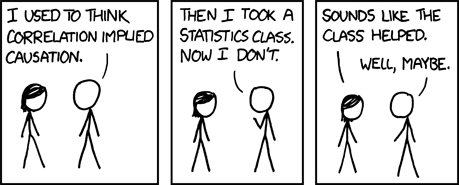
The reasoning goes something like this: "There are gaps in the eelgrass. People anchor there. Therefore the gaps must be caused by anchoring".

There are gaps elsewhere well away from the anchorage

"ah well, we dont know what has caused those"

But nobody anchors there.

"But the gaps in the anchorage must have been caused by anchors".

Why?

"Because people anchor there. Therefore the gaps must be caused by anchoring"


And so it goes on...and on and on.
 
Last edited:
The reasoning goes something like this: "There are gaps in the eelgrass. People anchor there. Therefore the gaps must be caused by anchoring".

correlation.png
 
Can someone explain why the SHT is so animated about getting anchoring banned. Is it because they have a genuine concern for the wellbeing of seahorses or is there another agenda?
 
Is it because they have a genuine concern for the wellbeing of seahorses or is there another agenda?

Once it becomes tribal, the thing is self-sustaining even in the absence of reason. You fight them because they're the enemy, and they're the enemy because you fight them.

Pete
 
Top