Stubborn screws in Genoa track into teak toe rail?

Nigelb

Well-Known Member
Joined
10 Nov 2012
Messages
178
Location
Winchester
Visit site
I have an original 1979 Lewmar track, on the teak toe rail that needs replacing.

I suspect many of the screws will be difficult to remove, clearly want to remove as many as possible without drilling the heads off.

Do I use some heat first?......before drilling or tapping etc.

I assume an impact driver is inappropriate as the rail will take the force.

Any tricks?
 
If you have a powered impact driver I can't see why it would damage the rail, although the old type that are whacked with a hammer probably would. I'd certainly use one, but make sure that the bit is a perfect fit, and even then be careful - they do like to twist out of slotted screw heads. I think heat would be too risky, burning the wood or turning gooey stuff into solid screw grabbing concrete.
 
Try tightening the screw up first before trying to undo. This does normally make it easier to remove screws. One of the impact screwdrivers may also assist in this. I wouldn't use heat unless you can target each screw individually.
 
Try tightening the screw up first before trying to undo. This does normally make it easier to remove screws. One of the impact screwdrivers may also assist in this. I wouldn't use heat unless you can target each screw individually.
:encouragement:

surely this track will be affixed with machine screws ( with a nut ) & not wood screws, what size is the yacht
 
I have an old handheld impact driver that I whack with a lead mallet. I've never damaged anything yet (including my mast) because the driver transmits the force via a strong(ish) spring so there's no direct connection between the mallet and the object that I am hitting. It's a fantastic tool that has got me out of some near impossible situations over the last 40 years.

As Old Harry says, it's likely there will be nuts underneath but sometimes even machine screws can be difficult to budge.
 
Assuming the screws are actually screws and stainless and the track is aluminium:

You shouldn't have any problems getting stainless screws out of teak, if that's all they're screwed into, or any GRP beneath. To soften up aluminium corrosion around the heads, soak them in release agent (e.g. WD-40 Specialist stuff) a day before, it'll help, but I think you'll find they're not that difficult to get out.

Make sure you use the right type and size driver/bit though. Knowing the differences between Philips and Pozidriv can make all the difference for this job (assuming they're either of those). Any slipping will quickly mash the screw head into uselessness, so be careful and try to loosen them by hand before using powertools.
 
I suspect they will be screws, I had a similar problem but it was fairleads that I was removing from my teak cap rail. The problem is that the wood fibres grip and almost bond with the metal of the screw it needs considerable force to break the initial adhesion I used a socket that took a large flat blade bit and a long extension bar. With someone pressing down and keeping the bit located in the screwhead they will crack off and are still quite stiff to unscrew.
 
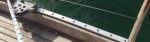
I am not at the boat at the moment, here is the best image I can find.

I am fairly confident they are screws and not bolts as there is no access from below.

Yacht is a 38ft ketch, the rail extends all the way to the quarter, approximately 5m.

I intend to replace with modern 2.5m track.

rail track.jpg
 
Last edited:
Assuming the screws are actually screws and stainless and the track is aluminium:

You shouldn't have any problems getting stainless screws out of teak, if that's all they're screwed into, or any GRP beneath. To soften up aluminium corrosion around the heads, soak them in release agent (e.g. WD-40 Specialist stuff) a day before, it'll help, but I think you'll find they're not that difficult to get out.

Make sure you use the right type and size driver/bit though. Knowing the differences between Philips and Pozidriv can make all the difference for this job (assuming they're either of those). Any slipping will quickly mash the screw head into uselessness, so be careful and try to loosen them by hand before using powertools.

I am concerned that if I use a release agent, like WD40 or penetrating oil, I will contaminate the wood and make it difficult to epoxy and plug the holes. The centres do not match modern tracks and the new track will be shorter. However it is likely that I will have to use a 10mm cutter so perhaps I can remove the contaminated wood?
 
If. You get a hammer through screwdriver.
You can hit this with s hammer, while applying a turning force with the other hand.
A reasonable turning force is needed..
 
The secret is a well fitting screwdriver. If they're ordinary slotted type it's worth regrinding the tip to get a perfect fit. Applying heat with a gas soldering iron sometimes helps.
 
I've got a large screwdriver which has a hexagon just below the handle which you can get a spanner on, lean heavily on the screwdriver and turn with the spanner, tighten and loosen & it should free. Must be a good fit, get a new screwdriver if necessary. Another screwdriver I have has a steel hexagon on the handle top which you can hammer to get it started, also make sure the slot is clean. Good luck.
 
I had exactly the same set up on my Ebbtide 33 Built in 1983 I had to remove the genoa track a couple of years ago. It came off without any trouble at all. So best of luck.
 
Top