Strip light LED driver efficiency

claudio

Well-Known Member
Joined
16 Aug 2003
Messages
480
Location
Cruising
Visit site
In order to protect my LED strip lights from over voltage I decided to buy some LED Constanst voltage drivers. The spec says
auto step down step up(SEPIC)
input 3-35V
output 1.25V-30V
biggest current 2A
conversion efficiency 92%
frequency 50KHz
Output ripple 40mV
temperature -40℃ to +85℃
size 48*23*14 (mm)

Now when I connect my LED strip direct to 13V supply, I measure the current draw at 800mA.
I then connect the driver in circuit and adjust the output voltage to 13V.
The current draw is now 1.29A from the input side (13V input still)

So by my calculations 490mA is being used to generate heat in the converter, this equates to 6.37W.

0.8x13 = 10.4W is being used by the LED strip

This is no where near the quoted efficiency of 92%

6.37/10.4 = 61.25% efficiency.
Agreed a little better than an incandescent but .....

Looking deeper into the chip specs it appears that the max efficiency quoted is around 90% at 32V input voltage.

Anybody have similar experiences ?
 
Anybody have similar experiences ?

Yes.
They tend, for obvious reasons, to quote the very best efficiencies but these may just relate to specific voltages and and currents. Outside that spec. the efficiencies decline. Unfortunately they don't always give the full information so that you can check it out beforehand. It is frustrating though.

As an aside. You mention 13 volts. I thought those strip lights usually worked on 12 volts?
 
The strip lights are quoted for automotive use, i.e. car battery 11.5 to 14.4 approx. They have series resistors built in so the current increase at 14.4V is accommodated. Using a constant voltage driver set to 12 or 13v (13.4 is normal trickle charge voltage) stabilises the voltage to the LED so that it reduces the flicker / strobing that can occur when other items are powered up.

I think am going to abandon the driver idea, I can't tolerate such low efficiency. That is 6.37W per LED strip x no of LED strips. It is far too much wasted energy.

I have been looking into a current limit circuit that basically uses negligible energy until the voltage rises above a set value. Excess voltage is diverted to shunt. This rarely happens but the current limit protects the LED strings.

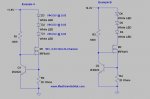
Its a very simple circuit using a mosfet for the pass element, a resistor for current sensor, a transistor and bias resistor to perform the limiting. I'll post a link or schematic.

MadScientist.jpgI-Lim.jpg
 
Last edited:
The strip lights are quoted for automotive use, i.e. car battery 11.5 to 14.4 approx. They have series resistors built in so the current increase at 14.4V is accommodated. Using a constant voltage driver set to 12 or 13v (13.4 is normal trickle charge voltage) stabilises the voltage to the LED so that it reduces the flicker / strobing that can occur when other items are powered up.

I think am going to abandon the driver idea, I can't tolerate such low efficiency. That is 6.37W per LED strip x no of LED strips. It is far too much wasted energy.

I have been looking into a current limit circuit that basically uses negligible energy until the voltage rises above a set value. Excess voltage is diverted to shunt. This rarely happens but the current limit protects the LED strings.

Its a very simple circuit using a mosfet for the pass element, a resistor for current sensor, a transistor and bias resistor to perform the limiting. I'll post a link or schematic.

View attachment 33362


Or you could go for constant voltage, not as elegant and doesn't allow for temp changes but I've had success with these for a variety of uses..
http://www.ebay.co.uk/itm/3-5-28V-t..._Measurement_Equipment_ET&hash=item51ab7d061a

Set the voltage for a light level which is bright enough and leave it.

Bit RF noisy though, a capacitor on the input cleans that up.

EDIT. DOH! Just read the post, might be the same units, pretty sure I had a measure of these and it wasn't too bad, power out close to power in..
 
Last edited:
I think that if you did the same test that I did in the original post, you will find that the efficiency is similar or worse. If you do test, please post your results
 
It would be better if they replaced the inline resistors in the LED strips with zero ohm links. You can then use a constant current driver. I designed one years ago (circa 2003) that drove Luxeon 1 LEDS, 1 Watt 350mA per LED. Input power was 1.1W LED output was 1W
Efficiency was better than 90% at 12V. We drove the LEDS in strings of 3.
 
In order to protect my LED strip lights from over voltage I decided to buy some LED Constanst voltage drivers. The spec says
auto step down step up(SEPIC)
input 3-35V
output 1.25V-30V
biggest current 2A
conversion efficiency 92%
frequency 50KHz
Output ripple 40mV
temperature -40℃ to +85℃
size 48*23*14 (mm)

Now when I connect my LED strip direct to 13V supply, I measure the current draw at 800mA.
I then connect the driver in circuit and adjust the output voltage to 13V.
The current draw is now 1.29A from the input side (13V input still)

So by my calculations 490mA is being used to generate heat in the converter, this equates to 6.37W.

0.8x13 = 10.4W is being used by the LED strip

This is no where near the quoted efficiency of 92%

6.37/10.4 = 61.25% efficiency.
Agreed a little better than an incandescent but .....

Looking deeper into the chip specs it appears that the max efficiency quoted is around 90% at 32V input voltage.

Anybody have similar experiences ?
The impact of the controller chip on efficiency is small compared to the choice of the other components in the design and the design specification. The 2 predominant areas for loss are the switching devices (MOSFETs and diodes) and the inductors, there are many factors involved in the losses for those.

The design specification for this device is very wide with voltage input to output ranges of 1:10 to 1:0.36. The convertor will only be 92% efficient over a small range and quite poor at the extremes. You would be better off with a convertor that has a fixed output voltage and a small input range, say Vin = 9V to 16V and Vout = 13V. That will be optimised to have the best efficiency where you are using it.

"Biggest current" is an odd expression. Two current figures are significant and sometimes quoted incorrectly in specs. The maximum DC output current is the one you are interested in and should be what "biggest current" refers to. The other is the maximum switching current which needs to be several times greater.

In short, your decision not to use it is correct.

Just out of interest, here is a design 9V to 16V in, 13V out up to 2A which I have plucked from the TI web-site. I'm not planning to build any.

ti.jpg
 
Last edited:
In short, your decision not to use it is correct.

Just out of interest, here is a design 9V to 16V in, 13V out up to 2A which I have plucked from the TI web-site. I'm not planning to build any.

View attachment 33370

Thanks for the detailed explanation. I just wanted to point out that the drivers are not ideal and that in my case, if I used 6 led strips at 800mA each, by using the LED driver modules I would be wasting nearly 40W in excess heat. That's enough to run a netbook !!
 
Thanks for the detailed explanation. I just wanted to point out that the drivers are not ideal and that in my case, if I used 6 led strips at 800mA each, by using the LED driver modules I would be wasting nearly 40W in excess heat. That's enough to run a netbook !!

What strips are you using? 800mA is a lot of LED light, I can have most of the boat lit for 0.5A.
 
5050 Strip LEDS are usually driven at 60mA per 3 LEDS, I have cut the strips at 14 groups of 3

14 x .06 = .84A

The 60mA is voltage dependent so 0.8A is slightly less than 60mA per 3 LEDS
 
You could take the view that efficiency is a lot more important when battery volts are lower, than when there is plenty of power and the battery is charging at 14V or whatever.
Using this approach, a nice simple low dropout linear regulator makes a lot of sense.

With any LED driving circuit, beware of regulators that draw current when no LEDs are on. It can add up!
 
I think am going to abandon the driver idea, I can't tolerate such low efficiency. That is 6.37W per LED strip x no of LED strips. It is far too much wasted energy.

I have been looking into a current limit circuit that basically uses negligible energy until the voltage rises above a set value. Excess voltage is diverted to shunt. This rarely happens but the current limit protects the LED strings.

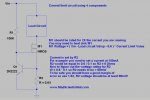
Its a very simple circuit using a mosfet for the pass element, a resistor for current sensor, a transistor and bias resistor to perform the limiting. I'll post a link or schematic.

View attachment 33363

I've just done a quick calculation, three off 2.2 ohm resistors in parallel give me a sense resistor (R2) of around 0.75 ohms
From the example 0.6/0.75 = 0.8A
Power dissipation in the resistor will be 0.8 * 0.75 = 0.6W, significantly less than the LED driver circuits

Any over voltage will be limited by the simple circuit, if the load draws less than 800mA I burn 0.6W in the resistor.
I think that I can live with that.
 
Last edited:
I've just done a quick calculation, three off 2.2 ohm resistors in parallel give me a sense resistor (R2) of around 0.75 ohms
From the example 0.6/0.75 = 0.8A
Power dissipation in the resistor will be 0.8 * 0.75 = 0.6W, significantly less than the LED driver circuits

Any over voltage will be limited by the simple circuit, if the load draws less than 800mA I burn 0.6W in the resistor.
I think that I can live with that.

But if you only run half the LEDs at max volts, the voltage drop will be half and the LEDs will see little benefit. If only one light is one, it will see nearly max volts.
 
But if you only run half the LEDs at max volts, the voltage drop will be half and the LEDs will see little benefit. If only one light is one, it will see nearly max volts.

The LED load will not be changed, extra strings require extra circuits
 
I suspect that the optimistic efficiency figures they quote are for low load currents. Once the transformer gets close to saturation the efficiency will drop like a stone.
 
I suspect that the optimistic efficiency figures they quote are for low load currents. Once the transformer gets close to saturation the efficiency will drop like a stone.

The efficiency didn't improve when driving a single segment of 3 LEDS at 60mA. I think that the figure is optimistic and quoted at nearly max voltage and low current. The driver is rated at 2A and that is optimistic too without additional heat sinking.
 
Top