Strip all gelcoat, or patch?

MapisM

Well-Known Member
Joined
11 Mar 2002
Messages
20,659
Visit site
A boating mate of mine whose boat has been left in the water for several years found the unpleasant surprise below.
What would you do folks, as per question in the title?
And - talking now to those who would suggest to strip all gelcoat - how would you treat the bare fiberglass afterwards?
Apologies in advance for not disclosing any further details on the boat (which does NOT come from a Mickey Mouse builder, anyhow), but the chap involved asked me not to.
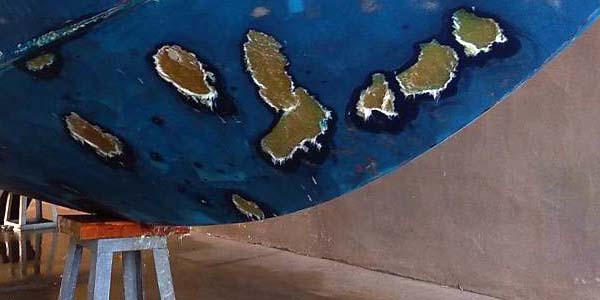
f7PIM2Y0_o.jpg
 
If your photo is showing the whole problem then I would patch, because its going to be anti fouled then it doesn’t need a perfect job.
 
Good point - it isn't the whole problem, unfortunately.
I just picked the possibly worst area, but most hull under the w/line is similarly affected.
 
My as well disclose the manufacturer, can’t see any reason why not .
Any future surveyor given the opportunity to examine will unearth the repairs / condition at the time .
Obviously no need to name the name if that’s the rational behind the cloak and dagger approach?
 
My as well disclose the manufacturer, can’t see any reason why not .
Any future surveyor given the opportunity to examine will unearth the repairs / condition at the time .
Obviously no need to name the name if that’s the rational behind the cloak and dagger approach?
It an Itama - he is just trying to spare you feelings ! ?
 
If the owner plans to do something special like coppercoat then a full gelcoat might be worth it
 
A boating mate of mine whose boat has been left in the water for several years found the unpleasant surprise below.
What would you do folks, as per question in the title?
And - talking now to those who would suggest to strip all gelcoat - how would you treat the bare fiberglass afterwards?
Apologies in advance for not disclosing any further details on the boat (which does NOT come from a Mickey Mouse builder, anyhow), but the chap involved asked me not to.
f7PIM2Y0_o.jpg
What caused that? Is the rest of the hull sound!
 
One of Mapish,s Friends ... with an Itama .Nah :)Aside looks like white gel coat anyhow.
Never say never, PF.
And what's wrong with white gelcoat, anyhow?
That's the hallmark of true connoisseurs - see example below, exactly as she came out of Cantieri Navali di Roma....
nf6tWm1b_o.jpg
 
What caused that?
Well, osmotic pressure from sea water, what else? :rolleyes:

PS: P, in hindsight I'm wondering if you meant what caused those large-ish patches of gelcoat to detach, back to bare grp.
And if so, of course it wasn't the osmosis alone. I mean, the boat was not lifted to reveal what you can see in the pic!
Those areas were "cleaned/exposed" manually, after leaving the boat on the dry for a while and finding that the hull didn't dry out homogeneously.
In fact, the pic was taken while the job was in progress, and shows how the blue a/f is still wet around the patches that were being exposed.
Sorry if I previously misunderstood your question.
 
Last edited:
Ok, I'll throw in my view now.
Epoxy was also my first thought, without re-applying any gelcoat at all.
And then obviously the a/f - either traditional or possibly CC, since the old blue a/f is going to be stripped anyhow.

BUT, and it's a big but, I was thinking to suggest that friend of mine to have ALL the gelcoat stripped, up to the w/line.
In fact, my impression is that it could take not very long before, after putting the boat back in the water, some other gelcoat detachments develop in other areas.
I mean, when I stripped the old a/f on my boat, I did have some blistering marks, mostly along the rails and roughly as large as a thumb nail (some a bit smaller, some a bit larger).
But overall, the gelcoat adhesion to the first GRP layer seemed still very strong.
So, I had the bubbles opened, patched with vinylester resin (just because the hull was originally moulded with it, rather than polyester), and eventually I went straight for CC.

Now, it seems to me that in this hull (in spite of the similar age) the adhesion problem is much more extended, and randomly distributed.
Which leads me to think that patching only the parts now exposed is akin to looking for more somewhere else in the future.
Of course the job takes longer and is more expensive compared to just patching, but hopefully should avoid other similar headaches in the future to the owner.

Wadduthink, folks? TIA!
 
Wadduthink, folks? TIA!

not much it's a gamble innit?
what if there wont be any more pieces that will dislodge and bubble in the future? what if after x years that's all that's the problem?
and then what if, removing all the gel u/w and reapplying whatever all around, you end up with more problems than initially three yrs down the road?

cannot answer really any of these Qs

so good luck to your friend!

V.
 
A boating mate of mine whose boat has been left in the water for several years found the unpleasant surprise below.
What would you do folks, as per question in the title?
And - talking now to those who would suggest to strip all gelcoat - how would you treat the bare fiberglass afterwards?
Apologies in advance for not disclosing any further details on the boat (which does NOT come from a Mickey Mouse builder, anyhow), but the chap involved asked me not to.
f7PIM2Y0_o.jpg
not much it's a gamble innit?
what if there wont be any more pieces that will dislodge and bubble in the future? what if after x years that's all that's the problem?
and then what if, removing all the gel u/w and reapplying whatever all around, you end up with more problems than initially three yrs down the road?

cannot answer really any of these Qs

so good luck to your friend!

V.
Got to figure the cause.

If it going to progress then obviously you need to do the lot.

Also is it just the gelcoat coming off? Looks more than that to me.

if it’s just gelcoat then solvent free epoxy is the solution. Applied wet on tacky. You can thicken it and smooth it with a blade for an 80% job or fill and longboard for a 100% job.
edit and I meant 80% cosmetically still 100% effective.

Final coat of solvented epoxy when still not cured and you don’t have to sand it to apply antifoul.

If it’s more than the gelcoat come off you need to add strength back with some mat under the epoxy.
 
Last edited:
In 2004 I was taking care of a Fairline Phantom and an Azimut and both had a similar problem at the first lift out since first launch.
The gelcoat guy called it gel-coat chipping (at the time), and the patches where much bigger on the Fairline (largest of about 7 sq cm) then on the Azimut (largest about 3 sq cm).
In both cases the dealers gave the blame to the pressure of the power wash from the yard. The interesting part that the yards hauls hundreds of boats and only these had these problems.
Another technical guy later told me that yards where obliged to change resin matrix in 2003 to a new more fire retardant mix and some gelcoat was not bonding as it should.
 
My thought would to be to strip all the a/f and look again at the gelcoat adhesion. I would expect to prefer then to replace all the gelcoat below the waterline for peace of mind.
 
My thought would to be to strip all the a/f and look again at the gelcoat adhesion. I would expect to prefer then to replace all the gelcoat below the waterline for peace of mind.
Good advice re the inspection.
We did do a nearly new catamaran once (when I had my boat business) that had osmosis in a very localised part of one hull. Surveyor recommended a local repair.
(As an aside though the builder asked us to strip the gelcoat from the whole hull and duly paid our bill.)
So it is possible to get a localised fault. But it’s more likely you are right about doing the whole thing too.
 
I would try to get in contact with the manufacturer to ask if the problem is known. They perhaps have a plan to solve the problem. Otherwise more pictures from the hull would be helpful the get an overview how many areas are affected.
 
is it just the gelcoat coming off? Looks more than that to me.
Excellent question.
I had the very same doubt when I received the above pic (and a few others, but none clearer than this one), because I also have yet to see the boat in flesh.
The owner told me that according to the yard it isn't as bad as it looks in the pics, and the GRP is still sound.
But I'm very curious to see the hull in flesh - something I should be able to do within a couple of weeks.
 
Top