
Strange anode usage

slipknot

Well-Known Member
Joined
28 Nov 2003
Messages
548
Location
South Coast
Visit site
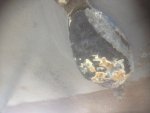
One week earlier this year old anode was in reasonable condition showing usual signs of erosion for its age, and not discoloured at all. Boat was lifted 1 week later and the anode was completely black as you can see in the picture.

It is connected to a Volvo 2030, & P bracket only

Any ideas as to what would make an anode do this?
 

Attachments

  • Keel 058.jpg
    Keel 058.jpg
    90.9 KB · Views: 0
1 week an the anode looks like that! Lucky you got her out of the water when you did!!
Looks like you've got an electrical problem.
Is you boat steel or aluminium?
I would check all my electrical circuits and bonding.
I would also check the shore power connection and just check that some doppy idiot hasn't left a chafed cable fizzing in the water near by!!!
It's also known that people welding on boats nearby quickly eat anodes!
If you're not sure how to check your electrical circuits and bonding get a very good marine engineer! Stray currents can eat through metal quickly!
Andy
 
In a marina, a stray electric current in area- ours has looked like that with a next door boat constantly letting it's shore power lead dangle in the water-
i'm no expert, but was told there is an interaction(induction current??) and some form of galvanic action occurrs, besides the obvious possible damaged insulation safety risk.

i'll stand back and make room for those who really know:o
 
Last edited:
In a marina, a stray electric current in area- ours has looked like that with a next door boat constantly letting it's shore power lead dangle in the water-
i'm no expert, but was told there is an interaction(induction current??) and some form of galvanic action occurrs, besides the obvious possible damaged insulation safety risk.

i'll stand back and make room for those who really know:o

There does not appear to be any excessive corrosion that galvanic action resulting from such behavior might cause.

The question remains though. Why is it black? .. I dont know!
 
Thanks for the replies so far. Boat doesn't sit in mud, it stays afloat. The anode had been on for a year with the boat in regular use and the anode was ok. 1 week later completely different as you see. Any suggestions very gratefully received, but I think I ought to get an electrician to take a look.
 
Sailing in mucky water? A dose of sulphide could have done that as a chemical reaction instead of galvanic corrosion.

So the black colour is due to what exactly?....... It's not zinc sulphide, thats white or light yellow
 
Some people seem to think that zinc turning black can be due to surface etching, or copper deposits on a pitted surface: http://www.madsci.org/posts/archives/2000-03/953740232.Ch.r.html

But it does appear that zinc will turn black in hydrochloric acid, or in copper sulphate solutions. Maybe copper leeching from newly antifouled boats?

Copper will deposit on zinc from copper sulphate solution but it seems unlikely that there would be enough copper in the water for that to happen. If it were the case the anodes of a freshly antifouled boat would rapidly become coated in copper .. ??
 
So the black colour is due to what exactly?....... It's not zinc sulphide, thats white or light yellow

I was simply suggesting that the cause may be chemical and not necessarily galvanic and gave sulphide as a potential cause. Many metal salts are white but are known to form other colours if not in their pure crystalline form or stoichiometry; black zinc oxide is perhaps a more fitting example of this.
 
I was simply suggesting that the cause may be chemical and not necessarily galvanic and gave sulphide as a potential cause. Many metal salts are white but are known to form other colours if not in their pure crystalline form or stoichiometry; black zinc oxide is perhaps a more fitting example of this.

What is black zinc oxide?
 
Are you moored next to one of those French aluminium boats by any chancejf?jdj

No, the very same boats have been moored nearby all the previous year with no effect. This occurred in one week.

I will replace the anode this week and disect the old one to see what it reveals. I doubt that it will tell me anything though.

Any other checks or suggestions would be appreciated as right now a new anode is going on without finding a fault or carrying out a fix.
Ian
 
Still not solved this mystery. Can anyone recommend a good marine electrician in the Southampton/Solent area that would check out the electrics?
Thanks
 
Still not solved this mystery. Can anyone recommend a good marine electrician in the Southampton/Solent area that would check out the electrics?
Thanks
The anode turned black but unless there was also an appreciable sudden loss of zinc is there really a problem for an electrician to find an answer to.

I'd think to solve the mystery the first thing to do would be to get the black material identified.

I dont think the location of the boat has been discussed. Any chance of any local polluting discharge? Of what though id not like to guess.
 
When you fit the new anode leave the shore power disconnected for a week, then check it. Then do the same with the shorepower connected. If it only happens when connected to 220V, then fit an isolation transformer - this will isolate you from any pontoon outlets problems and nearby boat electrics faults entirely. If it continues to happen, then you have a fault onboard your own boat. D
 
The anode turned black but unless there was also an appreciable sudden loss of zinc is there really a problem for an electrician to find an answer to.

I'd think to solve the mystery the first thing to do would be to get the black material identified.

I dont think the location of the boat has been discussed. Any chance of any local polluting discharge? Of what though id not like to guess.

I think that may well be the answer. We know from the other corrosion problem, graphitic corrosion, shown on my website, that the water chemistry is somewhat unusual. Maybe nitrate run-off, sewage, industrial, something else?
 
The trouble with this theory is that the boat is in a marina with many other boats nearby who have not had the same problem. I have even spoken to the previous occupier of my current berth who had not had any problem in the 6 years he was there with a very similar boat. There are also several other marinas very close by where if local conditions were the reason, many other boats would have the same symptoms.
My boat has been kept within 50 mtrs of its present location since it was launched in 1998. You would think that if local conditions were the cause it would have happened before.
The anode anode went like this in one week and not in the previous 15 years.
 
What about the copper coat or has there been a copper coating/sheathing near by? The only reason I mention this is that I found copper pipes black (in salty conditions) with a furry black deposit, so after a bit of google work I found there is a reaction between copper and zinc that produces a blackness on the zinc: http://chemed.chem.purdue.edu/demos/demosheets/9.11.html I cant comment if this link demonstrates a feasible mechanism, I have very little understanding of chemistry, perhaps this will help direct the investigation.
 
Top