Stitching an internal corner on a canvas awning

superheat6k

Well-Known Member
Joined
10 Jan 2012
Messages
6,798
Location
South Coast
Visit site
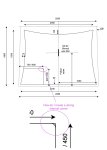
I have now mostly finished the design of my awning, and thanks to you guys I now know how to make a felled seam.

The gaps at the edges and corners are to allow for the hooks which will attach to elastic rope passing around the edges. The anchor points are already created on the boat.

I have to create and opening in one corner to allow access to the flybridge ladder. This creates an internal corner, that I would prefer to radius, to reduce the stress raiser at the internal corner this creates.

I have searched You Tube for ideas on how to do this, but all I can find are techniques for an internal corner on upholstery.

Thanks.

p !Sun awning.jpg
 
I have now mostly finished the design of my awning, and thanks to you guys I now know how to make a felled seam.

The gaps at the edges and corners are to allow for the hooks which will attach to elastic rope passing around the edges. The anchor points are already created on the boat.

I have to create and opening in one corner to allow access to the flybridge ladder. This creates an internal corner, that I would prefer to radius, to reduce the stress raiser at the internal corner this creates.

I have searched You Tube for ideas on how to do this, but all I can find are techniques for an internal corner on upholstery.

Thanks.

p !View attachment 150628
How are you fixing the awning in place? How you do the corners will have some bearing on how you secure the awning. We use strong webbing at corners on our sun awning that goes over the boom. Far better than brass eyelets that tend to pull out. We sew webbing into the awning where the load points are and add reinforcement layers of fabric where necessary
.
 
How are you fixing the awning in place? How you do the corners will have some bearing on how you secure the awning. We use strong webbing at corners on our sun awning that goes over the boom. Far better than brass eyelets that tend to pull out. We sew webbing into the awning where the load points are and add reinforcement layers of fabric where necessary
.
I have chosen a lighter material than heavy canvas as this will only be used periodically. The edge will have an 8mm elastic rope band within the seam, and this will hook onto four support points for which I have allowed ~ 50mm on the base edge and corners and 100mm on the open edges and corners.

I have found a tutorial on the Sailrite website. They suggest 8% chord distance, so I will adjust for this.

I will also place double reinforcing pads of the same material at each corner, protruding back ~250 mm from each corner.

Where the cut out sits I will lock the corners to the edge band, and I might use rope instead for this section.
 
Is the corner Rt Angle, 45° or Arc?
Webbing is the strongest, it doesn't need a raw edge folding in and it's easier to fold or bend around an arc.
The corner will be 90 degree but I will reinforce it. I think a sandwich of 2 square reinforcing pieces folded diagonally and sat across the corner at 45 degrees, with the outer slightly larger to accommodate a hem.

I might add some webbing also at the corners.
 
I have now mostly finished the design of my awning, and thanks to you guys I now know how to make a felled seam.

The gaps at the edges and corners are to allow for the hooks which will attach to elastic rope passing around the edges. The anchor points are already created on the boat.

I have to create and opening in one corner to allow access to the flybridge ladder. This creates an internal corner, that I would prefer to radius, to reduce the stress raiser at the internal corner this creates.

I have searched You Tube for ideas on how to do this, but all I can find are techniques for an internal corner on upholstery.

Thanks.

p !View attachment 150628
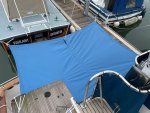
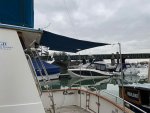
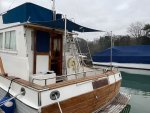
I made my new cockpit sun awning today using a soft, but waterproof denim style fabric from Point North. This is considerably lighter than the more normal canvas, and for a sun awning I thought ideal.

I used a heavy webbing material along the two edges of the ladder access opening.

For the central seam I found a method called a French Seam where the two pieces are joined with a simple stitch row about 1/2" from the edge with the pieces laid one on the other with the upper faces together. The overlaps are then flared and a separate pieces of cloth, suitable hemmed is stitched laying along and covering the flared edges. This allowed me to then open up the slit for the backstay which I reinforced the edges also with the heavy webbing.

Again I used the heavy webbing to provide anchor points in the corners, which I reinforced with fabric offcuts.

It was a reasonable fit first try, just need to refine the attachment points and adjust the position, for which I am using 8mm elastic rope.

IMG_0716.jpegIMG_0720.jpegIMG_0721.jpeg
 
Top