
Stern seal earthing strap broke.......?

Tormod

New Member
Joined
21 Feb 2012
Messages
20
Location
Boat- relocated to Lagos Marina
Visit site
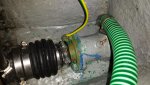
I was cleaning the verdigris / patina (googled it) off the stern seal/shaft and, typically, I just happened to break the crimp connection of the earth cable to the shaft which is secured to one of the two securing bolts. See attached.
I would appreciate some advise / guidance from those more technically minded. I believe it needs to be reconnected to ensure the continuity of the bonding but I am very wary of slackening the retaining bolt as I fear it may break the seal and allow water ingress, albeit, drips. Do you think it would seal back again or am I making a mountain out of .........?
(The green hose is the manual bilge pump suction!)

Thanks
Tormod
 

Attachments

  • 20150330_161022.jpg
    20150330_161022.jpg
    99.1 KB · Views: 1
Should be safe undoing just one bolt. However, that wire is not doing anything for your shaft or prop, only the stern tube and probably not really necessary. You need to bond the shaft with a wire to the gearbox and a bridging wire across the coupling unless it is solid.
 
If you do not want to disturb the bolt with the boat afloat then simply clamp the wire under a large jubilee clip wrapped around the stern tube brass end.
 
It is just a flexi hose (not fixed) with a metal bell-mouth to ensure it remains open to suction. I guess one jubilee will suffice! Sorry, just to clarify again....it's the suction hose for the manual bilge pump.
 
Last edited:
Thanks for the confirmation on the bolt and indeed the question whether it serves any purpose as it is. Will need to trace the wire to see if it is run back to the gearbox to ensure some continuity. Cheers.

The wire is likely to go back to the anode. There should be a separate wire going to the shaft from the anode. The shaft and the tube are not connected.
 
Slight thread drift - sorry - but does the gathered expertise recommend that the stern tube always be bonded to an anode? Is it normal that it be so?
 
Slight thread drift - sorry - but does the gathered expertise recommend that the stern tube always be bonded to an anode? Is it normal that it be so?

No. Dates from times past when corrosion first became an issue and there was a tendency to connect anything metal to an anode. No reason to have it in a metal tube in GRP as there are no dissimilar metals.
 
Shaft and tube could be connected if white metal bearings? Not with cutless

That is a possibility, and indeed my boat originally had a white metal inner bearing and was wired to the anode, but not clear what the potential difference is between the white metal alloy and the bronze housing. Moot point for me now as the white metal replaced by a cutless and the stuffing box by a Volvo seal. Hooray! no more greasy water drips.
 
In the likely absence of a galvanic couple, the only problem the stern tube is going to suffer is dezincification, assuming it to be a manganese bronze or brass. Many of these were made in bronze but yours appears to be too yellow to be that particular alloy. Unfortunately an anode does not provide particularly good protection against dezincification, so fitting one is barely worth the trouble.
 
>the gathered expertise recommend that the stern tube always be bonded to an anode? Is it normal that it be so?

I don't know it makes difference but we had a steel boat and there was no earth wire. We also sailed a whole range of different size charter boats including, Benneteau, Jeanneau, and American built boats and never saw an earth wire on the stern tube.
 
>the gathered expertise recommend that the stern tube always be bonded to an anode? Is it normal that it be so?

I don't know it makes difference but we had a steel boat and there was no earth wire. We also sailed a whole range of different size charter boats including, Benneteau, Jeanneau, and American built boats and never saw an earth wire on the stern tube.

First it is not an earth wire. It connects item where there is potential for galvanic corrosion to a zinc anode so that the zinc is sacrificial. Second, hardly surprising that the boats you cite did not have such a connection as the stern tubes would have been GRP or in some cases stainless steel, so not prone to galvanic corrosion.
 
Top