Steelboats

Status
Not open for further replies.
No I am definitely not .Others have repeatedly attacked me, for trying to pass on the benefit of over 4 decades of steel boat experience.

Yes, you do engage in name-calling. "Plastic" boats. "Toy" boats. "Marina queens".

No-one doubts or disputes that steel has some advantages over GRP. The problem with these threads is that you refuse to recognise that GRP has some advantages over steel.

For long-term, long distance cruising, both are appropriate hull materials. As proven by the fact that thousands of people do exactly that, in both steel and GRP boats. There is an argument that GRP is the more suitable material, on the basis that there are far more people using that material than steel.

What is the right material for each person / couple / family? That will depend on their preferences and priorities. For people like you who seem to end up on the rocks more often than others, perhaps steel is best. But there is no one material that is "best".

Everyone on this thread accepts that. Except you. That is what you are wrong about.
 
Brent

Do I read this correctly, that you weld zinc primed steel ?

Wjat's the difference between 'wheelabraded' blasting and pressurised air blasting ?
 
Brent

Do I read this correctly, that you weld zinc primed steel ?

Wjat's the difference between 'wheelabraded' blasting and pressurised air blasting ?

wheelabratorctdiagram-promo_0.jpg


a wheelabrator used wheels to fling the grit/shot at the steel as it passes through the machine.

The pic above if for a component wheelabrator one for sheet steel will have a roller conveyor that the sheet travels over and under the wheels throwing the grit at the surface of the steel.

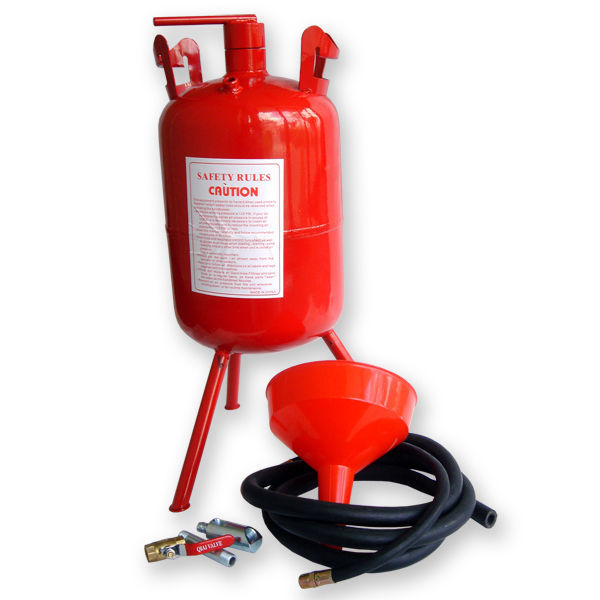
This is a small pot grit blaster.

s-l640.jpg


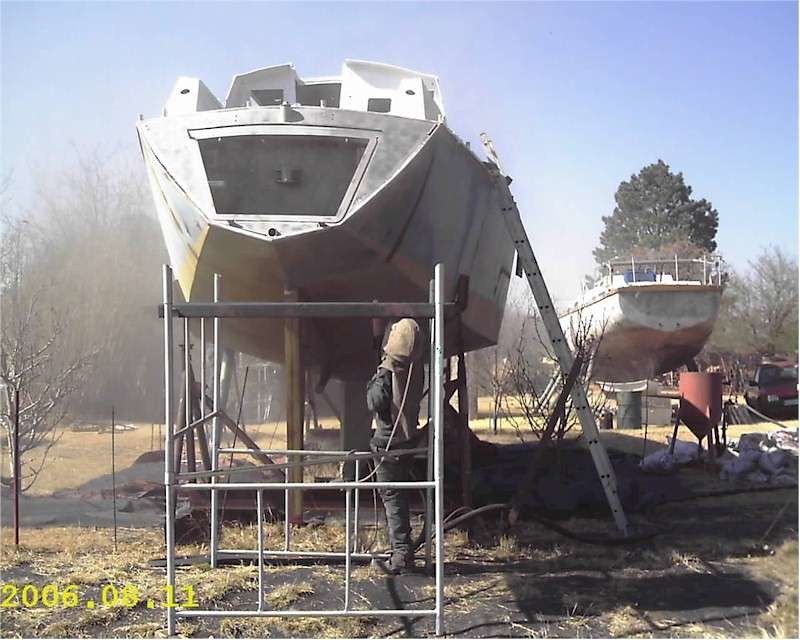
The pot that was used on mine was a lot bigger and the compressor came on a trailer and was diesel engine driven as used by road repair crews.


You can see the red pot used buy my other boat

36046320826_7c8f8aa74e_b.jpg
 
Last edited by a moderator:
What do you mean by " get good paint". Did you mean " get good PAINTERS"?
Surely the same paint is available all over the world. Or is that a fallacy

Usually but not always, Brasil for example wasn't easy, even if it exists it can be hard to track down. Massive import tax so only local available plus getting stuff delivered is such a lottery, might turn up at some point in some obscure office , like Gandi said of democracy - sounds like a good idea :)

Didn't get the paint I wanted in Brasil but seems to be holding up just fine. :cool:
 
The joys of steel, a rare easy job yesterday - chop all the links of a foot of stainless chain in half and weld them on to the deck. A load of really strong eyes, 6 round the mast base (never did trust that eye in the ali mast foot for the kicker) and one each corner of main hatch should that ever cause concern mid ocean. When the bolted stanchion bases get swapped for welded bases each one will have a half chain link welded on as well , can't have too many tie down points on a cruising boat :cool: Cost - next to nothing, time is free :)
Finally no more little leaks round the mast/hatch as there are no holes at all, apart from gooseneck for cables. Load of epoxy paint and that can be forgotten about for at least a decade, probably a lot longer as other areas done years ago in the tropics are still as good as the day after they were done. No more sealant required ever hopefully soon.

Blocks shackled to those loops will chafe the paint under them. I prefer to weld them down on stainless pads, but putting a cover of stainless welds under them, and grinding the welds smooth, helps a lot.
I prefer to weld in flush stainless half inch acorn nuts. That gives you a threaded, stainless lined, flush with the deck hole, you can screw padeyes into , leaving nothing to stub your toes on elsewhere on the deck. A big rubber pad around them prevents the blocks from chipping the deck paint. Hypalon sundeck coating also helps.
Welding stainless track onto a steel deck is a maintenance time bomb, a big mistake.
 
I just read the December 2018 issue of Sail magazine. On page 20 Nigel Calder talks about hitting a bar and causing skeg damage. He also mentions a sister ship sinking in mid ocean from similar skeg damage.
I have read of several plastic boats sinking in mid ocean, from the same problem.

On page 68 is the mention of one charter fleet in the west Indies losing 50 boats to hurricanes,and hundreds lost in other charter fleets, all in a single season.

Kinda blows the theory that very experienced cruisers in plastic boats never hit things, or screw up! Kinda blows the theory that plastic boats are never wrecked, and don't have to be tough, because, being plastic, their skippers never screw up.
 
Last edited:
wheelabratorctdiagram-promo_0.jpg


a wheelabrator used wheels to fling the grit/shot at the steel as it passes through the machine.

The pic above if for a component wheelabrator one for sheet steel will have a roller conveyor that the sheet travels over and under the wheels throwing the grit at the surface of the steel.

This is a small pot grit blaster.

s-l640.jpg


The pot that was used on mine was a lot bigger and the compressor came on a trailer and was diesel engine driven as used by road repair crews.


You can see the red pot used buy my other boat

36046320826_7c8f8aa74e_b.jpg

So nice to have mostly avoided this job, by getting my steel wheelabraded and primed at the source. Much cleaner to work with, too. Cheaper than having to do it after fabrication.
For unloading big sheets , remaining wheelabrader shot acts as ball bearings between big sheets of steel. I just tie them to a tree, and drive the truck out from under them.
 
Brent

Do I read this correctly, that you weld zinc primed steel ?

Wjat's the difference between 'wheelabraded' blasting and pressurised air blasting ?

Yes have done for years . The zinc they use is compensation board approved. Thin, so an extra coat on after fabrication is a good idea, especially if you are going to take awhile, and are working outside.
 
Yes, you do engage in name-calling. "Plastic" boats. "Toy" boats. "Marina queens".

No-one doubts or disputes that steel has some advantages over GRP. The problem with these threads is that you refuse to recognise that GRP has some advantages over steel.

For long-term, long distance cruising, both are appropriate hull materials. As proven by the fact that thousands of people do exactly that, in both steel and GRP boats. There is an argument that GRP is the more suitable material, on the basis that there are far more people using that material than steel.

What is the right material for each person / couple / family? That will depend on their preferences and priorities. For people like you who seem to end up on the rocks more often than others, perhaps steel is best. But there is no one material that is "best".

Everyone on this thread accepts that. Except you. That is what you are wrong about.

Your suggestion is that plastic is as tough as steel and as likely to survive a foggy midnight, mid ocean collision with a container, a ship , log, etc, as a steel boat. What a crock! Steel is far safer, as the Gringo incident, and others like it, clearly prove, beyond all reasonable doubt.
Believing that being in a plastic hull, eliminates the chance of you hitting something not visible in the night, is incredibly naive.
 
wheelabratorctdiagram-promo_0.jpg


a wheelabrator used wheels to fling the grit/shot at the steel as it passes through the machine.

The pic above if for a component wheelabrator one for sheet steel will have a roller conveyor that the sheet travels over and under the wheels throwing the grit at the surface of the steel.

This is a small pot grit blaster.

s-l640.jpg


The pot that was used on mine was a lot bigger and the compressor came on a trailer and was diesel engine driven as used by road repair crews.


You can see the red pot used buy my other boat

36046320826_7c8f8aa74e_b.jpg

One shop I worked in had the spray nozzles for the primer ,positioned above the rolls, so it would be painted as soon as it left the wheelabrader.
 
I just read the December 2018 issue of Sail magazine. On page 20 Nigel Calder talks about hitting a bar and causing skeg damage. He also mentions a sister ship sinking in mid ocean from similar skeg damage.
I have read of several plastic boats sinking in mid ocean, from the same problem.

On page 68 is the mention of one charter fleet in the west Indies losing 50 boats to hurricanes,and hundreds lost in other charter fleets, all in a single season.

Kinda blows the theory that very experienced cruisers in plastic boats never hit things, or screw up! Kinda blows the theory that plastic boats are never wrecked, and don't have to be tough, because, being plastic, their skippers never screw up.

I happen to have met Nigel Calder. I've also heard him lecture on the subject of Blue Water Sailing. He is very experienced and is a big fan of skegs for rudders.

What is interesting to me is all his boats have been GRP. Even the ones he had built to his spec from scratch.

Yet you quote him as an authority. Any comments?
 
Yes, its truly amazing how, when a boat proves dangerously inadequate ,people still cling to them, assuming that in any contact, breakage is inevitable, and unavoidable, rather than thinking of what could have been made strong enough to prevent it.
It's like having something break , and rather than make it stronger , replacing it with something identical to what proved inadequate in the first place.
A very common syndrome,.
 
I just read the December 2018 issue of Sail magazine. On page 20 Nigel Calder talks about hitting a bar and causing skeg damage. He also mentions a sister ship sinking in mid ocean from similar skeg damage.
I have read of several plastic boats sinking in mid ocean, from the same problem.

On page 68 is the mention of one charter fleet in the west Indies losing 50 boats to hurricanes,and hundreds lost in other charter fleets, all in a single season.

Kinda blows the theory that very experienced cruisers in plastic boats never hit things, or screw up! Kinda blows the theory that plastic boats are never wrecked, and don't have to be tough, because, being plastic, their skippers never screw up.

Once again you are being highly selective with your "statistics".

Please give PRECISE details of the "several" boats lost through skeg failures.

Are you so detached from the rest of the world that you are not aware of the hurricanes in the Caribbean in 2017 which destroyed complete island communities and inevitably many hundreds of boats, some of which no doubt were built of steel. Equally inevitably the majority of the boats destroyed would be GRP for the simple reason that the majority are built of GRP.

When are you going to learn that people here are not taken in by your unsubstantiated claims which only show how ignorant you are about the subject.
 
Just read the article, then email Sail ,saying they must be lying, as you "know" plastic boats "never" break. Tell Calder that ,while you are at it.
 
Last edited:
I have just re-read loads of posts on this thread, and related ones.

Not one, from many contributors, has ever said GRP never broke.

Brent-what part of " I agree that steel is a stronger material to build long term liveaboard in out of the way places " are you incapable of understanding.

Most sailors don't live aboard in out of the way places and regularly cross oceans.

For their purposes, steel boats may not be suitable, unless they have one built by you-which you don't do-they are unlikely to find one well sorted and low maintenance like your one obviously is.

Most sailors have a wife or partner. A simple strong boat like your would mean many, many wives or partners would not go sailing. They like a bit of luxury, like hot showers, microwaves, walk round beds, comfortable salon seating and table and room to entertain.

I don't expect your strong, simple, Pacific crossing , reef bashing, lee shore surviving boat would do for them.

So, your potential players are of a certain type, who, like you, wish for a simple, strong boat that can survive potential disasters.

They, compared to mainstream sailors, are small in number. As are steel boats, compared to GRP, timber, glassed timber and Aluminium.

Nigel Calder chooses GRP, Tom Cunliffe chose GRP after he sold his timber Pilot Cutter. The world girdling solo lady sailor Jean Socrates-on her third time round-chose another GRP Naiad. This after ending up on a Brazilian beach when her autohelm failed. The hull was not breached, but the Insurance paid out and she got another one.

Very small numbers of sailors choose steel when getting a new boat, or even a used boat.

I cant help wondering where we are all going wrong by choosing such an inferior material. Especially as very few world girdling GRP boats suffer catastrophic hull failure. If they did, we would know about it. They are not perfect, very little IS perfect, but most give good service and are suitable for the job. And they don't corrode.

I have had four GRP boats, a very well built British Hunter 27 OOD-a steep learning curve for a new sailor as it was a bit lively, a GibSea 96, built in France by Gilbert Marine, also very satisfactory and well built. Then came a senior moment and we spent a great deal of money on a very strong and well built Island Packet 350. Six fantastic years later we changed to another Island Packet, the Motorsailer model, the SP Cruiser.

None have ever had any problems with hull integrity or keels dropping off, or osmosis, or balsa cores-none had such a thing.

However, the corten steel Hartley 32 I am currently working on in Wellington Is keeping me very busy dealing with what was obvious bad practice during build. The rusty window apertures are Donald Ducked. My tame welder/metalworker is away from site and despite promising, he is unable to cut out the rust and weld in new metal until he returns.

Trouble is, the yard needs the space, so I must fake it up and have it done properly next year when I return to Wellington.

It is noticeable though, this steel boat takes far, far more time to keep nice-all my boats have been nice-than any of the others.

Would I recommend a steel boat to a prospective owner?-only if they were planning long term liveaboard in far flung places.

Anything else, keep clear of old steel boats. They are trouble-from direct and current-experience.
 
Blocks shackled to those loops will chafe the paint under them. I prefer to weld them down on stainless pads, but putting a cover of stainless welds under them, and grinding the welds smooth, helps a lot.
I.
Some stainless weld underneath - another excellent tip ta, though steel shackles uses onboard these days are very few - soft shackles all round so hopefully will be ok.
Not many blocks either , more and more low friction rings and dyneema. A simpler boat with less moving parts as time goes by with some high tech materials :cool:
 
I have just re-read loads of posts on this thread, and related ones.

Not one, from many contributors, has ever said GRP never broke.

Brent-what part of " I agree that steel is a stronger material to build long term liveaboard in out of the way places " are you incapable of understanding.

Most sailors don't live aboard in out of the way places and regularly cross oceans.

For their purposes, steel boats may not be suitable, unless they have one built by you-which you don't do-they are unlikely to find one well sorted and low maintenance like your one obviously is.

Most sailors have a wife or partner. A simple strong boat like your would mean many, many wives or partners would not go sailing. They like a bit of luxury, like hot showers, microwaves, walk round beds, comfortable salon seating and table and room to entertain.

I don't expect your strong, simple, Pacific crossing , reef bashing, lee shore surviving boat would do for them.

So, your potential players are of a certain type, who, like you, wish for a simple, strong boat that can survive potential disasters.

They, compared to mainstream sailors, are small in number. As are steel boats, compared to GRP, timber, glassed timber and Aluminium.

Nigel Calder chooses GRP, Tom Cunliffe chose GRP after he sold his timber Pilot Cutter. The world girdling solo lady sailor Jean Socrates-on her third time round-chose another GRP Naiad. This after ending up on a Brazilian beach when her autohelm failed. The hull was not breached, but the Insurance paid out and she got another one.

Very small numbers of sailors choose steel when getting a new boat, or even a used boat.

I cant help wondering where we are all going wrong by choosing such an inferior material. Especially as very few world girdling GRP boats suffer catastrophic hull failure. If they did, we would know about it. They are not perfect, very little IS perfect, but most give good service and are suitable for the job. And they don't corrode.

I have had four GRP boats, a very well built British Hunter 27 OOD-a steep learning curve for a new sailor as it was a bit lively, a GibSea 96, built in France by Gilbert Marine, also very satisfactory and well built. Then came a senior moment and we spent a great deal of money on a very strong and well built Island Packet 350. Six fantastic years later we changed to another Island Packet, the Motorsailer model, the SP Cruiser.

None have ever had any problems with hull integrity or keels dropping off, or osmosis, or balsa cores-none had such a thing.

However, the corten steel Hartley 32 I am currently working on in Wellington Is keeping me very busy dealing with what was obvious bad practice during build. The rusty window apertures are Donald Ducked. My tame welder/metalworker is away from site and despite promising, he is unable to cut out the rust and weld in new metal until he returns.

Trouble is, the yard needs the space, so I must fake it up and have it done properly next year when I return to Wellington.

It is noticeable though, this steel boat takes far, far more time to keep nice-all my boats have been nice-than any of the others.

Would I recommend a steel boat to a prospective owner?-only if they were planning long term liveaboard in far flung places.

Anything else, keep clear of old steel boats. They are trouble-from direct and current-experience.

Agreed .
You can do the window work while in the water. You don't need to be in a yard for that. My current boat was launched as a bare shell, the rest of the detail was done after launching. ( in ten days)

Maybe a strip of stainless under the window, to direct condensation above the spray foam, rather than under it, would help. Steve on Silas Crosby wisely had that area flame sprayed. Extra thick epoxy down there , is also a good idea, as is learning to do your own welding and fabricating.

Yes there are some well built plastic boats ( older "unstylish "boats who's keels never fell off) but they are rare.
For couples with wiser wives, who value safety over pretentiousness, I am meeting far more lately , who's wives insist on steel. So much for your theory that all women are dense and pretentious ,when it comes to cruising priorities! Many are far wiser than their husbands. (Who make unfounded, baseless assumptions on what their wives really want ,or how wise they really are, given the relevant info .
)
Jean Socrate's boat is a metal , aluminium. She would have had a lot more problems had it been plastic.

Sail magazine had a series of articles recently about a guy doing a single handed, high latitude, Southern Ocean circumnavigation in a Bob Perry designed, stock plastic boat. It took him 3 Perry designed goose necks to get around the Horn. The first broke before he got to Mexico. He was soaking wet and pumping for his life the whole way, a huge contrast to Moitessier's trips in the same area.

Compare Web Chiles book "Storm passage" , a similar experience, to that of Moitessier, in "The Long Way" and "Cape Horn the Logical Route" .

Why did he choose plastic ?
A NAZI ear criminal was famously quoted as saying"If you repeat a lie often enough, it becomes generally accepted as fact. " Chiles , the Sleavin family, the guy in the Perry design, and m,any more heard the lie "Steel bad,plastic good " so often that they bought it, and had far more miserable and dangerous trips than they ever would have in good steel boat , as Bernard proved, over and over. Ditto many cruisers. Such continual repeating of lies works, or they wouldn't spend $billions doing it.
Another reason is, steel boat builders cling tenaciously to 1950's building methods, which needlessly puts the price of a new steel boat far beyond what it should be, and out of reach of many.

The guy I sold my last boat to, ex navy, said he always wanted a steel boat but some of the prices he saw made him believe he would never afford one in his lifetime.

Yes, plastic is better, for marina queens and occasional short term cruising, as I have said all along. ( Which you refuse to read). My boats are for a small part of the market, those who prefer toughness over pretentiousness, who prefer the self reliance and knowledge which comes from building your own boat, and for whom cruising is a full time, way of life, a use for which they are far superior to plastic. Yes, it is a small part of the market , but big enough to keep me as busy as I ever wanted to be, enough to have had to train others to do my job.The rest of the market? Who cares?
 
Last edited:
I have seen several boats ,Van De Stadt ,and some French boats which use only the sharp end of the hull plate, extended up, to serve as a toe rail .I have been hired to put a solid SS rod ,or SS pipe on it ,to protect it from paint chipping and protect the feet .If a big enough pipe is used, you can weld your stanchions to it , eliminating toe busters. A sheet bock clamp can make it into a track for your jib sheet.
I have timed myself welding the outside of this rail, on a 36 .3 hours for the entire outside weld, 6 hours for both sides. With cutting and fitting, a day and a half should do it ,well worth doing.
A hose running water along the deck, should keep anything below the weld cool, avoiding burning anything there.
 
Last edited:
Where did you get ‘proves dangerously inadequate’ from?

Is there some sort of proof that we don’t know about or do you mean ‘in my opinion’?

Dangerously inadequate for the kid who lost his boat in a collision with a whale at night, for those who convinced Tom Cunliffe to state that the fig leaf rudder has the highest failure rate of any rudder design , for the Sleavin family , for the hundreds lost in the west indies in a single year last year, dangerously fragile enough for the Cal 48 I mentioned, losing his rudder in sheltered water in a flat sea, those lost in the 79 fastnet race, Pandemonium which lost its keel in mid Pacific, those lost in Cabo in 82, and many many more.
 
Last edited:
Status
Not open for further replies.
Top