Steel yacht dry dock maintenance - newbie needing advice!

Hi, another van de stadt steel boat owner here- forgive me if I'm teaching you to suck eggs, but have you checked with the yard where you're hauling out that you can grit blast and work on steel- not all yards permit it; the neighbouring boats can get very sniffy about rust particle marks all over their shiny gel coats.....
 
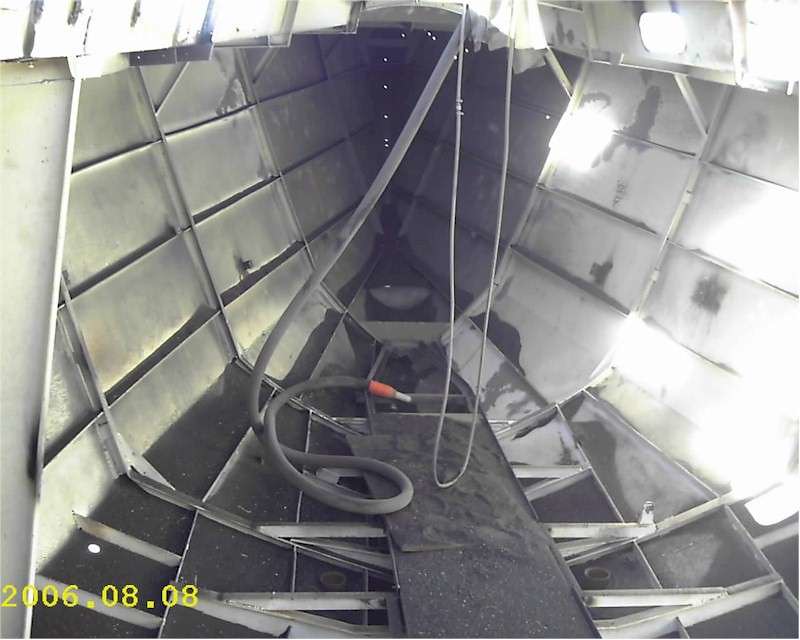
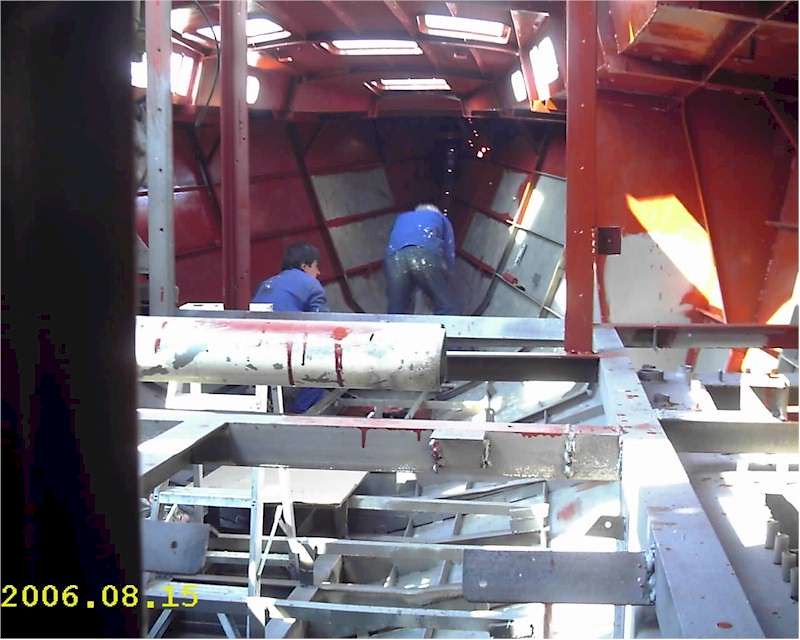
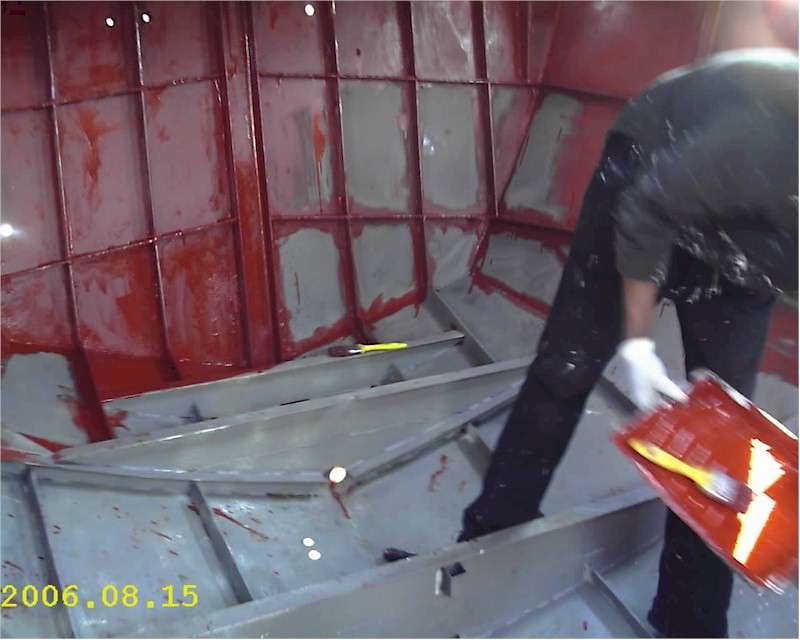
As said have the shot blasting done on a low humudity day otherwsie you risk flash rusting. To stop the hull rusting apply two coats of zinc rich epoxy. Measuring the thicknsss of the hull is a good idea it shows up areas of rust if there are any. If there are any they need to be cut out steel welded in the hole and painted with the epxoy and topcoat.

Zinc is great above the waterline ,not so good below the waterline. It corrodes behind the paint ,letting your epoxy fall off . Best put straight epoxy on blasted steel, below the waterline.
The only reliable way to get antifouling to stick to epoxy, is put the first coat of antifouling on the last coat of epoxy, while the epoxy is still wet.
On zinc, I like to put a bit of stainless welding around the bolt hole, so the stainless bolts will contact the stainless weld, eliminating the chance of rust stopping the electrical contact. A tack on one corner of the mild steel strap is the best solution.
 
I would suggest you ask the manufacturers of the epoxy you intend coating with for recommendations. They will specify the blasting profile, preparation procedure, and sensitivity for flash rusting. Some commercial epoxy products go on after wet blasting (traditional sandblasting/grit blasting of commercial ships are not done any more, I hear) and the first coat goes on in an hour, even though the steel is still damp/wet. If you are going to work in a major port you might well find that some shipbuilders may have a few hundred liters of expensive coating left over from the last oil tanker they did. Coatings differ. I coated two days after blasting, but that was on the Highveld, and in dry winter conditions, so not comparable at all. Good luck!
 
A pedantic correction. You will have a grit blast. not a shot blast.
If the coating scheme is in good condition why are you blasting at all? Did the surveyor check it extensively or just superficially?
You say 3.75mm from 4mm originally. How sure are you of that?
I would get the boat out of the water before making any serious decisions. Buy a decent second hand coating thickness gauge from e-bay (Elcometer 345) and get someone to do an extensive steel thickness survey if you are not sure. If the steel is OK and the coating is OK why accelerate problems by blasting?
If you do blast ignore all the scaremongering about getting a coat of anticorrosive on so quickly. All modern epoxy primers are compatible with flash rusting. First make sure the blasting is done properly, and you cannot do that while worrying about flash rusting. You should aim for a blast standard of Sa2.5 Many blasters will claim that while having no idea what it is. Buy or borrow a visual standard!
When flash rusting occurs, as it will, if it is black you have a salt contamintation problem and need to remove before proceeding. If the flash rusting is ginger don't worry about it. Just b
rush off any loose powdery stuff before coating.
When the surface is clean and dry put on a good surface tolerant epoxy. With a clean surface it is better than a zinc rich material which is for when you can't get your steel properly clean.
Be under no illusions. A clean and salt and dust free surface is far more important than getting your primer on quickly. The idea of priming within a few minutes of blasting is wholly unrealistic!
Make sure your first anticorrosive coat is applied properly. Full coverage is most important. After that you can relax and build a good film thickness of barrier coats before your finish or antifouling

+1 from a steel yacht owner. Had mine glass bead blasted (wet so no salt contamination?) 4years ago but not back to bare metal where the original epoxy was still sound. The surface finish was like 80grade wet& dry, more so on the remaining expoxied areas.

I used Epoxy mastic coating from Rustbusters and also some Jotun epoxy. Some areas had ginger patches, none were black and I've had no issues with it so far.

Due to the high build nature of the epoxy, I applied only 3 thick coats, was 'high' on the fumes despite doing it in the open air (I recommend a suitable mask) , and had to get it done before the unusually warm dry weather (for Argyll) broke.

The blasting exposed to paper thin areas of the hull, to the extent that the blasting penetrated right through. I saw this as a good 'side effect' because, due to the difficult and time consuming dismantling needed to get to the affect areas, any knock from a floating log or the like, would have resulted in the boat sinking before the leak could have been stemmed.

The areas are where water had been collecting for 30+ years, namely under the head and below the chain locker. None had collected under the galley sink or around the seacocks thankfully so only those two areas needed repair.

So, to the op. if the blasting does expose any nasties, its probably a good thing, but the internal dismantling is almost more of a job than the repair, as it needs to be done so it can be put back 'invisibly'.
 

Attachments

  • hull.jpg
    hull.jpg
    94.5 KB · Views: 0
  • HOLE1.jpg
    HOLE1.jpg
    84.5 KB · Views: 0
  • HOLE2.jpg
    HOLE2.jpg
    52.3 KB · Views: 0
Last edited:
Replace any doubtful thru hulls with welded in sch 40 stainless pipe nipples.
Avoid any kind of acid based etc primer.
Tried an etch primer. Flash rusted instantly, so couldn't follow the directions to let it dry overnight. A friend tried it, following the manufacturers directions , and his paint fell off in sheets. So he blasted again, and epoxied the blasted surface ,ignoring the manufacturers directions ( International paints) ,and had no further problems.
I had major problems with International's directions on my first boat. Just did not work. Major blistering.
 
Try not to touch the blasted surface with fingers, you will leave prints all over the surface. Skin exudes compounds that will corrode newly prepared steel quite quickly.
 
Replace any doubtful thru hulls with welded in sch 40 stainless pipe nipples.
Avoid any kind of acid based etc primer.
Tried an etch primer. Flash rusted instantly, so couldn't follow the directions to let it dry overnight. A friend tried it, following the manufacturers directions , and his paint fell off in sheets. So he blasted again, and epoxied the blasted surface ,ignoring the manufacturers directions ( International paints) ,and had no further problems.
I had major problems with International's directions on my first boat. Just did not work. Major blistering.


This, Brent, is your usual scattergun approach to giving information. Almost complete lack of key details such as type of steel you etched, make of the etch, rel humidity, standard of surface preparation, type of blast medium used, and of course, your "friend" who had all the problems.

And let alone blaming one of the world's largest and most researched paint manufacturers for something you did on your first boat - how many years ago ?

And BTW, an easy question, what magic wire or rods do you use to weld stainless to ordinary steel, please ?
 
Replace any doubtful thru hulls with welded in sch 40 stainless pipe nipples.

Not good advice. Chromium carbides will form in the weld pool, reducing the chromium content of the stainless and rendering it susceptible to severe corrosion. Known as sensitisation, a common failure mode. Would not matter if it could be painted but inside a tube is not possible.
 
As said make sure there is no humidity otherwise you risk flash rusting, so sunny day in summer only. The paint should be two coats of Zinc rich epoxy that will stop any rust applied immediately after the blasting.
 
Welding 316 stainless to mild steel

316L (including ER316LSi) filler metal should be used with 316L and 316 base metals. ... Use 309L (including ER309LSi) when joining mild steel or low alloy steel to stainless steels, for joining dissimilar stainless steels such as 409 to itself or to 304L stainless, as well as for joining 309 base metal.

https://www.bssa.org.uk/topics.php?article=101

As far a grit blasting not all grit are equal, sharp angular grit is the best do not use sand apart from health issues sand is not hard enough.

Grit blast outside then paint first coat within same day

36046320826_7c8f8aa74e_b.jpg


First primer epoxy straight after grip blasting.

36086104865_7d7e038016_b.jpg


Epoxy tar used below water line white epoxy primer above

36046319466_0acd2e4510_b.jpg
r

Grit blast inside then paint first coat within 6 hours

36046321166_f9768f75f1_b.jpg


35277444413_361bec24b2_b.jpg


36046320306_c358faa640_b.jpg
 
Last edited by a moderator:
No doubt there are people here with way more knowledge of steel prep than I have. Particularly with little boats.

Just my opinion. New construction. New Steel. Is one thing. Existing vessel something else entirely.

I kind of wonder why the surveyor recommended blasting the whole exterior hull back to bare metal. If I read that on a survey I might have run away.
3.75 mm left from 4 mm. Doesn't fit my observations of old existing steel. If steel corrode evenly steel would be wonderful. If anyone figures out how to make steel corrode evenly he will soon be a billionaire.
My observation. Steel corrodes unevenly. The main problem with older steel plate is severe pitting. Corrosion in steel is often exacerbated in areas by electrolysis. Often in differences in the steel.
My observation. Corrosion tends to be worse along welds or where damage to coating has occurred. Close to dissimilar metals.
The corrosion tends to concentrate in particular areas or pits.

My observation dealing with steel. you will never get a coating as good as the original coating again. I would be reluctant to recommend going back to bare metal unless the original coating had almost completely failed. Or because multiple recoating's had built up to much paint.

I would say blasting a hull back to bare steel is not a DIY job. Its an expensive professional ship yard job.

If I was doing DIY. I would lift boat. pressure wash and clean to remove, fouling, dirt, grease loose pint and scale. Only scale back the pitted areas to bare metal. I would extended out from pits to clean uncorded steel. I would coat exposed areas with phosphoric acid. Prior to recoating. Why. My opinion even after blasting you wont get the paint on fast enough to prevent corrosion starting on the bare steel.
Multiple coats as per paint manufacture. Fill and sand if you feel like it. Then a couple of top coats. Anti foul of your choice after.

The odd thing is epoxy. If that's what's on their use the same. Usually two part epoxy has a very nice finish. doesn't like being painted over. Is very hard. Being hard is more susceptible to damage.
Wouldn't be my first choice for a boats side or bottom. But I might be out of date.
 
Top