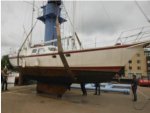
Steel yacht dry dock maintenance - newbie needing advice!

Sooshark

Active Member
Joined
20 Apr 2016
Messages
50
Location
London
Visit site
Hey everyone.

My boat is coming out the water as soon as the temperature turns and the weather is dry. The plan is to shotblast and paint. I was hoping that maybe people on here could offer advice on things to do/check/change whilst the boat is out the water. I am very new to all this and want to be as diligent as possible.

Or perhaps there are already guides out there and someone could point me in the right direction?

Thanks in advance!! Happy Sunday to all.
 
Make sure the shotblasters get a holding coat on immediately after blasting. Try and have it done with a dry and humidity free f/cast.
 
Hey everyone.

My boat is coming out the water .......................... things to do/check/change whilst the boat is out the water. .

Anodes, skin fittings/seacocks, prop(s) & shaft(s), cutlass bearing(s). Rudder(s) perhaps

If Rogershaw answers take note of what he says.
 
As said have the shot blasting done on a low humudity day otherwsie you risk flash rusting. To stop the hull rusting apply two coats of zinc rich epoxy. Measuring the thicknsss of the hull is a good idea it shows up areas of rust if there are any. If there are any they need to be cut out steel welded in the hole and painted with the epxoy and topcoat.
 
As said have the shot blasting done on a low humudity day otherwsie you risk flash rusting. To stop the hull rusting apply two coats of zinc rich epoxy. Measuring the thicknsss of the hull is a good idea it shows up areas of rust if there are any. If there are any they need to be cut out steel welded in the hole and painted with the epxoy and topcoat.

The boat was bought last year (or, errr, a year and a half ago now it's 2017..) and had a full survey. Believe the hull to be in good condition (hopefully still is!) 3.75mm down from 4mm.
 
My surveyor advised against going back to the hull, unless absolutely necessary. My experience of boats is that you dont have to make work cos theres more than enough to do anyway.

Boat survey done Sept 2015 said strip hull and keel back to bare metal and treat with suitable epoxy. Think it needs doing!
 
I know a surveyor for big ships. He works on the principal that freshly bright steel has to be painted within an hour with an epoxy primer, and even that might be too long if there is salt spray in the air. Bright steel is VERY reactive.

Five minutes is far to long.
 
A pedantic correction. You will have a grit blast. not a shot blast.
If the coating scheme is in good condition why are you blasting at all? Did the surveyor check it extensively or just superficially?
You say 3.75mm from 4mm originally. How sure are you of that?
I would get the boat out of the water before making any serious decisions. Buy a decent second hand coating thickness gauge from e-bay (Elcometer 345) and get someone to do an extensive steel thickness survey if you are not sure. If the steel is OK and the coating is OK why accelerate problems by blasting?
If you do blast ignore all the scaremongering about getting a coat of anticorrosive on so quickly. All modern epoxy primers are compatible with flash rusting. First make sure the blasting is done properly, and you cannot do that while worrying about flash rusting. You should aim for a blast standard of Sa2.5 Many blasters will claim that while having no idea what it is. Buy or borrow a visual standard!
When flash rusting occurs, as it will, if it is black you have a salt contamintation problem and need to remove before proceeding. If the flash rusting is ginger don't worry about it. Just b
rush off any loose powdery stuff before coating.
When the surface is clean and dry put on a good surface tolerant epoxy. With a clean surface it is better than a zinc rich material which is for when you can't get your steel properly clean.
Be under no illusions. A clean and salt and dust free surface is far more important than getting your primer on quickly. The idea of priming within a few minutes of blasting is wholly unrealistic!
Make sure your first anticorrosive coat is applied properly. Full coverage is most important. After that you can relax and build a good film thickness of barrier coats before your finish or antifouling
 
Good post pasarelle - however, tone your "scaremongering"language down a bit please as mine and others' posts were offered in good faith from our experiences - Thanks
 
A pedantic correction. You will have a grit blast. not a shot blast.
If the coating scheme is in good condition why are you blasting at all? Did the surveyor check it extensively or just superficially?
You say 3.75mm from 4mm originally. How sure are you of that?
I would get the boat out of the water before making any serious decisions. Buy a decent second hand coating thickness gauge from e-bay (Elcometer 345) and get someone to do an extensive steel thickness survey if you are not sure. If the steel is OK and the coating is OK why accelerate problems by blasting?
If you do blast ignore all the scaremongering about getting a coat of anticorrosive on so quickly. All modern epoxy primers are compatible with flash rusting. First make sure the blasting is done properly, and you cannot do that while worrying about flash rusting. You should aim for a blast standard of Sa2.5 Many blasters will claim that while having no idea what it is. Buy or borrow a visual standard!
When flash rusting occurs, as it will, if it is black you have a salt contamintation problem and need to remove before proceeding. If the flash rusting is ginger don't worry about it. Just b
rush off any loose powdery stuff before coating.
When the surface is clean and dry put on a good surface tolerant epoxy. With a clean surface it is better than a zinc rich material which is for when you can't get your steel properly clean.
Be under no illusions. A clean and salt and dust free surface is far more important than getting your primer on quickly. The idea of priming within a few minutes of blasting is wholly unrealistic!
Make sure your first anticorrosive coat is applied properly. Full coverage is most important. After that you can relax and build a good film thickness of barrier coats before your finish or antifouling


+1 from another steel boat owner

All good, practical advice,

Another tip is to use different coloured epoxy paint for each coat so that you can ensure you get good coverage
 
Good post pasarelle - however, tone your "scaremongering"language down a bit please as mine and others' posts were offered in good faith from our experiences - Thanks

Sorry, no offence meant. Just think this type of advice is rather misleading and can send someone down the wrong route and cause unexpected problems. I've no doubt it was given in good faith.
 
Top