Steel boats - hull maintenance and longevity

Strolls

Well-Known Member
Joined
9 Mar 2015
Messages
740
Visit site
I've seen Scott Fratcher's book Metal Boat Maintenance - A Do It Yourself Guide recommended a few times, and yesterday discovered an extensive preview available on Google Books: https://books.google.co.uk/books?id=peIEMVOvOIQC&pg=PA23

On page 23, Fratcher asserts that the paint on a hull of a new steel boat lasts about 15 years, the first repaint lasts 7 - 10 years, and thereafter repainting the hull must be done every 5 - 7 years.

He implies that around this age the pitting is so deep that it soon becomes time to use an angle-grinder to cut corroded sections from the hull and replace them. The interior cabinetry must be removed lest the welding cause a fire, and this is a big job.

I guess, based on the aforementioned intervals, sections of the hull would start needing replacement when a steel boat is about 30 years old?

I have to say that reading this has rather dulled my enthusiasm for steel boats. All the ones I bookmark are on the market for 3 years before selling for half the listing price - any I could afford would at least need a new paintjob nearly straight away!

The posters on Reddit's /r/sailing are very negative about steel boats - "stay away from them, they're a nightmare" - whereas this forum, particularly those who own or have owned steel boats have always seemed more positive and pragmatic.

Am I allowing myself to be scared off unduly, or should I stay away from 30 year old steel boats, since I'm inexperienced with a grinder?
 
FLBJHXx.jpg


qKApc3U.png
 
Can comment from a motorboat point of view, Having been around and involved with steel and before that with wooden boats,up to 10m for many years and with long term ownership.
Have no experience of new boats with super duper modern paints.
On older boats with old fashioned coatings,the hull,especially around the external waterline and the interior hidden by internal linings,will require constant monitoring.This is probably not to bad during initial ownership but as time goes on any lack of attention will multiply the problem.Usually its worst where you cannot see it start.
Once a simple plate on top of the weak structure would have been OK, now it must be welded in flush.
Know of one instance,where so much plate had been added the boat increased its draft by a noticable amount.Where as once every river side locality had a host of welders and fabricators, now the nearest one will have an ad on the web and the workshop will be located in a industrial unit on a farm 50 miles from any water.
We have a Pedro on our club moorings,which has not been used for some time,rust has completely corroded through the rubbing band.
What ever the disadvantages of composite plastic boats the real problem will be in finding a way of destroying the blimming things.
Down here on the Medway,the last commercial yard with any real steel expertise closed but a few months ago.
 
Last edited:
>On page 23, Fratcher asserts that the paint on a hull of a new steel boat lasts about 15 years, the first repaint lasts 7 - 10 years, and thereafter repainting the hull must be done every 5 - 7 years.
He implies that around this age the pitting is so deep that it soon becomes time to use an angle-grinder to cut corroded sections from the hull and replace them. The interior cabinetry must be removed lest the welding cause a fire, and this is a big job.

Pitting can't occur if the hull is painted properly, I have no idea where the author got that from. Also the author is wrong about you need to paint more often I wonder if has ever had a steel boat and is making things up. I got an error 404 not found on the URL.
 
Mine was 27 years old when I bought it for not a lot and 34 years old when I sold it with a bit of life left in it.

I had the hull below the waterline sandblasted and repainted with epoxy in Venezuela after another Caribbean boatyard left bare metal scrapes all over the hull during a bottom job.

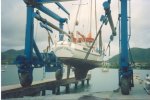
Haulout Rodney Bay.jpg
 
I've seen Scott Fratcher's book Metal Boat Maintenance - A Do It Yourself Guide recommended a few times, and yesterday discovered an extensive preview available on Google Books: https://books.google.co.uk/books?id=peIEMVOvOIQC&pg=PA23

On page 23, Fratcher asserts that the paint on a hull of a new steel boat lasts about 15 years, the first repaint lasts 7 - 10 years, and thereafter repainting the hull must be done every 5 - 7 years.

He implies that around this age the pitting is so deep that it soon becomes time to use an angle-grinder to cut corroded sections from the hull and replace them. The interior cabinetry must be removed lest the welding cause a fire, and this is a big job.
From my own experience of owning a steel yacht for the better part of 30 years, I'd say this is exactly true. The epoxy primer was fine for 15 years, but after this, grinding and repainting became a priority. Replacing small sections of plating started to be necessary at about 25 years, and by then a repaint was needing to be done every 3 years. Curiously, it was the deck that started to fail first.

It is possible to keep up with this more or less indefinitely, but it does take progressively more effort. You will certainly become experienced with a grinder (though it is a problem that many places will not allow grinding or welding, specially by amateurs). Equally, it is always practical to modify the furniture for easy removal, the result can be workmanlike if not the slick finish that has become so fashionable in recent years.

A total makeover, in terms of grit-blasting every surface, is a theoretical possibility but in practice will, by the time it becomes necessary, cost more than the boat is worth.

But at the end of the day, all boats have a finite life expectancy, and the fact is that that of steel is shorter than plastic. Accept this, and there are compensations in terms of price and strength.
 
Last edited:
Doing my homework to choose the right boat, so far I learned that most steel hulls corrode from the inside. Also, there isn't just mild steel on the market, there is corten, which corrodes slower and doesn't blister like mild steel. Initially I was also very reluctant to buy a steel boat but less afraid of a corten hull, which gives a peace of mind regarding internals, maybe even corrodes a bit slower outside.

Besides, that "30 years of no-repaint period" might be a mistake and the whole maintenance scheme would be much more sustainable/last 100+years, if the proper coatings and antifouling are applied already after 10 years.

No wonder though, why most "cheap" second hand steel boats age around 30 years...
 
Last edited:
On page 23, Fratcher asserts that the paint on a hull of a new steel boat lasts about 15 years, the first repaint lasts 7 - 10 years, and thereafter repainting the hull must be done every 5 - 7 years.

If the boat was epoxy coated from new then his comments are total rubbish. The steel will be inert within the coating unless it is damaged. My thirty year old De-groot was good as new when sold (including the two pack gloss that came up like new every time it was polished). When ultrasound checked for the sale survey the worst area of wastage on the hull was 0.1mm so the 4mm plate when new was down to 3.9mm after 30 years and only in one small area.

If the book was written 50 years ago then he may have been right, any newer and he's an idiot!
 
If the boat was epoxy coated from new then his comments are total rubbish. The steel will be inert within the coating unless it is damaged. My thirty year old De-groot was good as new when sold (including the two pack gloss that came up like new every time it was polished). When ultrasound checked for the sale survey the worst area of wastage on the hull was 0.1mm so the 4mm plate when new was down to 3.9mm after 30 years and only in one small area.

If the book was written 50 years ago then he may have been right, any newer and he's an idiot!

Yepp, that's what I've heard and seen on my sailing instructor's boat. His one is also 20+years old, lost <0.1mm - he has no intentions to sell it though:D. The point is to ensure electrolytic and mechanical protection both inside and out. 4mm-> are you on corten or normal steel?
 
If the boat was epoxy coated from new then his comments are total rubbish. The steel will be inert within the coating unless it is damaged. My thirty year old De-groot was good as new when sold (including the two pack gloss that came up like new every time it was polished). When ultrasound checked for the sale survey the worst area of wastage on the hull was 0.1mm so the 4mm plate when new was down to 3.9mm after 30 years and only in one small area.

If the book was written 50 years ago then he may have been right, any newer and he's an idiot!

Where?

Temperature makes such a difference, if your boat was in the tropics then fairly certain things would be different.

In the tropics the slightest of nicks will be staining rust straight away, very different to northern europe.

My first blast & repaint was about 20 years, now looking at another blast just over 10 years, a chunk of that in the tropics.

Maybe he's not such an idiot.
 
Last edited:
If the boat was epoxy coated from new then his comments are total rubbish...If the book was written 50 years ago then he may have been right, any newer and he's an idiot!

Were there any epoxy coatings for steel boats, fifty years ago? I reckon the author is looking primarily at rescuing technically uneconomic propositions, rather than setting up a new hull to escape the pitting fate.

On the other hand, he let this work go to print with the words "Don't disperse" when I'm sure he meant "Don't despair"...

...so idiocy may be the reason. :rolleyes:

I find it extremely heartening to read that the old life expectancy of steel, needn't apply to new steel hulls, given the right coating.
 
Where?

Temperature makes such a difference, if your boat was in the tropics then fairly certain things would be different.

In the tropics the slightest of nicks will be staining rust straight away, very different to northern europe.

My first blast & repaint was about 20 years, now looking at another blast just over 10 years, a chunk of that in the tropics.

Maybe he's not such an idiot.

Proper flame sprayed zinc after that reblasting?
 
There are also "cold" options: http://www.klostermann-chemie.de/en/products/zinc-spray.php (obviously have to be applied more often than every 30 years).

In the meantime I found this:

I would like to share some experience that I have with flame spray.
I have friend with a 36 foot steel sailboat that was built in Holland more than 80 years ago. On the inside the boat was flame sprayed with zinc at the time it was manufactured. Insulation in the form of rock wool was installed and over the years got wet. There is not a sign of rust, on the unpainted zinc, in any area that we inspected on the inside of the boat. I can't speak for what was applied on the outside of the boat because there looks to be 80 years worth of paint.
I have flame sprayed the inside of my 39 foot steel sailboat with zinc so I have at least a minimal amount of experience with sand blasting and zinc flame spray. I bought a type Y Metco gun and a box full of spare parts on ebay for 140 US$. The gun works perfectly. The pure zinc wire costs around 7US$ per kilo and covers around 5 square meters per kilo. It takes a minute or two to spray a square meter, on a straight run. Add in the cost of gas and oxygen and the cost would come in below 1 US$ per square foot. Compared to epoxy coating systems, primer ... primer. paint. I believe the zinc is the cheaper of the two, or at least in this neck of the woods zinc is cheaper? There are issues about welding over zinc etc. etc. but since this is already longer than most will want to read, I wont go into them.

Who is right then? Following the quoted book's logic, an 80 year old steel hull shouldn't exist...
 
Last edited:
I've seen Scott Fratcher's book Metal Boat Maintenance - A Do It Yourself Guide recommended a few times, and yesterday discovered an extensive preview available on Google Books: https://books.google.co.uk/books?id=peIEMVOvOIQC&pg=PA23

On page 23, Fratcher asserts that the paint on a hull of a new steel boat lasts about 15 years, the first repaint lasts 7 - 10 years, and thereafter repainting the hull must be done every 5 - 7 years.

He implies that around this age the pitting is so deep that it soon becomes time to use an angle-grinder to cut corroded sections from the hull and replace them. The interior cabinetry must be removed lest the welding cause a fire, and this is a big job.

I guess, based on the aforementioned intervals, sections of the hull would start needing replacement when a steel boat is about 30 years old?

I have to say that reading this has rather dulled my enthusiasm for steel boats. All the ones I bookmark are on the market for 3 years before selling for half the listing price - any I could afford would at least need a new paintjob nearly straight away!

The posters on Reddit's /r/sailing are very negative about steel boats - "stay away from them, they're a nightmare" - whereas this forum, particularly those who own or have owned steel boats have always seemed more positive and pragmatic.

Am I allowing myself to be scared off unduly, or should I stay away from 30 year old steel boats, since I'm inexperienced with a grinder?

Not a steel boat owner but I did work for 40 years in the steel industry and am a boat owner of 30 years too.

You can expect a steel boat to be maintenance heavy - steel and salt water dont mix but the outside is the easy bit. Much more difficult will be dealing with internal rusting from bilge water and condensation. So it all depends on how well the boat was built and how effectively it was painted. Lot of variability in this area since many steel boats are owner built and owners vary from the really skilled to those who just think they are skilled.

There is a second issue - weight. The smaller the boat, the more difficult it is to get enough ballast where needed on a steel boat because the hull weighs so much.

If you are handy, know how to weld, used to working with your hands then why not buy a good steel boat. If you are expecting to use the yard to do work, forget it. Will be a money pit.
 
Speaking only as an observer, not an owner, I've seen many steel boats having patches welded in, sometimes multiples. They looked quite reasonable at a glance at the outside but had rotted from within, in areas not normally seen. Main cause was bad building where the stringers hadn't been notched to allow condensation and any water ingress to drain into the bilge.
 
Most steel boats rot away from the inside. The best modern treatment for a new hull is to plasma spray with zinc i.e. to galvanise it prior to painting. This method is being used on some high quality European canal barges.
 
Most steel boats rot away from the inside. The best modern treatment for a new hull is to plasma spray with zinc i.e. to galvanise it prior to painting. This method is being used on some high quality European canal barges.

Indeed, a zinc layer is the best protection steel could get. I just wonder how much would it cost to sand-blast and flame spray a used boat which wasn't coated originally.
 
Top