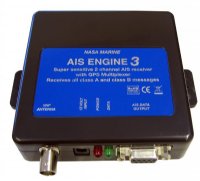
Stand-alone AIS

The NASA kit has worked fine for us too. This, our first season with it, was terrific crossing to France and back etc.

The tails are so good that I put a ruler on them and if the line drives 'through' our little spot in the middle, I knew we had a problem. Conversely, if it missed us, then we were able to just keep an eye on it (and the ship) but much more reassured that we were not in the ship's path.

North up actually suited us better, especially when crossing a West/East lane but also worked well in a North/South one.

We set the alarm for 8nm until we were closer up to the lane, then 4nm and then off altogether once they were in sight and 'elephant racing' around us. Very vaulable for picking up the bigger fishing boats too.
 
The tails are so good that I put a ruler on them and if the line drives 'through' our little spot in the middle, I knew we had a problem. Conversely, if it missed us, then we were able to just keep an eye on it (and the ship) but much more reassured that we were not in the ship's path.

Hmm, still think I'd like the CPA and TCPA data rather than trying to extrapolate lines on a display.

Back when I was still using a power-hungry Dell laptop (the current netbook is a big improvement) and OziExplorer (raster charts only - now OpenCPN) I posted this as an example of some potential close encounters. I think the actual data calculations were very useful for decision-making at that time.
 
Hmm, still think I'd like the CPA and TCPA data rather than trying to extrapolate lines on a display.

Back when I was still using a power-hungry Dell laptop (the current netbook is a big improvement) and OziExplorer (raster charts only - now OpenCPN) I posted this as an example of some potential close encounters. I think the actual data calculations were very useful for decision-making at that time.

For 0.1A I can happily live without CPA :) In practice you can see easily if it needs attention.
 
For 0.1A I can happily live without CPA :) In practice you can see easily if it needs attention.

But the algorithms must be in there, it seems odd the data is not displayed, even if as an option. As I mentioned, I find it useful.

The AISWatchMate RX mentioned by doug748, which has similar functionality (and probably similar current draw) provides it: "You are alerted immediately with the closest point of approach (CPA) and the time until CPA."

I can happily live with a netbook's power consumption - when motoring there's a surfeit of Amps and when there's enough wind for sailing there's usually enough from the Air-X wind generator to keep up with all power requirements, of which the refrigerator is the major requirement.
 
But the algorithms must be in there, it seems odd the data is not displayed, even if as an option. As I mentioned, I find it useful.

The AISWatchMate RX mentioned by doug748, which has similar functionality (and probably similar current draw) provides it: "You are alerted immediately with the closest point of approach (CPA) and the time until CPA."

In fairness, The WatchMate RX is £430 - about twice the price of the Nasa product - so you'd expect it to have better functions.
 
In fairness, The WatchMate RX is £430 - about twice the price of the Nasa product - so you'd expect it to have better functions.

A few lines of code; a sub-routine or two - peanuts.

I would expect the price difference between the two units to be due to the quality of the basic electronics where the Watchmate is a genuine simultaneous two-channel system and the NASA the restrictive single-channel system that switches between the two frequencies alternately. Therein lies a fundamental improvement and higher costs and well worth the extra.
 
A few lines of code; a sub-routine or two - peanuts.

I would expect the price difference between the two units to be due to the quality of the basic electronics where the Watchmate is a genuine simultaneous two-channel system and the NASA the restrictive single-channel system that switches between the two frequencies alternately. Therein lies a fundamental improvement and higher costs and well worth the extra.

You're probably right, just a bit of code. I've never had the pleasure of using a system with cpa and time to cpa so don't miss what I've never had :) The nasa can be a bit slow picking up the full details of a vessel which is a bit annoying sometimes, is that a result of switching channels? But all in all a really great gadget for the money.
Shame you can't get nmea out of it to have the option of using it with a laptop as well. Do other units do this? Bit dull having to buy an ais engine and another aerial etc to get that side sorted out.
 
I've never had the pleasure of using a system with cpa and time to cpa so don't miss what I've never had :)
In some cases I find it invaluable. If you followed my link to my experience in the Gulf of Trieste, it was the CPAs alone that dictated slowing for the first ship to pass, seeing that 143m was too close, and crossing ahead of the second with 397m clearance.

The nasa can be a bit slow picking up the full details of a vessel which is a bit annoying sometimes, is that a result of switching channels?

Exactly. If two separate reports arrive on each channel only one will be processed and the system will have to synchronise with the other on a succeeding transmission - no big deal normally with Class A because a moving ship has frequent position sentences but it starts to get silly with out-of synch, fast-moving Class B reports where they are less frequent and the display results in a jumping target.

The major discrepancy is missed (out-of-synch) static data sentences which, for both Class A and B, are sent only every 6 minutes, meaning it is easy to be without the ship's name for at least 12 minutes. This was once a problem for me when I needed to call a ship that was on a collision course (I too have only a simplex receiver - i.e. one channel at a time).

Shame you can't get nmea out of it to have the option of using it with a laptop as well. Do other units do this?
Dunno really, I'm not au fait with what's on the market because I prefer feeding AIS and GPS into a PC with the CM93 charts as the perfect backup to the plotter - which is too old to display AIS targets anyway. It's also a ridiculously cheap solution as I need a PC aboard ... to access this forum among other uses. :D
 
Last edited:
it was the CPAs alone that dictated slowing for the first ship to pass, seeing that 143m was too close, and crossing ahead of the second with 397m clearance.

The ahead / behind distinction is interesting to me. I have a CP180i that I occasionally plug in (prefer paper for most purposes) and just before the Scuttlebutt trip I got one of those ANT200 AIS antenna units to connect to it.

The combination worked in that ships showed up on screen, and I could hover the cursor over them for more information, but I was a bit disappointed in what it actually showed. No info on how far away the ship was, for instance, or many of the other AIS fields I'm used to seeing on Web displays. My main complaint was that although it did show a CPA and TCPA, it didn't say whether this would be ahead or astern of the ship. My tolerance distance for crossing astern is a lot closer than for crossing ahead!

Anyone else have this plotter - was I just missing something?

Pete
 
Have just used the Vesper Watchmate on the first leg of the Mini Transat. Absolutely brilliant.

It has one thing the NASA unit doesn't: it can transmit.

If you are going for a stand alone unit, I highly recommend the Vesper.
 
If you are going for a stand alone unit, I highly recommend the Vesper.

Obviously I haven't used it, but after a bit of research I agree it looks like an excellent bit of kit. If I was starting from scratch I'd seriously consider the receiver version.

Pete
 
If the tadpole is pointing at the centre then you really should be thinking of doing something ;)

Erm, perhaps I'm missing something here, but surely the "tadpole" is of limited use as it may actually be a threat even if not "pointing at the centre". Surely, unless the unit calculates a CPA - that is, extrapolates one's own track and that of the target - then the displayed data is of very dubious value.

In the computer navigation programs that I have tried and that support AIS the extrapolated tracks of both own ship and target ship are shown with the CPA point clearly marked. The OziExplorer example I linked to shows that and the OpenCPN does also and is even more graphically elegant.

Even if "the tadpole is pointing at the centre" then the threat may be low (unless very close) if you are not on the same or reciprocal course. In fact, I'm not sure what the right evasive action would be from the examples I've seen - seems like a recipe for an 'AIS assisted collision' to me. :eek:
 
I've come across this offering -

22173-nasa-ais-engine-v3_1279_general.jpg


Why on earth are manufacturers still producing kit with RS232 output? When was the last time you bought a PC with a serial port?
 
Erm, perhaps I'm missing something here, but surely the "tadpole" is of limited use as it may actually be a threat even if not "pointing at the centre". Surely, unless the unit calculates a CPA - that is, extrapolates one's own track and that of the target - then the displayed data is of very dubious value.

In the computer navigation programs that I have tried and that support AIS the extrapolated tracks of both own ship and target ship are shown with the CPA point clearly marked. The OziExplorer example I linked to shows that and the OpenCPN does also and is even more graphically elegant.

Even if "the tadpole is pointing at the centre" then the threat may be low (unless very close) if you are not on the same or reciprocal course. In fact, I'm not sure what the right evasive action would be from the examples I've seen - seems like a recipe for an 'AIS assisted collision' to me. :eek:

AIUI the tadpole is a vector sum of your velocity and that of the other vessel. If the vector is pointing at you, you have a problem, if not, then OK. The tadpole vector includes your speed and course, and that of the other vessel.
 
Erm, perhaps I'm missing something here, but surely the "tadpole" is of limited use as it may actually be a threat even if not "pointing at the centre". Surely, unless the unit calculates a CPA - that is, extrapolates one's own track and that of the target - then the displayed data is of very dubious value.

The tadpole trail shows the ships course relative to yours at both vessils speeds and courses at that time, if it points slightly ahead of centre then it will pass in front of you. If it points straight at centre then it will hit you. Just the same as if the relative compass bearing between the the boats remained the same. Assuming both boats maintain speed and course. It won't show exactly how far in front or behind the target will pass but I would never cut across the bows of anything serious unless a very long way in front. And with a bit of practice you can estimate that pretty accurately.
In practice it works very well for me anyway, a seconds glance will tell if you need to pay attention.
I rely on mine quite heavily single handed offshore, so the extra power and complexity of running a laptop 24/7 doesn't really work. Wouild be nice to have that capibility as well but wouldn't want to head out there without a very simple reliable standalone unit.
 
Thanks Pyrojames and Conachair, that's answered my concerns - I did say that I could be missing something ...

But it does prove that the calculations for CPA and TCPA are in there and could be displayed - strange they are not, at least to me who likes more data than less.
 
But it does prove that the calculations for CPA and TCPA are in there and could be displayed - strange they are not, at least to me who likes more data than less.

I don't think so. The Nasa unit won't perform any CPA/TCPA calculations. All it's doing is displaying the relative positions of AIS transmitters.
 
...In practice it works very well for me anyway, a seconds glance will tell if you need to pay attention.
I rely on mine quite heavily single handed offshore..

There you have it.

As already mentioned, I have just bought a plotter with AIS overlay and have had a chance to use it over the weekend. In my view the Nasa standalone is the better tool and I shall be keeping it. Such is hubris

The Nasa gives you an unequivocal, instant graphical alert which is so useful when shorthanded. No figures, no button pressing, no mental arithmetic just the information you need to know, at a glance.

It may be crude, slow, simplistic and worryingly inexpensive but, in my view, it is a very polished piece of kit.

It must have been selling now for almost ten years.
 
The Nasa gives you an unequivocal, instant graphical alert which is so useful when shorthanded. No figures, no button pressing, no mental arithmetic just the information you need to know, at a glance.

As does the Vesper. You can set different parameters for anchored, harbour, coastal and offshore use. While offshore I set my alarms to sound if there is any vessel within 5 miles, or that has a CPA of less than 2 miles. When the alarm sounds it indicates the vessel, CPA and time to CPA. With a couple of button presses you will see more information including the orientation at CPA, which shows whether the target is going to pass in front, behind or beside.

You can select each target and get this information whenever you want.

The information you get will depend on what the target vessel has programmed into their own AIS unit, but usually includes vessel name, MMSI, radio call sign, class of AIS, current position (lat/long), speed, heading, COG, rate of turn, and status (eg "under engine" or "not under command", which I saw a couple of days out of Madeira) and often includes what kind of ship it is (eg cargo), what it is carrying and where it is bound.

The NASA unit is cheaper and I've never seen one live, but I wouldn't switch my Vesper for anything else. And definitely go for the transceiver and not just the receiver. I used it when crossing the top of the Finisterre TSS. Don't know if it helped, but I had no issues with nearby ships as I went across.
 
Top