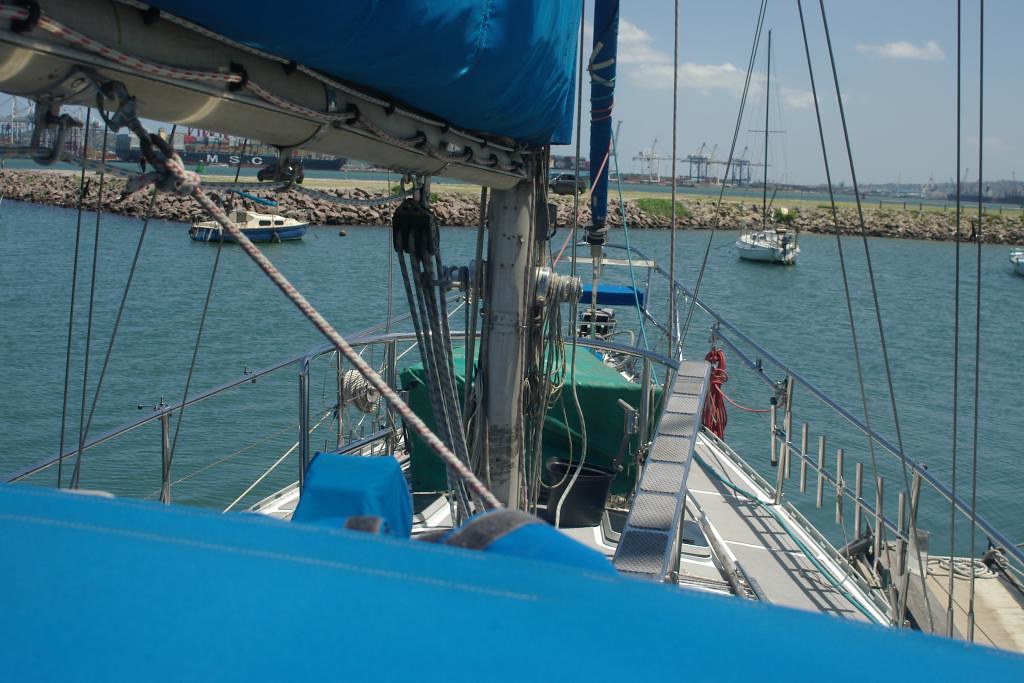
Stainless Steel guard rails on a sailing boat

Ashman

Well-Known Member
Joined
8 Sep 2009
Messages
99
Location
South West
Visit site
I am contemplating replacing the top wire rope of our forward guard rails with stainless steel tube and was wondering if there were any obvious reasons not to do it?
As I approach my seventh decade I am conscious that I am not as confident on the foredeck as I used to be especially in heavy weather and I think that a solid rail would be far more reassuring at those moments when you just need something to grab.

Our 40’ centre cockpit ketch already has a stainless steel top rail around the aft deck and there is a midship gate where the wire section starts. Other than weight and cost are there any other issues that I should be considering?
I know another forumite who has successfully converted his top rails to stainless steel and is very pleased with the result.......so if it is such a good idea why haven’t others done it?
 
I am contemplating replacing the top wire rope of our forward guard rails with stainless steel tube and was wondering if there were any obvious reasons not to do it?
As I approach my seventh decade I am conscious that I am not as confident on the foredeck as I used to be especially in heavy weather and I think that a solid rail would be far more reassuring at those moments when you just need something to grab.

Our 40’ centre cockpit ketch already has a stainless steel top rail around the aft deck and there is a midship gate where the wire section starts. Other than weight and cost are there any other issues that I should be considering?
I know another forumite who has successfully converted his top rails to stainless steel and is very pleased with the result.......so if it is such a good idea why haven’t others done it?
Cost implication`s for production boats
 
I know the feeling !! The big 80 approaches and I know I have to be more careful moving around the boat! I don't really know if 'solid' rails would make me feel safer though. I find most guard rails/wire are too low for me, just the right height in fact to tip me over! Mine would need to be 6 inches higher.
Possibly solid rails would be even more of an incentive for crew ( and especially crew of other boats ) to use them for pushing their boat off and thus straining the fittings.
I might consider some grab rails say around the mast.
 
I am contemplating replacing the top wire rope of our forward guard rails with stainless steel tube and was wondering if there were any obvious reasons not to do it?
As I approach my seventh decade I am conscious that I am not as confident on the foredeck as I used to be especially in heavy weather and I think that a solid rail would be far more reassuring at those moments when you just need something to grab.

Our 40’ centre cockpit ketch already has a stainless steel top rail around the aft deck and there is a midship gate where the wire section starts. Other than weight and cost are there any other issues that I should be considering?
I know another forumite who has successfully converted his top rails to stainless steel and is very pleased with the result.......so if it is such a good idea why haven’t others done it?
When I built my boat DistantShaw a 59 ft steel aft cockpit I fitted 38mm dia stanchions and top rails. I also increased the height of the stanchions and top rails to be a crutch level so its less likely to be tipped over a lower rail.

BTW I am currently 72 and SWMBO similar age.

35953418671_f03c19590e_b.jpg


You can also see the mast pulpit and the removable walkway to reach the sail statpack.
 
Last edited by a moderator:
Friend had stainless stanchions with a wooden top rail. Quite rotten in parts. So we replaced the top rail with 40x20 SS tube . Most fun was getting the curve right over the length of the boat . Gates were SS chain at around 1/3 from aft, with Pelican clips.
 
Not sure I follow. Both my upper and lower lifelines can be severed at the aft end meaning the recovery of a man overboard means less lifting. Getting a man overboard into the correct position for recovery is important and as far as I am aware require yachts involved in racing require lifelines to be attached by rope in order that recovery is made easier by dropping the lifelines to deck level.
My logic may be different but it is still logic ?
 
Most motorboats have stainless rails - sometimes a cable for the mid rail.
As a motor boater I find the cables on yachts don't give me the same feeling of safety when on deck.
If concerned about side access you can have a gate - often done as a chain , or cable as may be seen on a yacht if the designer has given any thought to getting on and off the boat .
 
When I built my boat DistantShaw a 59 ft steel aft cockpit I fitted 38mm dia stanchions and top rails. I also increased the height of the stanchions and top rails to be a crutch level so its less likely to be tipped over a lower rail.

BTW I am currently 72 and SWMBO similar age.

35953418671_f03c19590e_b.jpg


You can also see the mast pulpit and the removable walkway to reach the sail statpack.
That looks like a seriously thought-out boat with interesting ideas incorporated.

Do you have a website or blog where I can see more details of her?
 
A friend who's legs were disabled had solid guardrails fitted on two boats I did a lot of sailing on, the first (home built) with galvanised rails, the second a big cruising cat with stainless rails added from new.

I really like them - it makes moving around the boat, and off of it, so much easier. I imagine it would actually make recovering a MOB easier, as those still aboard would be able to lean on or over it, and tie off lines on it during the recovery, and it provides something solid for the MOB (if capable) to hang on to. They're also very handy for tying on or mounting all sorts of things.

You need quite a big boat to make it work visually.

Do not underestimate the weight involved! It is considerable.

Apart from the weight and the cost, the only disadvantage, to my mind, is potential cost/complications if it gets damaged. While it will put up with minor/medium knocks that might have damaged a wire guard rail stanchion, in part because the load will be spread across several stanchions, if you do get hit by anything serious, or e.g catch it on some solid projection when you are moving, straightening out the bends can be challenging, and in extremis there's little 'give' before it starts damaging the deck/hull. In the first of my friend's boats mentioned we were towing a boat with a dead engine out of Vlissingen harbour so he could sail home to the UK. We were towing him alongside (partly because of both the particular manoeuvring needs, but mainly because of his bloody great long bowsprit!) when a ferry passed nearby at speed. The wash caused the two boats (both very heavy ferro-cement) to crash against one another while swinging up and down, stoving in the guardrails. Fortunately there was only minor cosmetic damage to our very strong hull, but even after repair the guardrails were never quite right, visually, again.
 
Top