Stainless Steel Exhaust Elbow- 304 or 316?

Add in Marine .I thought i emphasised that .

Road diesel exhaust products from vehicles are totally different to spraying sea water into 550* C marine exhausts .
Lets no run away on a tangent of NONE marine .
I have explained the composition of the exhaust gases and the insoluble salts in seawater. Apart from that we have water and sodium chloride and maybe some minor soluble salts. So where do these mysterious strong acids come from?
 
Comment from another forum
There are two grades of 316. There is the common or guardian variety and there is 316L. The L denotes a lower carbon content.
What makes stainless steel "stainless" is the chromium content of the steel. If the steel is heated to between about 250 - 530 degC. (casting, welding etc) for any length of time, the chromium combines with the carbon to form chromium carbide. This depletes local areas of the protective chromium and the steel rusts! (Sensitization)
316L contains the lower carbon content. As such it sensitizes the steel to a lesser extent and the corrosion resistant quality of the steel is not compromised.
316 is fine for general use (cutlery etc) but for more aggressive marine applications it's 316L.
But be prepared to pay more for it!
PS if you want to create rust spots on stainless steel knives, braze the blade to the handle with a low silver content (cheaper) alloy and use oxy-acetylene. Seldom fails!
 
Comment from another forum
There are two grades of 316. There is the common or guardian variety and there is 316L. The L denotes a lower carbon content.
What makes stainless steel "stainless" is the chromium content of the steel. If the steel is heated to between about 250 - 530 degC. (casting, welding etc) for any length of time, the chromium combines with the carbon to form chromium carbide. This depletes local areas of the protective chromium and the steel rusts! (Sensitization)
316L contains the lower carbon content. As such it sensitizes the steel to a lesser extent and the corrosion resistant quality of the steel is not compromised.
316 is fine for general use (cutlery etc) but for more aggressive marine applications it's 316L.
But be prepared to pay more for it!
PS if you want to create rust spots on stainless steel knives, braze the blade to the handle with a low silver content (cheaper) alloy and use oxy-acetylene. Seldom fails!
316L also contains preferential carbide formers such as Niobium to protect the chromium.
 
Was it definitely only carbon? I have encountered carbon plus salts in engine waterway passages and in production gas compressors.it looked like carbon but there was a lot of salt mixed in.
It was super soft and there was no way to know when you weren't removing carbon. I would normally expect a Dremel to have limited impact on cast iron but in the exhaust elbow cleaning process it seemed to just make the orifice bigger on each subsequent clean
 
An update

There are a number of ways to buy from China. Aliexpress is one option another is Alibaba. There are other options 'Made in China' is another. The first 2 operations are owned by the same man. Aliexpress is predominately retail (and you often buy from a retail outlet (a shop), Alibaba is primarily commercial, selling to industry, and you usually buy from a factory, but sometimes a large trading company. Aliexpress is geared up for small orders, Alibaba supplies in bulk often sent by sea. Both Aliexpress and Alibaba offer financial protection should something go seriously wrong. Our experience is that either offer a reliable source - except you don't know what the quality is like for many items. For rode components we have ordered trial lots (1-2 pieces), tested them then ordered 10 pieces. For chain I order through an Australian importer/distributor as they then handle the bureaucracy of shipment by sea and port costs - but I know where the chain was made). There are many chain makers, many 10s or many 100s - I think it important to work with a single source.

The 316 elbow and the 304 elbow come from the same manufacturer, hence the similarity of the photographs. If you want one elbow you can only source the 304 elbow, if you buy in bulk you can buy either, but the minimum order quantity is 200 units (though this might be negotiable - you might be able to buy one as a trial - don't know). The manufacturer in this case has set themselves up to sell some individual units but also in bulk.

The 316 elbow costs about 25% more than the 304 elbow, ex China

The 316 elbow bought as one unit is really only available from parts4engines (?) and you will pay in sterling, vat and freight from China included - but not local delivery in the UK. We are paying A$250 delivered for a 304 unit (that's about stg125). When I look at the parts4engines site they are quoting A$400, I assume excluding freight from UK to Oz - you need to check for UK sterling prices. I have not exhaustively searched but prices for the cast, genuine, green painted elbow costs around A$600 excluding delivery.

We are assuming that the 304 quality will be the same, except for the base metal, as the 316 unit. Same mould, same casting facility.

We have ordered and paid for the 304 unit. It is in transit and coming air freight. It may arrive next week (that's the estimate) or the following week. If you were buying 200 units it would be cheaper to use sea freight but will take 6-8 weeks normally (maybe longer as sea freight out of China is currently suffering disruptions).

When the unit arrives I'll post some pictures with a focus on the internals to see how they have engineered the water intake.

I'm working on the basic assumptions that stainless will be better than cast iron, or cast steel, partially because as Tranona mentions I'm romantically persuaded that 'stainless' will be better - but also because those that have stainless elbows (on any engine) seem to think they are better. I'd point out that the reports from forum members are not necessarily statistical significant - no reflection on the members but there are really not many reports. I'm obviously not going to be able to advise whether 316 might not have been a better option.

Jonathan
 
I’m the OP. On the basis of the discussion above I also ordered a 304 elbow from AliExpress. Cost £163, including VAT & ship to uk.
An interesting discussion- thanks for taking the time to input.

John
 
I’m the OP. On the basis of the discussion above I also ordered a 304 elbow from AliExpress. Cost £163, including VAT & ship to uk.
An interesting discussion- thanks for taking the time to input.

John

You did well!

We should get our elbows at a similar time - report back your thoughts and maybe we can report back in 2 years time with good news :)

Jonathan
 
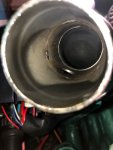
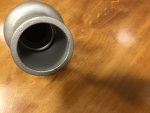
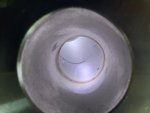
Recently fitted " Welded" stainless steel exhaust elbow on my 2040, picture of the inside taken after about 15 hrs running, not a lot to see, but much nicer than the cast iron one of 2000 hrs that it replaced. Cast iron version held onboard as a working spare.
IIRC it was one of the more expensive replacements traded with gcope of this parish after he discovered he needed a high rise version!
 

Attachments

  • 2040_exhaust-15 hrs.jpg
    2040_exhaust-15 hrs.jpg
    45.5 KB · Views: 12
  • Exterior of stainless steel exhaust.png
    Exterior of stainless steel exhaust.png
    452.9 KB · Views: 13
Last edited:
We are buying the Aliexpress 304 version. It will arrive in about 2-3 weeks. It will be installed soon after.

For those of you with patience and good memories - I'll let you know how we get on, in terms of any installation issues and more important - was it, long term, a good buy.

We actually found the original manufacturer of this item but the Aliexpress offer is through the retail arm of the manufacturer. I am sure the price is negotiable - if you buy 100 units - but we are sticking to just one (I hope we don't need 100!)

Jonathan
I built one out of 316 pipe fittings ten years ago for my MD22, I took it off today to check it, Hardly any carbon in it no deterioration in the metal
 
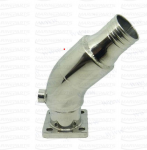
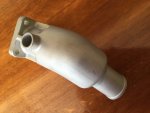
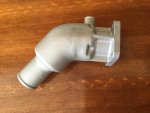
For completeness - this is the stainless 304 exhaust elbow bought through Aliexpress. It took 10 days from confirmation of our payment in China, PayPal, to receipt of the elbow in Sydney. The movement of the elbow was full trackable. The courier was a company, we had never heard of Yun Express.

Sorry but the pictures have been posted twice :(

IMG_9531.jpeg

IMG_9529.jpeg

The elbow was supplied with a gasket, seen in the background in the zip lock bag.


IMG_9527.jpeg

The water is introduced through the spigot and the spigot connects to a cylinder on the inside of the unit, you can see the open end of the rim of the cylinder in the above picture.

If anyone wants other pictures - now is the time. Once its fitted - I am not taking it off for .....years!

The unit fits, I quickly tried it.

Its a very nicely produced item. No complaints at all.

I'll install the unit to the exhaust manifold in the next couple of days, including the exhaust hose that fits on the elbow. I'll do that at home as its all here, and then fit the manifold and heat exchanger when the weather is conducive (this engine bay is open to the elements when the hatch is open) - not raining. I mentioned that in order to release the old elbow I had to slit the retaining nuts from the studs. I have bought some M8 galvanised flanged, serrated nuts as replacement and will use grease, copiously.

I have not decided if I should take the opportunity to change the thermostat in the manifold and the hose that connects the heat exchanger to the water pump (both are over 20 years old. I have the long manifold gasket on order.

I have not quite worked out how the device was made. The unit looks to be neatly cast - but I cannot work out how they joined the internal cylinder to the base unit and the spigot.

IMG_9531.jpegIMG_9529.jpegIMG_9532.jpegIMG_9527.jpeg
 
Tube was from Metals4U. It's now part of our guardrails supporting solar panels. We are 35nm from Venezuela in Curacao. How do you return them?
My original pulpit and pushpit are rust free and original to the boat. We see lots of modern cruisers with extensive rust on deck fittings. The poor quality of new s/s is not just my problem. My Swiss friend was saying just the other day that the s/s on his new FP catamaran is junk.
Hmm. I ordered some stainless tube earlier this year to make a davit for the outboard. I was very careful and precise with the size and spec.
The first length that came was the wrong OD.
The second length that came was the wrong wall thickness.
The third length that came had a saw cut in it at mid length.
The fourth length was correct.
Maybe what you ordered was not what was supplied.
 
I have not quite worked out how the device was made. The unit looks to be neatly cast - but I cannot work out how they joined the internal cylinder to the base unit and the spigot.

I think its all just a single casting in that there are no joins. In essence it is the flange with a pipe poking out and over half the pipe a second pipe is slid over it, closed off at the end nearest the flange and then the size of this sleeving pipe is reduced to make it the same size as the original pipe sticking out of the flange. All just made in one cast .......quite simple really I would think
 
The inner tube is bigger than the entry or exit tubes.

I'm in favour of lost wax or investment casting - though I had not appreciated that the technique can be used for such pieces.

There is no sign of a joint on the outside but there is a line of heat treatment where the flanged end meets the widened tube and spigot, so there might be a joint where the bolt holes flange and those flanges join the widened part of the elbow. If there is a joint - it is exceptionally well concealed on the outside.

If there is a joint it is where the elbow 'bends' - it might thus be made in 2 pieces: The face plate with the 4 holes, the inner tube, spigot and the outer tube upto the bend all as one piece.

My knowledge does not extend to how you join the 2 pieces together - but as I mention there is a heat treatment line on the inside, impossible to take a picture.

Jonathan
 
I would be interested in how they cast this, lost wax is very good at detailed casting but with this sort of internal profile quite a lot of work. I’ve seen it done on turbine blades at Rolls Royce and the work is quite involved and centrifugal casting for complex stuff. 3 D printing for the patten may today make it economical to produce small numbers though.

it does look good though
 
Daverw I have this nasty suspicion that Rolls Royce turbine blades have a bit more accuracy than my elbow! I believe, again dredging the depths of my memory, that the Rocna flukes being cast in China use investment casting, or lost wax, which is how they achieve the detailing of the upturn of the heel with the word 'Rocna' and the Kiwi bird motif etc. I have a friend in the jewellery business and he made a Celtic knot (I think that is the term or name) in silver cast using lost wax - amazing detail.


Maybe I should not look in too much detail.....?

I don't know what a new genuine Volvo cast elbow looks like inside - I have never been motivated to look.

Used elbows that I have looked at, and I'm working from memory, have the constriction the build up of salts that restrict the elbow developed well inside the elbow, up near the bend. I had assumed that this was where the sea water and exhaust gases were mixed.

My new elbow appears to have the spigot feeding an internal cylinder that exits at the point where the exhaust hose, clamped to the outside, commences. The mixing on the new elbow is right at the end of the elbow not at the corner.

If you look at the very last 2 pictures of the inside, above, you can see the end of the internal cylinder at the point where the elbow is restricted so as to take the hose. This means the sea water is being mixed at the point of constriction at the end of the elbow.

As I outline - I don't know if this is different from the genuine elbow and if it is different - does it make any difference? The sea water via the spigot on the new elbow looks to offer good mixing at the interface of the internal cylinder and the constriction at the end of the elbow.

Jonathan
 
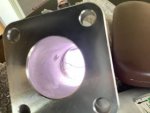
I received my new elbow from AliExpress today. There are clear joints and heat lines visible inside the elbow, but no weld. Presumably it’s welded from the outside although there aren’t obvious weld marks on the outside.
 

Attachments

  • C41DC93A-0615-4615-AB1B-5757F28E9F81.jpeg
    C41DC93A-0615-4615-AB1B-5757F28E9F81.jpeg
    9.4 KB · Views: 14
  • 4419C093-2E64-4070-A09E-9900364245B7.jpeg
    4419C093-2E64-4070-A09E-9900364245B7.jpeg
    13.5 KB · Views: 15
Daverw I have this nasty suspicion that Rolls Royce turbine blades have a bit more accuracy than my elbow! I believe, again dredging the depths of my memory, that the Rocna flukes being cast in China use investment casting, or lost wax, which is how they achieve the detailing of the upturn of the heel with the word 'Rocna' and the Kiwi bird motif etc. I have a friend in the jewellery business and he made a Celtic knot (I think that is the term or name) in silver cast using lost wax - amazing detail.


Maybe I should not look in too much detail.....?

I don't know what a new genuine Volvo cast elbow looks like inside - I have never been motivated to look.

Used elbows that I have looked at, and I'm working from memory, have the constriction the build up of salts that restrict the elbow developed well inside the elbow, up near the bend. I had assumed that this was where the sea water and exhaust gases were mixed.

My new elbow appears to have the spigot feeding an internal cylinder that exits at the point where the exhaust hose, clamped to the outside, commences. The mixing on the new elbow is right at the end of the elbow not at the corner.

If you look at the very last 2 pictures of the inside, above, you can see the end of the internal cylinder at the point where the elbow is restricted so as to take the hose. This means the sea water is being mixed at the point of constriction at the end of the elbow.

As I outline - I don't know if this is different from the genuine elbow and if it is different - does it make any difference? The sea water via the spigot on the new elbow looks to offer good mixing at the interface of the internal cylinder and the constriction at the end of the elbow.

Jonathan
Mine is the same, so flange, threaded nipple, threaded 45 deg elbow, then the mixer tube from ASAP. The mixer tube is a tube within a tube and the water exits at the full circumference. straight into the rubber exhaust to the plastic silencer. So no silly little holes to get blocked. The elbow stays at exhaust heat which i think is a positive. The coolant within the heat exchanger is right up to the flange. I wrapped fi glass tape around the uncooled elbow, has worked well for the last ten years ish
 
In the true spirit of YBW, and specifically PBO, we now need some responsible individual ( I've thus counted me out) to send the 'active' members an alert at some time in the future to check the innards of their fancy new, currently, in the future - older - elbows and give the attentive audience an update. I note that many like to reactivate ancient threads (within which are retired members) - but hopefully the schedule can be designed that we are all still mentally alert.

Jonathan
 
In the true spirit of YBW, and specifically PBO, we now need some responsible individual ( I've thus counted me out) to send the 'active' members an alert at some time in the future to check the innards of their fancy new, currently, in the future - older - elbows and give the attentive audience an update. I note that many like to reactivate ancient threads (within which are retired members) - but hopefully the schedule can be designed that we are all still mentally alert.

Jonathan
My home made effort has proved its worth after 10 ish years with no significant build up of carbon or salts, Myself and others think that the inherent "slipperyness" of SS contributes to this
 
Top