
Stainless anchor chain - pitting and repair links?

jetx

New Member
Joined
12 Oct 2018
Messages
5
Visit site
New-to-me boat came with about 65 meters of 10mm stainless anchor chain, which has occasional links stamped "WSA4". I believe this is a Wasi (Germany) marking indicating grade A4 chain. Can anyone confirm this?

More importantly, after inspecting, I found one terribly pitted link (see photo) which almost looks worm-eaten. The adjacent links, and indeed the entire remainder of the chain, look perfectly fine. Any ideas what would cause this kind of damage to just a single link? I'm thinking it may have been a manufacturing defect, but suppose it's possible that this one-and-only-one link sat in a puddle of water at the bottom of the anchor locker for some extended period.

Finally, I'm considering replacing the link with a rivet-link. Either this SS one by Osculati or the galvanized Crosby G355 missing link. Any thoughts or recommendations on this?

Much thanks.
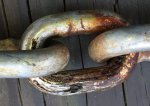
 

Attachments

  • Bad chain link.jpg
    Bad chain link.jpg
    139.5 KB · Views: 0
I would not use an Oscaluti link - it is unlikely to be a G4 link, they get most of their stuff from China and it is possibly simply 316. I'd have a look at the Cromox range - do they do a joining link" - send them an email and ask. Cromox is a G6 chain, so stronger than your (apparently) G4. Cromox do make a Omega link, its in their on line catalogue (which will be G6) but it might not pass your gypsy, or it might need help to pass the gypsy, and this may be a real pain. But it would be safe. It depends where the duff link is - and you might be able to live with it. Equally it might pass through, or by, the gypsy. Cromox, I think, is sold by Andersen in the UK, Newcastle?, you could ask them if they have a reasonably compatible 'C' link. I would not use a Crosby link - its a different steel and my guess is you will simply introduce a place for more localised corrosion (Vyv will hopefully come along later).

Sorry but I'm a bit far away to know all the suppliers in the UK - but that should keep you busy to start with.

Lifting chain is normally joined with Omega links - as the chain is not normally restricted by gypsies. But Andersen (I think they have Nordic roots) supply some pretty specialised high tensile components - shackles etc - and they are good place to start. I may have the spelling wrong.

Cromox is the usual chain for ground tackle if you want quality stainless (no disrespect to Wasi) and they are the other good option. Most stainless is 316 - and it has a very low yield (and I would not use it in the rode).

Jonathan
 
An interesting failure! It appears to be advanced pitting corrosion that has clearly attacked along the 'fibres' in the original wire. Chain is manufactured in a continuous process, which would seem to rule out a manufacturing defect that occurred on a single link, as the wire in the failed link was adjacent to those on either side. Such a localised defect in a drawn wire is pretty much impossible. So I agree with you that there has been some localised attack, maybe because that link was coated in mud or something similar, keeping it wet.

As Jonathan suggests, using a galvanised link in an otherwise stainless chain is not ideal, although I have seen it done without causing serious problems. I attach two photos, both of the same rode. One shows a C-link joining two lengths of galvanised chain, the other joining stainless and galvanised. Although both C-links are badly corroded I don't think the one adjacent to the stainless is a lot worse. The message here is clear - C-links corrode quite quickly and need regular inspection and maybe painting.

I do not know whether Cromox C-links exist but they would be a good choice if they do. Otherwise I think I would go with Crosby, as they have twice the strength of a 316 link, although still only slightly more than 316 chain.

 
Thank you Jonathan and Vyv... your advice is very much appreciated. I’ll go with Cromox if I can find it, or otherwise with the Crosby.

FWIW, the old Wasi catalogs I’ve found do indicate that their A4 chain is 316, as you both suspected. They list breaking strength for the 10mm at 50 kn or about 11,200 lbs, which is ~same as BBB, but only 70% of G4 at ~16,200lbs. Does that sound about right?
 
Jetx,

BBB is effectively a G30 grade. American G30 and Metric G30 are the same, or similar to each other - but American G30, BBB and metric G30 all have different link sizes (imperial chain links tend to be bigger (wider and, particularly, longer). Imperial chains will not fit on metric windlass and BBB is different in size to Imperial G30. If you build windlass you need a lot of different gypsies!

BBB is now a bit 'old' and has been replaced by G30 and more recently by G43, G43 seems to now be the default quality installed on new vessels in America. I don't know why as G30 seems perfectly acceptable in the rest of the world and issues of failure are like hen's teeth (despite the fact much chain now comes from China - stop worrying about China as a source!, worry about the integrity of the importer/distributor).

This is all very interesting, maybe :) , but no use to you.

Vyv will possibly post later - and knows the numbers - but 316 stainless is quite strong (or its strong enough) the problem is that it has a low yield - it stretches permanently at a lower tension than would G30. However G30 should not yield at a tension below approximately 2 times the WLL - and 2 x WLL is 50% of minimum Breaking Strength.

So - Wasi are saying the breaking strength is a min of 'about 5t' which puts a WLL of about 1.25t. Assuming that 10mm is appropriate for the yacht then if you exceed the WLL - I would seriously worry at your choices of anchorage! I suspect something on the bow will deform first (bow roller particularly) before the chain.

But being cautious I would use a decent snubber - nylon 12mm or 14mm and vessel length. The snubber will ensure there are no snatch loads, the sort that knock a wine glass over (you surely serve wine in a glass? :) ).

As I say - G30 in Europe (and Australia and New Zealand) has had no issues of failure due to strength of the wire. Your chain is made by a highly reputable supplier and having been used for some time - appears sufficiently robust. As mentioned the link that exhibits corrosion may well be due to being stored with damp rope and that link possibly lay on a different metal (shackle, anchor) and does not appear to be indicative of the rest of the chain. If the chain does stretch you will know immediately - it will not fit the gypsy (windlass) - but will still have strength as its breaking strength is 5t (even though it yields lower than G30).

I think Vyv made mention - chain is made from a long continuous wire and if the wire was at fault I would expect more links, especially in proximity to the one in the photo to show corrosion. I think it is an isolated case of poor maintenance and storage.

I would sleep soundly - but I would watch the joiner - every few months.

I confess if the stainless were from an unknown source I might show more concern.

Going back to the 'C' link - I thought I'd made mention - do not be clever and weld it - you will seriously diminish its strength. Once installed maybe paint that section, or use cable ties to mark the location - and keep a watch on the joining link.

If you cannot find a Cromox 'C' link - when you contact Tecni to source the Crosby 'C' link ask them is they have a stainless 'C' link joiner - explaining to them why. They may have something from an American chain maker - and if this draws a blank - buy the Crosby version.

Jonathan
 
Top