Stacking keel backing plates?

nickpitcher

New Member
Joined
12 Feb 2023
Messages
8
Location
North Shore, New Zealand
Visit site
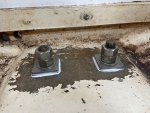
My current keel backing plates are 3mm thick, which I believe to be inadequate at spreading the load with 3/4" bolts over GRP. See photo attached.

So my question is, rather than going through the effort of re-bedding the plates, would it be ok for me to simply stack an additional plate on top of each of the existing plates to make up for it?

Or are my 3mm plates sufficient?

Cheers
 

Attachments

  • IMG_1839.jpg
    IMG_1839.jpg
    393 KB · Views: 41
My current keel backing plates are 3mm thick, which I believe to be inadequate at spreading the load with 3/4" bolts over GRP. See photo attached.

So my question is, rather than going through the effort of re-bedding the plates, would it be ok for me to simply stack an additional plate on top of each of the existing plates to make up for it?

Or are my 3mm plates sufficient?

Cheers
It would help to know what boat you are talking about. 3mm is fine for a 20ft but not a 40ft boat. Also if it is a fin or twin keel, whether the boaat dries out on every tide, et., etc. The more iformation you provide, the better the answers you will obtain.
 
Looking at you pic I have used bigger backing plates for mooring cleats. I would suggest an initial plate over as big an area as you can reasonable cover with a second smaller one on top to spread any unfair loads (an unintended grounding?) as widely as possible. I always bedded backing plates etc in a fresh mix of car body filler paste to ensure even contact over the area, but others may well come up with a better system. However, a lot depends on the thickness of the grp layup and if there is already a reinforcing plate bonded in.

Caveat - I am not an engineer, but having seen a mooring cleat and fastenings on one boat, and also the chainplate support structure on a big modern boat, pulled out through the deck a believer of "as strong as possible".
 
+1 - the OP's pic shows a neat job, but the plates are far too diminutive.

I'm also no engineer, but take the view that a backing plate is there to offer a 'challenge' to the (maximum possible) loads along the lines of 'go on - pull me through the laminate' and/or 'distort me'! In other words, they need to offer as much resistance as possible via area and thickness (ours on a 41' AWB aren't that thick - I'd say 6mm or 1/4")
 
The OP posted a trick question. Without knowing the thickness of the FRP, it is not possible to answer.

However, some guidelines.
  • Thickness. The washer should generally be about 1/4 to 1/6 minimum of the bolt diameter, or it will just bend before distributing the force. Standard fender washer s are too thin for use as backing plates in any use (if they don't bend, you probably didn't actually need a fender washer). Double thickness fender washers re avialbe for backing use, but they are only sold by bolt distributors, not chandleries IME. 3mm is marginally thin for the bolt diameter, but not as a washer with a bolting washer stacked on top of it. If it were a large backing plate it would need to be thicker, up to 6 mm.
  • Size. This depends entirely on the thickness of the GRP. If the glass is well reinforced and thick enough (typically 2 bolt diameters, but this depends on the lay-up), the force must only be distributed far enough to prevent localized compression failure (crushing) of the fiberglass. The washer is big enough for that. Note also that people often recommend using fiberglass plate for backing plates (G10); this is obviously no different than making the fiberglass thicker and using a washer. If the glass is thick enough the bolt will break first.
So without knowing more about the fiberglass, there is no hope of a meaningful answer.

The advice for a bigger, thicker plate is not wrong, since you can't know the layup.
 
The OP posted a trick question. Without knowing the thickness of the FRP, it is not possible to answer.

However, some guidelines.
  • Thickness. The washer should generally be about 1/4 to 1/6 minimum of the bolt diameter, or it will just bend before distributing the force. Standard fender washer s are too thin for use as backing plates in any use (if they don't bend, you probably didn't actually need a fender washer). Double thickness fender washers re avialbe for backing use, but they are only sold by bolt distributors, not chandleries IME. 3mm is marginally thin for the bolt diameter, but not as a washer with a bolting washer stacked on top of it. If it were a large backing plate it would need to be thicker, up to 6 mm.
  • Size. This depends entirely on the thickness of the GRP. If the glass is well reinforced and thick enough (typically 2 bolt diameters, but this depends on the lay-up), the force must only be distributed far enough to prevent localized compression failure (crushing) of the fiberglass. The washer is big enough for that. Note also that people often recommend using fiberglass plate for backing plates (G10); this is obviously no different than making the fiberglass thicker and using a washer. If the glass is thick enough the bolt will break first.
So without knowing more about the fiberglass, there is no hope of a meaningful answer.

The advice for a bigger, thicker plate is not wrong, since you can't know the layup.
2 times bolt diameter sounds remarkably thick for a modern boat and unlikely even for one built in the 1960s.
 
2 times bolt diameter sounds remarkably thick for a modern boat and unlikely even for one built in the 1960s.

Yup. Agreed, and probably conservative. 1 - 1.5 diameters is safe for a layup with a respectable glass ratio and not much mat, but I typed something larger because sometimes there is a lot of glop in the bottom of the mold. My testing was based on rolled laminate with roving and biax.

One thing I wanted to make clear is that sometimes more glass is a better answer than big backing plates, particularly when the surface is lumpy or the plate will but right up to a corner. All sorts of stress concentrations are probable, avoided by laying up the required glass. I cases where core sealing is required, it can be a combined operation. I've done this with new winches and mooring cleats, where a proper backing plate just was not going to fit. It might be smart in a case like this, where the backing plate would be butted up into corners, creating stress risers. Additional glass would conform and spread the load. Also possibly easier than cutting and drilling the backing plates, since the OP probably lacks a band saw and a press. But it would require some glass skills.

Just a thought.
 
Bit of confusion here about thickness of laminate and thickness of backing washer. 2* bolt diameter is 1 1/2" in this case - not way out for the centreline of a hull that does not seem to have any floors or reinforcing grid.

It is not clear what the total bolt arrangements are for the keel. They look in the photo to be a pair of side by side rather than fore and aft and the size would support that. If that is the case the backing plates (apart from being a bit thin) would be seem OK.

Hopefully the OP will provide more information as there is a lot of guesswork at the moment.
 
It would help to know what boat you are talking about. 3mm is fine for a 20ft but not a 40ft boat. Also if it is a fin or twin keel, whether the boaat dries out on every tide, et., etc. The more iformation you provide, the better the answers you will obtain.

Good point. It’s 26ft with a fin keel and is moored in a marina (doesn’t dry out). You’ll find some more specific data here: SailboatData.com - CAVALIER 26 Sailboat

If the rule of thumb is that the plate should be 1/4 of the bolt diameter thick, then they need to be 3/16” thick (4.8mm). So my question is, if I stack an additional 3mm plate (or thicker if necessary) on top of each of the existing 3mm plates, will that make up for it?

Cheers
 
Bit of confusion here about thickness of laminate and thickness of backing washer. 2* bolt diameter is 1 1/2" in this case - not way out for the centreline of a hull that does not seem to have any floors or reinforcing grid.

It is not clear what the total bolt arrangements are for the keel. They look in the photo to be a pair of side by side rather than fore and aft and the size would support that. If that is the case the backing plates (apart from being a bit thin) would be seem OK.

Hopefully the OP will provide more information as there is a lot of guesswork at the moment.

You’re correct, the bolts are in a side-by-side configuration. There are 12 bolts in total, and all but the fore and aft bolts are in pairs as per the photo. The center 6 bolts are 3/4” and the remaining 6 are 1/2”.

I’m not exactly sure of the thickness of the laminate, I’ll try measure it today. However I can say that it’s considerably thicker down the centreline. It’s raised by approximately an inch.
 
Last edited:
Can't see how doubling would make any difference. It is all way over engineered and there is no sign of compression of the solid laminate after 40 odd years. If they are all neat and clean like that and properly torqued no problems. A 40 year old boat looking like that would be an unusial sight!
 
Can't see how doubling would make any difference. It is all way over engineered and there is no sign of compression of the solid laminate after 40 odd years. If they are all neat and clean like that and properly torqued no problems. A 40 year old boat looking like that would be an unusial sight!

This is the new hardware. I replaced the old plates, washers and nuts due to corrosion. The old hardware was very well bedded so the bolts were in great condition.

However upon reflection I realised that the old plates were approx 4-5mm thick (probably 3/16"), which I didn't really think about at the time as I was more concerned about bedding them with the right sealant, torquing them correctly, etc. Plus my local bolt distributer only had them in 3mm.

Anyway this is where I'm at now, so for peace of mind I think I'll stack an additional 5mm plate on at least each of the 3/4" bolt plates. Seems like that'll be overly adequate. Then potentially replace/re-bed the lot with thicker plates during my next haul out.
 
Last edited:
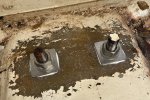
So I've gone ahead and added an additional 5mm plate to each of the existing plates. Pretty happy with the result, looks much more heavy duty.

Thanks everyone for your help.

Now to paint it...
 

Attachments

  • image00001.jpg
    image00001.jpg
    363.1 KB · Views: 20
Last edited:
Top