
Stabilizers-power/control?

realslimshady

Well-Known Member
Joined
31 Jul 2007
Messages
438
Location
Andover
Visit site
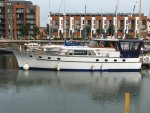
My brother recently acquired this 50' steel Dutch motor yacht-stabilizers are fitted but survey decribed them as 'non-functioning'.
We are in the process of ripping out (what we hope is) redundant equipment from the engine room, when one of the boatyard staff commented that the stabilizers might be compressor-driven.
I have no idea, and we can find nothing to guide us onboard. So wondered if anyone could suggest what we might be looking for, control-wise?
And suggestions as to what might drive them.
She's 1960 built, would there have been a fairly standard industry-wide norm for this installation?
Any help appreciated :-)
 

Attachments

  • trusty.jpg
    trusty.jpg
    94.6 KB · Views: 0
See if they're hydraulic, just by looking at them. If you don't know, post lots of pictures. I'd expect them to be hydraulic as opposed to compressed air (which you'd associate the word "compressor" with)

I'd expect there to be a hydraulic pump driven by a belt off the flywheel of an engine (or one pump on each engine maybe). Should be obvious. And I'd expect a gyro based control box in the helm station.

If they are vosper minifins we have lots of spares because my brother just removed a set of those from his 50 foot boat
 
Last edited:
I'd expect them to be hydraulic as opposed to compressed air
Yep, I also would.
That said, I half recall to have read about some earlier compressed air fin stabs...
Besides, if whoever suggested that they are "compressor-driven" said so because he spotted a compressor onboard, I can't think of any other reason for fitting it on a vessel like that.
I mean, it would be way OTT just as an onboard "tool", considering the boat size.

Oh, and +1 on what Firefly said.
Looking forward to more pics and a very interesting restoring project! :encouragement:
 
thanks for the replies. Our understanding was that the compressor/tank etc was because the previous owner did scuba diving, but if there are such things as compressed-air driven stabilizers, perhaps further investigation is required...
 
Also-never having encountered stabilisers on a boat before (only Boeing/Airbus vertical/horizontal types :-) ) what form would the controls for them take? Simply 'on-off'? Knob, switch, lever, gauge? And how do they work? Could be some thread drift here...
 
Also-never having encountered stabilisers on a boat before (only Boeing/Airbus vertical/horizontal types :-) ) what form would the controls for them take? Simply 'on-off'? Knob, switch, lever, gauge? And how do they work? Could be some thread drift here...

Why not ask Kim Hollamby? I'll let him know there's a thread running here so hopefully he'll drop in with some words of wisdom.
 
Also-never having encountered stabilisers on a boat before (only Boeing/Airbus vertical/horizontal types :-) ) what form would the controls for them take? Simply 'on-off'? Knob, switch, lever, gauge? And how do they work? Could be some thread drift here...
Modern stuff is all electronic using accelerometers etc. Old stuff had mechanical gyro with microswitches that were mechanically actuated as the gyro precessed (when the boat rolled), and you'd have an on/off control plus a gain control
 
Modern stuff is all electronic using accelerometers etc. Old stuff had mechanical gyro with microswitches that were mechanically actuated as the gyro precessed (when the boat rolled), and you'd have an on/off control plus a gain control

ah, ok cool. thanks, now I get the gist.
 
Just thinking aloud (while I wait for my brother to carry out investigative work)-a 1960s fitted compressed-air driven mechanical-gyro controlled stabilising system is not going to be the best...
If, in the future it is decided that functioning stabilisers are required, then one would think it possible to attach modern actuating/sensing equipment to the original stabilisers themselves....?
 
If, in the future it is decided that functioning stabilisers are required, then one would think it possible to attach modern actuating/sensing equipment to the original stabilisers themselves....?
I very much doubt that this is a realistic possibility.
I mean, the fins as such aren't the most expensive component of a stabilizing system - they are basically pieces of moulded plastic with a steel shaft inside.
Then again, if you should decide to fit some new fin stabs, already having a right (and already strengthened) place for them in the hull is better than nothing anyway.
The easier option by far would be fitting electric stabs, but I'm afraid at the moment the smallest model available is way too big for your boat (BartW installed them in his boat, but she's 70+ feet).
You can choose hydraulic stabs with a size suitable for your boat from several builders, but there's much more than just replacing actuators and sensors involved.
You need one (possibly on each engine, for redundancy) hydraulic pump, plus an oil reservoir and hoses, to start with. And if you wish to use them also at anchor, you must add a 3rd hydraulic pump, driven by an electric motor, feeded by the genset through a VFD device.
Considering the type of vessel we are talking about, I'd probably close the fins holes and call it a day.
My guess is that she's less prone to rolling than most modern hulls.
Besidee, if and when you'd like to stabilize her, you'll always have the alternative of fitting a seakeeper.
 
Thanks for that. As I can't realistically see any time soon where they are going to be needed, perhaps we'll just forget about them.. :-) underwater and out of sight is out of mind, after all!
 
Top