
Spreaders

Jase6100

Active Member
Joined
20 Jul 2020
Messages
43
Visit site
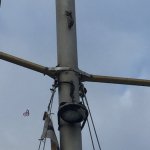
Next job on my work plan is to upgrade the spreaders. They are currently connected to the mast by a thin stainless strap that runs horizontally to the mast and the spreaders, that look as though they’ve modified from a spinikar pole, are bolted on to this
1610787242843.jpeg

I’m not happy with this and was wondering the best set up for my boat 29 feet. I have looked at other yachts in the marina and boats a similar size to mine have a bracket riveted or bolted to the mast and the spreaders push into them.


Any ides where to get replacement spreaders and the posts/ brackets or who would tackle a job such as this in the Lincolnshire area?

Thanks
 
I would be concerned about the corrosion at the front of that mast, behind the stainless strap.

Spreaders come in a few flavours. If your rig has the shrouds going to chain plates aft othe mast, then the spreaders tend to be pushing the middle of the mast forwards and someimes holding it back. If the shrouds are in line, the spreaders tend to be in fairly pure compression, pholding the middle of the mast sideways.
This has a big influence on the demands on the spreader bracket.
 
I updated ours last year, z spars mast, original had brackets and the upgrade had a spar through the mast with speadders bolted on each side, lots of detail on Z Spars web site
 
Thanks for the replies. The photo is not the clearest I took it from the deck and the zoom has lost some of the definition. I’m aware of the potential for corrosion where stainless interacts with aluminium. I did clean it and checked it prior to stepping and it looked ok. I have copied another picture that shows how the spreaders are connected. Doesn’t seem right at all to me and is another example of the Heath Robinson bodge up jobs that are a feature of the boat. I’m slowly but surly addressing each issue as are find them.
 
Nearly every boatyard has abandoned masts in it, many with spreaders, have a look you may be able to salvage and adapt something to fit your mast. These are not swept back, they would not be strong enough for that? The vertical angle you want to achieve should be such that the angle to the wire above and below is equal, though some older boats managed with flat spreaders. Dont do anything that involves making big holes in the mast wall, if a compression bar is needed it should not be more than 8-10mm max. but retrofitting an effective one will require considerable ingenuity.
 
Thanks for the replies. The photo is not the clearest I took it from the deck and the zoom has lost some of the definition. I’m aware of the potential for corrosion where stainless interacts with aluminium. I did clean it and checked it prior to stepping and it looked ok. I have copied another picture that shows how the spreaders are connected. Doesn’t seem right at all to me and is another example of the Heath Robinson bodge up jobs that are a feature of the boat. I’m slowly but surly addressing each issue as are find them.
The stresses on the mast where tangs and spreaders meet is a subject for expert opinion. Agreed the present setup seems capable of improvement. Rebasing the spreaders with feet suitable to the mast profile seems necessary but might involve raising the spreaders 50-70mm. This will also displace the spreaders out about 20mm but the rigging should be capable of necessary adjustment. I would want to remove the horizontal strap this way. This shouldn't cost the earth.

Getting the mast down for this and giving it a thorough overhaul looks wise.

PWG
 
I plan to unstep the mast at the earliest opportunity. I am fortunate to have fellow colleagues, at the yacht club, who have much more knowledge and experience than me who have offered to assess and offer potential solutions.

I will share the information and suggestions provided for consideration.

Thanks again

Jason
 
As already suggested above - I don't think I have ever seen a boatyard without old/ broken masts you might be able to salvage some parts.

What are you actually trying to do?
Beef it up for piece of mind? - because it is a bit weird!
What about getting two feet from a bimini frame you could slot and pin into the end of the spreader and rivet to the mast.
 
Yes, definitely want to ensure that the rigging set up is robust and seaworthy. It’s clear from comments that the current arrangement is not sufficient to take the forces and could contribute to a mast catastrophe. As I mentioned, since I got the boat I have had to make a lot of changes and improvements to the engine and the standing and running rigging. This was to enable a few trips out make further assessment and evaluation. The current issue attracted more focus after a sail before lockdown. When we returned I noticed the starboard cap stay had lost some tension and when we checked the spreader it had moved upward slightly.
 
Some spreaders as well as a riveted racket also have a bar that passes through the mast into each side.
does that not apply to nearly all masts? If not what stops the mast getting crushed between the spreaders?
 
This seems to be a common 'pro' arrangement....


45731030872_44d7208e71_w.jpg


Most yards and, I s'pose, any spar maker should be able to supply something suitable.
 
I have been undertaking further research into the original design of the spars and rigging on the Kings Cruiser 29 and have found that the spreader arrangement does seem to be consistent with that on my boat. These boats were manufactured in the early 70’s and this may have been the method that was used at this time.

The mast I have seems to be original and fits the description from information I have found

Anyway, I’m going to get it inspected to be sure.
 
does that not apply to nearly all masts? If not what stops the mast getting crushed between the spreaders?
I've been reflecting on this, and the answer is that very few that I've seen do it. Maybe a quarter had a through bar, but it did nothing to transfer the load to the other side.

What isn't immediately obvious is that the compression from the spreader end is more or less matched by the tension in the shroud (lower or intermediate) connecting directly beneath it.

The picture @zoidberg posted below yours is typical, and doesn't transmit the load (it's not a spreader fitting anyway, but the principle is the same).

The worst one I've seen was on a mass-produced boat where the spreader root fitting was a casting that included holes for the clevis pins to take two lower shrouds on each side. To tidy the lower terminal up they felt that it was a good idea to recess them into the root fitting a bit. Lovely - until you found that that meant there were a pair of lumps on the back surface of the root. So to fit it to the mast there was a big hole needed cutting into the mast tube itself - as well as the four rivet holes each side.
 
I broke the mast on a 28 foot Commando (Angus Primrose design, 1960s. ) and will look to see if I can find the spreader attachment. It consisted of a stainless steel plate about 1mm thick that went round the mast, riveted on, leaving a slot for the sail track. There were two stub tubes welded on at the sides to take the 25mm aluminium tube spreaders and tangs welded on for the lower shrouds. If I find it I will take a photo and post it here.

The reason the mast failed (according to the surveyor) was the spreaders were too low at 48% of mast height, they had not been swept up to equalise the angles of the wires at the shroud ends and there was some corrosion in the walls of the mast. The mast was renewed with a kit from Z-Spars with cast aluminium fittings and the shrouds were fixed at the recommended height of 55% (?) of mast height.
 
Looking at the photo I can see intermediate stays going forward and aft ie 4 intermediate stays. This means the centre of the mast is positively located by the 4 stays. This means the spreaders are not required to do anything but improve the angle of the cap shrouds to the top of the mast. This means the only load on the spreaders is end pressure. This might help in designing the new spreader base but might also explain why the existing bases have been adequate.
Different from a fractional rig where the intermediate stays only pull aft and the spreaders tips are forced forward when leaning on the cap shrouds with chain plates located well aft of abeam the mast. The push forward via the spreaders counteracts the pull aft of the intermediate stays and so locates the mast middle in fore and aft direction. So the base of the spreaders is critical in holding this swept back angle. (I am guessing this does not apply to your spreaders) ol'will
 
I broke the mast on a 28 foot Commando (Angus Primrose design, 1960s. ) and will look to see if I can find the spreader attachment. It consisted of a stainless steel plate about 1mm thick that went round the mast, riveted on, leaving a slot for the sail track. There were two stub tubes welded on at the sides to take the 25mm aluminium tube spreaders and tangs welded on for the lower shrouds. If I find it I will take a photo and post it here.

The reason the mast failed (according to the surveyor) was the spreaders were too low at 48% of mast height, they had not been swept up to equalise the angles of the wires at the shroud ends and there was some corrosion in the walls of the mast. The mast was renewed with a kit from Z-Spars with cast aluminium fittings and the shrouds were fixed at the recommended height of 55% (?) of mast height.
I would seriously doubt you lost your mast from spreader not equalising the angle to the cap shrouds. If this were the cause the spreader would be totally pushed out of line beyond 45 degrees down or up, if not broken off. I also doubt the location of the spreaders from 48% to best 55% was the cause. Of course you do not describe the rig type. Presumably mast head. Also depends on the size of the mast. Smaller rigs are more forgiving. Certainly my spreaders on fractional rig are way lower than 48% of mast height. Perhaps 48% of height to the hounds. (top of cap shrouds) with 20% or so mast unsupported above that. I also doubt that the corrosion of the wall of the mast was that bad as to cause the mast to fail. (without you being aware of it)
Masts are usually lost through as failure of rigging (wires or fittings) Any way not for me to say why your mast broke. Just an opinion. ol'will
 
Looking at the photo I can see intermediate stays going forward and aft ie 4 intermediate stays. This means the centre of the mast is positively located by the 4 stays. This means the spreaders are not required to do anything but improve the angle of the cap shrouds to the top of the mast. This means the only load on the spreaders is end pressure. This might help in designing the new spreader base but might also explain why the existing bases have been adequate.
Different from a fractional rig where the intermediate stays only pull aft and the spreaders tips are forced forward when leaning on the cap shrouds with chain plates located well aft of abeam the mast. The push forward via the spreaders counteracts the pull aft of the intermediate stays and so locates the mast middle in fore and aft direction. So the base of the spreaders is critical in holding this swept back angle. (I am guessing this does not apply to your spreaders) ol'will
Thanks for your information. If you look at the photo you can also notice that the starboard spreader has lifted slightly and this initially brought my attention to the set up. I also noticed that the corresponding cap stay had lost some tension. Do you think the movement of the stay caused the loss of tension or change in tension caused the spreader to move?
 
Top