Spreader lengths..........?

dukes4monny

Well-Known Member
Joined
4 Feb 2008
Messages
963
Visit site
Hi all, after my recent thread regarding spreader angles (bisecting shrouds), I have a new conundrum which has been thrown at me.......
I've just ordered a new roller furling genoa. During discussions with the sail maker, he said I could (should?) look at reducing the length of my spreaders to improve general sailing performance........
He says that older boats like mine were usually fitted with overly long spreaders and these govern how tight the genoa can be sheeted with a big affect on airflow and also pointing ability.
He said I should aim for an optimum angle of the shroud at the masthead of 15°.
Whilst I understand the theory involved with this, I am left wondering whether I am going to be reducing the overall integrity of my rig by doing this?
It's a masthead rig on a 1976 Jag27.
I don't race her, she's only used for cruising.......but I'm not a fair weather sailor either......
What's the opinion of the learned forumites, is this a modification worth doing............or best avoided?
I know that the shrouds would also need to be shorter.....but I'm fitting new ones anyway.

Thanks for any advice.
 
Re: Speader lengths..........?

I'm assuming that the Jag has a single spreader rig with full lower stays, i.e. there is no sweep to the spreaders to prevent pumping? If that is the case, then the sailmaker may well be right in suggesting that the angles can be reduced by shortening the spreaders. I guess you have to first measure the angle of the cap shroud at the masthead to see if you have room for improvement and decide whether you want to give it a try! You might find that you need to increase the cap-shroud tension to prevent the masthead from sagging away, though.
The above is not based on any first hand expertise, just surmise!

Rob.
 
Re: Speader lengths..........?

15 degrees is very high, the general consensus is that 12 degrees is about right. If you have an angle of more than 15 then it's very high indeed. On a masthead in line rig the spreader length is straightforward the lengths and angles are simple geometry. On a swept back rig it's a bit more involved. As the caps are tightened the mast will bend forward and the spreaders need to be long enough to accommodate that. In cutting the spreaders the chain plate positions are paramount, you wouldn't normally cut the first spreaders to less than the distance between chain plate and mast wall. I suggest you leave all the calcs to a yacht or rig designer and ensure that liability is accepted,
 
Re: Speader lengths..........?

An angle at the masthead of 12 degrees is considered the minimum for any rig, so 15 degrees for a single spreader cruising rig sounds a bit racey to me!
I'm sure it will provide some improvement on the wind but I don't know whether you would notice any significant gain over the current set up that you wouldn't also attribute to your new sails and rigging.
I believe the Jaguar 27 is based on the Catalina 27 which I know quite well. There were several rig options on these boats over the years, but they do have a reputation for sailing well so shortening the spreaders might be a very marginal tweak.
Entirely my personal opinion, of course, and worth what you pay for it!
 
Re: Speader lengths..........?

He did actually mention 12° as the 'ideal', but he implied that it would be safer with 15°........which I guess is why some doubts have crept in for me.........
Yes the rig is in line masthead with single spreader and fore and aft lowers.
Are you saying that the cap shrouds should run parallel to the mast up to the spreaders? If that is the case, then I would also need to move the chainplates inboard to accommodate the shorter spreaders?
 
Re: Speader lengths..........?

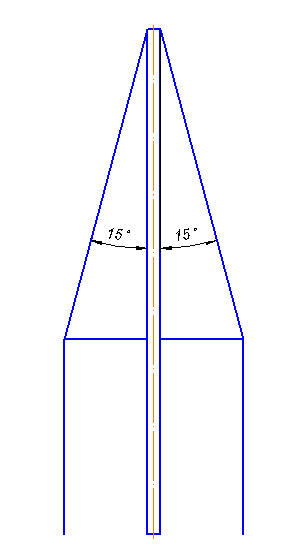
I just want to make sure we are all talking about the same angle here..........
I've created a quick cad drawing of the angle that 'I think' he's talking about:

angle.jpg
 
Re: Speader lengths..........?

Yes the drawing is what I thought and 15 degrees is better support than 12, the point is that you could reduce the spreader length so that you approach 12 degrees and be OK.. The lowers should normally be parallel to the mast. If you think about it if the spreaders were made smaller then the spreaders would have to point further up so that the tip bisects the angle on the shroud. If it doesn't bisect then the resulting force won't be in line with the spreader. You also have to deflect the cap shroud by 12 degrees ideally, don't have more because the resultant force on the the spreader will be too high. Any less deflection means the spreader will cease to support anything at all.
Moving the chain plates is a major job, very unlikely to be worthwhile. You might get away with an inch or two off the spreaders but that might not help much with the sheeting as the clew will normally fairly close to the chain plate.

You may have guessed, I've been down the same the same road on mine.
 
Re: Speader lengths..........?

Thanks savageseadog, it's nice to hear this from someone who has actually been through it already..........
To be honest, I understood everything up until the point where you say that the "cap shroud should be deflected by 12 degree's", do you mean that the spreaders should be swept aft to give the 12 degree's?

I've been sailing for years but have never really considered what thought has gone into that metal pole that I hang the sails on... /forums/images/graemlins/ooo.gif
 
Re: Speader lengths..........?

[ QUOTE ]
do you mean that the spreaders should be swept aft to give the 12 degree's?

[/ QUOTE ] No. If you look at your drawing, at the spreader tip, the wire changes direction. If there were 0 degrees deflection or included angle 180, then the wire would be straight. You normally want approx 12 degrees which would be an included angle of 168 degrees. The spreader bisects that angle so 84 degrees between the wire and spreader above and below.
It's good to work these things out and think about them because you discover how important these things are.
 
Re: Speader lengths..........?

Thanks, I completely understand that now.
[ QUOTE ]
It's good to work these things out and think about them because you discover how important these things are.

[/ QUOTE ]
Too right......now I've started drawing this all out, it turns into a bit of a Chinese puzzle.
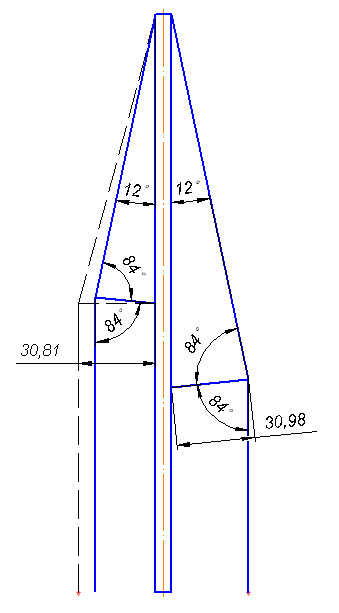
If you look at the following doodled cad drawing, which is not to scale, but illustrates the problems involved.
On the left hand side is the original setup displayed with dashed lines.
Simply changing the angles and keeping the spreader in the original position gives the result with the solid lines. You can see that the chainplates would need to be moved inboard to keep things correct.
The right hand side shows the alternative to this is to move the spreader down and lengthen it to maintain the angles and use the existing chainplate positions.........
Interestingly, the spreader ends up about the same length as the original............my head hurts now /forums/images/graemlins/blush.gif
angle2.jpg
 
Re: Speader lengths..........?

You can actually see that the new arrangement in blue on the left actually looks right.
On most boats changing the chainplate positions is very difficult,. Remember that the maximum load on them is about the same as the weight of the boat. You will need a bulkhead and metal reinforcings or other support below deck.
Without modification (of the boat) you could make the rig taller but any changes like that will need input from a designer.
 
Re: Speader lengths..........?

[ QUOTE ]
Thanks, I completely understand that now.
[ QUOTE ]
It's good to work these things out and think about them because you discover how important these things are.

[/ QUOTE ]
Too right......now I've started drawing this all out, it turns into a bit of a Chinese puzzle.
If you look at the following doodled cad drawing, which is not to scale, but illustrates the problems involved.
On the left hand side is the original setup displayed with dashed lines.
Simply changing the angles and keeping the spreader in the original position gives the result with the solid lines. You can see that the chainplates would need to be moved inboard to keep things correct.
The right hand side shows the alternative to this is to move the spreader down and lengthen it to maintain the angles and use the existing chainplate positions.........
Interestingly, the spreader ends up about the same length as the original............my head hurts now /forums/images/graemlins/blush.gif
angle2.jpg


[/ QUOTE ]

Well done ! I like this stuff !

Just a thought toward different sheeting angles :-

I love messing about with sheeting angles , particularly as I still have hank on sails.

My limited knowledge reveals that you must have the right keel and boat to take full advantage of tighter sheeting plus sea state etc. On my rather heavy boat with a long keel I just lose too much speed. You might do much better with the Jaguar !

My favourite sail is the blade jib with full hoist and with just under 100% foot.It can be made off to almost anywhere with blocks and lines and is very versatile. I even use it when motoring to windward with the clew tied to the base of the mast.

One day I would love a furling gear but would certainly get a blade jib to fit as well.
 
Re: Speader lengths..........?

Just to recap.
The sailmaker has suggested a smaller sheeting angle for the jib. When using the largest jib or full jib (roller) the leach will foul the spreader tip and stay wire. This is not a problem with a smaller jib.

A shorter spreader may ease the problem a little but really needs chain plates further inboard to give a big change of sheeting angle.

When you have rough seas to beat into and stronger winds a wider sheeting angle is often better for more power.

With smaller sail you can try reducing the sheeting angle when going to windward by taking the sheet inside the stay. This can be done with a tweaker line puling the sheet inboard.
Really good pointing ability is a function as already said of hull and keel shape as well as sail shape.

IMHO the advantages of a smaller jib sheeting angle may not justify the risk of reducing spreader length and or chain plate position all of which will put more stress on the mast when driving hard.

good luck olewill
 
Top