Spliced loop failed on mooring strop

Jaguar 25

Well-Known Member
Joined
14 Nov 2012
Messages
466
Location
Liverpool
Visit site
When I went to my boat this week the primary mooring strop was dangling from the bow after the spliced loop around the thimble used to attach it to the mooring buoy had completely undone. I don't reckon to be an expert splicer but I have never had one undo before. I am on Ullswater and the mooring does take a battering from the Ullswater steamers' wakes as they pass a couple of times an hour.

I have produced a new strop (from new, but the same type of rope) but this time I have taken the last part of the three strands and turned them back over the spliced rope and then applied a whipping to hold them in situ and a cable tie at the bottom of the thimble to keep the rope snugly against the thimble.

What should I do differently?
 
How old was it and how often do you check it?

I made some non thimble splices for mooring about three years ago, standard splice, no whipping. but tapered. I definitely fall into the 'amateur' category but they seem fine. I had much more difficulty making a thimble version and keeping it tight.
 
What type of rope was it, and how many tucks did you give it? I've never had a splice fail, but always do three tucks minimum, ideally more.
 
I had problems with my thimble type strops. Its difficult for an amateur to get them sufficiently tight. Maybe a whipping would help.

I have teporarily used a cable tie to keep the spliced rope firmly against the thimble. Whipping used to keep the three splicing ends folded back. I will supplement the cable tie with whipping this week. I may also splice another loop into the strop at the mooring buoy end and attach it to the mooring buoy ring.

One thing is for sure, I am glad I had two strops even if they do twist together!
 
Storm Hector gave Cumbria a really good, (bad?) kicking mid-June. Could the splice have been damaged then?
Five tight tucks is the absolute minimum in my understanding to ensure security
 
Three tucks used to be considered OK for hemp, manilla, sisal etc, but for man made fibres, five tucks is the normal minimum. I have never seen a splice undo itself. If the mooring strop was getting severely (un)twisted, I suppose it might affect the splice, but it would affect the rope even more.
 
Is the splice getting twisted by the mooring rotating?

The other thing is pulling the splice tight. That requires a lot of pull on a big stiff rope.
 
Is the splice getting twisted by the mooring rotating?

The mooring strops do get twisted but I cannot see how this would affect the splice.

If it gets out of had, it can unlay the rope.
Even in moderation, it creates a lot of movement between the 3 strands and maybe allows the splice to work looser.
I think it's worse when the splice is not under continuous tension.
 
When I went to my boat this week the primary mooring strop was dangling from the bow after the spliced loop around the thimble used to attach it to the mooring buoy had completely undone. I don't reckon to be an expert splicer but I have never had one undo before. I am on Ullswater and the mooring does take a battering from the Ullswater steamers' wakes as they pass a couple of times an hour.

I have produced a new strop (from new, but the same type of rope) but this time I have taken the last part of the three strands and turned them back over the spliced rope and then applied a whipping to hold them in situ and a cable tie at the bottom of the thimble to keep the rope snugly against the thimble.

What should I do differently?

how many "tucks" had you done & what rope used
 
In my early days I remember having a splice come undone and it was because it was not under tension, and subject to gentle jerks - just like a mooring. It kind of "teased" apart. I now make sure I melt the tails so there is a lump preventing the tail slipping through the strand, and whip securely also. I have never had a splice come undone under tension, so I think the gentle jerking may be the issue here.
 
To echo what others have said, 3-strand can unsplice itself quite easily if twisted. I should check your swivel for free rotation, and in making the new strop I would use 8-plait. This won't unsplice through twisting and so is superior for mooring strops imho.
 
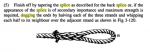
A technique used for eye splicesin man made fibre that are "critical" is to take five tucks and then, rather than tapering the ends or turning them back, to divide each of the three ends into half and whip adjacent halves together. This is stronger than turning them back and can look quite good. It's also a recognised technique to put a whipping around each leg of a thimble to stop it rotating out of the splice under heavy load.
 
I'm something of a novice to the whole boating/splicing thing, but I would never splice with less than three "loops" or whatever the term is. When I'm finished making a splice, I loop it around something heavy/fixed and pull the bejay**s out of it to help tighten it up. I think the notion of using a cable tie can't harm either.
 
A technique used for eye splicesin man made fibre that are "critical" is to take five tucks and then, rather than tapering the ends or turning them back, to divide each of the three ends into half and whip adjacent halves together. .

Note: This technique is called 'dogging'. Discussing this over a beer may inadvertantly lead to misconceptions in those who overhear you...

Dogging.PNG
 
Last edited:
A technique used for eye splicesin man made fibre that are "critical" is to take five tucks and then, rather than tapering the ends or turning them back, to divide each of the three ends into half and whip adjacent halves together. This is stronger than turning them back and can look quite good. It's also a recognised technique to put a whipping around each leg of a thimble to stop it rotating out of the splice under heavy load.

That sounds really good. I will try it later this week.
 
Top