
Southerly Deck Osmosis

antonyn

New Member
Joined
2 Feb 2016
Messages
2
Visit site
Hi, Wondered if anyone has experience of osmosis on the deck of a yacht. Went to view a 1984 Southerly 105 and the deck had bumps / blisters all over it like measles, and a few badly filled ones.
Oddly the hull was clear of blisters, but did have some small areas that looked as if they might be candidates for future issues.

Question is - do most old Southerly's suffer from this, or is this an exception?

Any advice helpful!!

Antony.
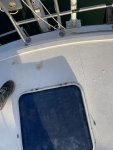
IMG_7139.JPEG
 
Last edited:
Probably caused by loose covers draped over decks trapping rain water, that then heated up in the sun. Hot fresh water for longish periods is about the worst combination you can get for causing "osmotic blisters". If the deck balsa core was wet as well it would also contribute. Often see them on hull topsides as well where covers have been against GRP.

Now this boat has them really difficult (but not impossible) to fix more or less invisibly.
 
I have seen blisters like these on several boats of different makes. Usually as jwilson said in post 2 where the deck has been covered by something that has been wet. On one boat it was an old towel that had been left under the sprayhood for some reason and for a long time. On another, carpet tiles had been fitted to the deck under the sprayhood near the companionway. They also used to get wet and when removed revealed the blisters. After being allowed to dry out over the winter under a cover, the deck was sanded heavily and defects were filled and devk paint applied. I didn't need to touch them again for many years.
 
When I removed some TreadMaster from my cockpit, I found some omosis blisters due to trapped water. So the above comment are correct. If the rest of the boat is in an acceptable condition, then negociate a good reduction in price. Then grind out each blister and leave to dry. Then fill with a gel coat filler like Teroson. Sand the non slip areas to smooth and tape up with long life masking tape so you can apply a couple of coats of non slip deck paint like Interdek. Grey is a nice colour, but the choice is yours. All Westerly boats have painted decks and they only need a fresh coat after several decades.
 
I wouldn't touch them unless you're going to do the whole area, patching textured gelcoat always looks rubbish unless painted with deck paint etc.
 
I wouldn't touch them unless you're going to do the whole area, patching textured gelcoat always looks rubbish unless painted with deck paint etc.
My thoughts too. I've heard it said that one can take an impression of the deck with some GRP (wax the deck well!) then press the mould into the filler, but I rather doubt it's as easy as it sounds. and a couple of mm out of alignment would ruin it.
 
My thoughts too. I've heard it said that one can take an impression of the deck with some GRP (wax the deck well!) then press the mould into the filler, but I rather doubt it's as easy as it sounds. and a couple of mm out of alignment would ruin it.

I tried this - works well

except

Once you have laid up and peeled off you get a decent mould, you can then make multiple pieces, You cannot sand the final pieces, or you remove the dimples. When you come to paint the paint runs off the pimples and fills the bits in-between. You need a few coats of paint (to get coverage and to ensure it lasts) and each coat slowly 'fills' the moulding reducing the effectiveness of the piece. You could use gel coat - but then its getting more complicated as you are not sure of getting a match. When I did it I was spray painting and needed to match.

The trouble with this sort of thing is that its a one off - you need to practice to get it right - and then you do it once only. If you were a professional you would know all the tricks - so for a one off - you learn the tricks - and never need them ever again!

The extra pieces I made (for a transom extension) I kept as part of my emergency repair kit - 400mm square glassed panels - and have never needed.

Jonathan
 
The GRP professional at a yard generally regarded as a high quality boatbuilder had to do the impressions bit after a couple of untrained and unsupervised apprentices damaged my deck by brute-force levering off a Sikaflexed-down alloy toerail. You can still see the joins, though the diamond dimples are faithfully recreated and all in line.
 
I tried this - works well

except

Once you have laid up and peeled off you get a decent mould, you can then make multiple pieces, You cannot sand the final pieces, or you remove the dimples. When you come to paint the paint runs off the pimples and fills the bits in-between. You need a few coats of paint (to get coverage and to ensure it lasts) and each coat slowly 'fills' the moulding reducing the effectiveness of the piece. You could use gel coat - but then its getting more complicated as you are not sure of getting a match. When I did it I was spray painting and needed to match.

The trouble with this sort of thing is that its a one off - you need to practice to get it right - and then you do it once only. If you were a professional you would know all the tricks - so for a one off - you learn the tricks - and never need them ever again!

The extra pieces I made (for a transom extension) I kept as part of my emergency repair kit - 400mm square glassed panels - and have never needed.

Jonathan
I did something similar with my old Southerly but the deck only had a couple of very small defects, just chips. I used a small wooden frame filled with plasticine. Just a matter of placing it over the area, marking the outer edges with masking tape and pressing the plasticine down quite hard. It lifted off easily to allow the area to be cleaned and filled. The plasticine worked well as a mould after some release agent sprayed on it. Alignment and use of just enough gelcoat was a bit tricky but the repairs were perfect.
 
This is an awful longshot. The blisters are either hollow or have fluid present, which could be extracted via a pinhole. If warmed with a heatgun could a blister be pressed back down? The skin is, after all, plastic. Once flattened a squirt of epoxy with a hyperdermic. Time consuming compared with grind and fill.
As I said, long shot...
 
Top