
Sounds Absorption

5teve

Well-Known Member
Joined
23 Feb 2016
Messages
262
Location
Western Australia
Visit site
Hi Guys

A bit different to the usual engine room noise question.. as the engine room has foam above it so internally the noise isnt too bad.

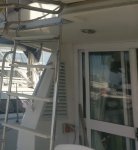
The issue is that the builder who is local made the engine vents face inwards where the saloon doors are. Great idea to stop any salt water ingress into the engine room in the crappy seas we get.. but not so good for holding a conversation when underway if you are sat on the deck..

Most of the noise comes up through the 'ducts' which to be fair are pretty big (probably 300x300 cross section at the top and 1000x500 at the bottom) so I am looking to tame the noise. I have been looking at the typical pyramid type foam and looking at sticking that inside the ducts to absorb the noise and also add a plate behind the louvered panel (maybe stood off the vent by 50-100mm also with this foam on)

I dont really want to spend the money on the foam without some confidence its going to mute it.. most of the stuff I read insinuates that it absorbs certain sounds - but i'd be interested to hear your thoughts on what may work..
 

Attachments

  • duct.JPG
    duct.JPG
    38.2 KB · Views: 2
One approach would be to introduce some internal baffling in the duct. 90 degree corners in ventilation ducts reduce sound transmission as does lining the duct with sound absorbing material.
The open area you need for airflow is presumably the open area at the louvres so any area in excess of this further down the ducting towards the engine room could be filled with sound absorbing foam.
A couple ( or more ) slats across the duct that block line of sight between louvres and engine room would cut down sound transmission. These would be at an angle but not 90 degrees to the airflow path.
The slats could have foam glued to them that would also absorb some sound. The best foam is open cell and as high density as you can get, this is normally measured in Kg/Cu.M.
Fibreglass likely to shower particles into engine room unless it has a surface coat or is bagged.
If you maintain at least the open area for airflow then you should experience a noticeable sound level reduction. The general approach is similar to that used in a transmission line loudspeaker enclosure.
An additional noise source could be the air flowing past the edges of the louvres but it would have to be moving at some speed for this effect. If this is happening then round off any sharp edges in the air pathway.
Rather a lot of work I suspect but it should work.
 
Last edited:
Be careful when installing internal duct lining if ducts are not designed to accommodate it, it can significantly reduce duct cross sectional area, potentially increasing resistance, velocity and/or impacting volume flow rate. There are some very effective acoustic flexible ducts available on the market, if you can fit them in, such as Euroflex 350. Although hard bends will provide a level of attenuation, a flexible acoustic duct might be a better option, if of course you have room to fit it in.
 
It would help to know how much excess duct cross section there is. It may be that the builder designed ducts that very over size, just what fitted neatly in the space.
Try blocking some of the grill and seeing if there is any detriment to the engine room air flow.
Once you are confident about how much extra you have you can then examine various solutions.
sound absorption with foam etc is just one method, confusing the sound path is another install baffles that permit some air along a shorter route while the rest has to go further.
If money is no object then there are active systems that use a loudspeaker to mix the inverse of the noise to cancel it out.
 
Vent it all upwards to the upper deck ?

Thanks Simon - not possible due to flybridge construction..

One approach would be to introduce some internal baffling in the duct. 90 degree corners in ventilation ducts reduce sound transmission as does lining the duct with sound absorbing material.
The open area you need for airflow is presumably the open area at the louvres so any area in excess of this further down the ducting towards the engine room could be filled with sound absorbing foam.
A couple ( or more ) slats across the duct that block line of sight between louvres and engine room would cut down sound transmission. These would be at an angle but not 90 degrees to the airflow path.
The slats could have foam glued to them that would also absorb some sound. The best foam is open cell and as high density as you can get, this is normally measured in Kg/Cu.M.
Fibreglass likely to shower particles into engine room unless it has a surface coat or is bagged.
If you maintain at least the open area for airflow then you should experience a noticeable sound level reduction. The general approach is similar to that used in a transmission line loudspeaker enclosure.
An additional noise source could be the air flowing past the edges of the louvres but it would have to be moving at some speed for this effect. If this is happening then round off any sharp edges in the air pathway.
Rather a lot of work I suspect but it should work.

Thanks Montemar - the thought had crossed my mind re perpendicular baffles - like a torturous path for the sound to travel. I think that most comments have given the local builder too much credit for thinking about the ducts. The open area of the louvres is far and above what the engine requires even at full chat.. they are that large I do not think you would feel the airflow from the engines sucking air..

The foam I am looking at is the pyramid type foam - fire retardant - acoustic foam - open cell and 25kg m3

Be careful when installing internal duct lining if ducts are not designed to accommodate it, it can significantly reduce duct cross sectional area, potentially increasing resistance, velocity and/or impacting volume flow rate. There are some very effective acoustic flexible ducts available on the market, if you can fit them in, such as Euroflex 350. Although hard bends will provide a level of attenuation, a flexible acoustic duct might be a better option, if of course you have room to fit it in.

Hi John - if you look at the picture - the section that the louvred panel is mounted - is completely hollow so from the flybridge, down past the louvred panel, and down to the deck is just one huge open 'column' for want of a better description with the bottom completely open to the engine room.. so adding some 50mm thick foam is not really going to restrict the airflow.. not unless I am severely underestimating the air consumption of the 6bta.. :)

It would help to know how much excess duct cross section there is. It may be that the builder designed ducts that very over size, just what fitted neatly in the space.
Try blocking some of the grill and seeing if there is any detriment to the engine room air flow.
Once you are confident about how much extra you have you can then examine various solutions.
sound absorption with foam etc is just one method, confusing the sound path is another install baffles that permit some air along a shorter route while the rest has to go further.
If money is no object then there are active systems that use a loudspeaker to mix the inverse of the noise to cancel it out.

Haha - money is most definitely an object! - I am currently redoing all the exhausts (including risers and mufflers), turbos, heat exchangers and aftercoolers due to the sheer lack of though and design by the builder.. (most of the engine issues are exhaust related) great hull... but that is where it ended! With this in mind its fair to say that the louvres are whatever would fit and look right in that position.. size has not been calculated in any way..

Your idea of blocking the grille to find out if there is any detriment - has actually made me wonder if they could be partially blocked permanently? That would reduce noise output and along with baffles and foam should get rid of a fair bit.. maybe something worth experimenting with with a bit of duct tape and plywood!

Thanks

Steve
 
Yes, I now see what you mean.

There are some very effective attenuated grilles/louvres that can be purchased and made to measure, I have specified them from time-to-time to plantroom inlets/outlets and doors. However, if they have used the duct as a low loss plenum, and you can gain access, a series of attenuated baffles and/or lining, breaking the sound path, installed internally might also be a viable option. You would need to consider if the noise can of course break out from the duct walls itself, in that case acoustic duct lining and an acoustic louvre would be the best way forward IMHO.
 
Top