soot measurement in exhaust gas

have you done a full- full test with a good run to verify.? I have found boat fuel gauge accuracy to be very imaginative,depending on the type and installation.

I also was introduced to an interesting test a few weeks back to help determine which engine is working harder (at a decent engine speed)- measure the temperature of the pipe from the turbo charger compressor side to the charge air cooler. They should be similar.
Yep, separate tanks, so when I fill I know the difference.
 
That's much better than nothing, but to do that you must have an IR thermal gun and go inside the e/r.
In which case, while you are at that, you could as well go for the full monty, and measure/compare the temp of each cylinder at the respective exhaust flange.
Btw, that is even better than the EGT number which you get in the displays of electronically controlled engines, because it only gives you a sort of average for all cylinders.
By measuring them separately, on top of the possible differences between the two engines, you can also spot in advance any potential malfunctioning of a single injector.
The only drawback (aside from needing a bit more time) is that depending on the installation, the access to the external engines sides might be a PITA - particularly with the engines hot and running... :ambivalence:

Your exhaust manifold and the bends are enveloped in water jacket from the close cooling .
You can,t see each pipe to accurately measure as the pipes are deep surrounded by liquid

Re fuel measuring fwiw if you have sight glasses , on each tank for each engine , use those mark them .
But a few % difference may be poss , not sure as mine seen identical, same rpm , same L/ h , load , and EGT,s within a couple of degrees .

https://imgur.com/a/bOih8
 
Your exhaust manifold and the bends are enveloped in water jacket from the close cooling .
You can,t see each pipe to accurately measure as the pipes are deep surrounded by liquid

Re fuel measuring fwiw if you have sight glasses , on each tank for each engine , use those mark them .
But a few % difference may be poss , not sure as mine seen identical, same rpm , same L/ h , load , and EGT,s within a couple of degrees .

https://imgur.com/a/bOih8
Wow, I'm flattered by how often you bother preparing pics specifically to comment some posts...
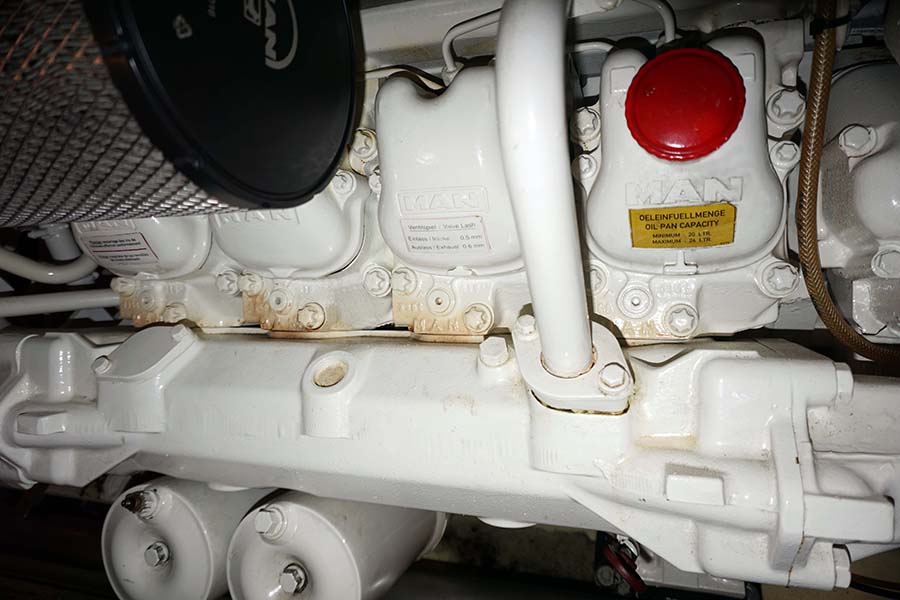
Btw, do tell, did you spray your rocker covers with gold paint? :D
Anyway, I can understand your bewilderment about this matter, because looking at your pic I would agree that it seems hard to do what I suggested, on those 6L engines.

That is very easy on MAN V engines, though.
You'll forgive me if I don't touch-up the pic below to better explain, but just look under the rocker covers, and you will see one Allen head for each cylinder...
HhnHwgpj_o.jpg

Now, I got straight from the horse's mouth that by pointing an IR gun to those bolt heads you can get a measurement closely related to the EGT of each cylinder, while the engine is running.
You can see why also from the pic, because that section of the cylinder head is before the jacketed manifold, and as close as you can get to the exhaust passages.
Goes without saying that by measuring, rather than the gas itself, some iron parts surrounding it (so to speak), you don't get numbers anywhere near 600 deg or whatever.
But the point is another one: as long as you get consistent readings in all cylinders, and also between the two engines (provided of course that all other "generic" parameters are ok), you can very reasonably assume that the combustion is fine in all chambers, which in turn means also that all injectors are fine.
Btw, coming to think of it, this is relevant also to Scubaman recent thread about injectors nozzles - I'll post a link there...


Ref. fuel burn, I did have sight gauges on my old boat (and I fitted them also on the DP, btw), but I never bothered closing the valve of the connecting pipe between port and stbd tanks, also because that makes life easier when refilling.
Therefore, I would have never noticed the differences that rafiki mentioned.
That's why I asked him, knowing that he also doesn't have any fuel burn instruments - as opposed to yourself and anyone else with the luxury of electronic engines! :D
 
just look under the rocker covers, and you will see one Allen head for each cylinder...
HhnHwgpj_o.jpg

Now, I got straight from the horse's mouth that by pointing an IR gun to those bolt heads you can get a measurement closely related to the EGT of each cylinder, while the engine is running.
You can see why also from the pic, because that section of the cylinder head is before the jacketed manifold, and as close as you can get to the exhaust passages.
Goes without saying that by measuring, rather than the gas itself, some iron parts surrounding it (so to speak), you don't get numbers anywhere near 600 deg or whatever.
But the point is another one: as long as you get consistent readings in all cylinders, and also between the two engines (provided of course that all other "generic" parameters are ok), you can very reasonably assume that the combustion is fine in all chambers, which in turn means also that all injectors are fine.

interesting comment MapisM,
this is a test that I used to do regularly, so I'm gladd this is confirmed by the MAN man.
and spicifically the position of that allen head screw, is a good reference,
(exact positioning of the IR gun is very important / gives different readings in that zone...)

so I won't bother installing EGT gauges, but concentrate on this measurement / comparing temps on all 24 cylinders,..

FYI, such a infrared measurement instrument is not expensive,
usefull for quickly checking / comparing different temps on different parts on the engines,
there should be one in every boat engine room ..
 
Last edited:
Bart needs help recognising if 1100 rpm is sub optimal re cylinder temps / pressure .
Conversely what effect 2000 rpm is having on his “ old girls “
MAN suggest EGT,s should sit somewhere north of 550 - to low 600 ,s
It’s not the actual cylinder temp. But an extrapolation for engine health .
Below 550 EGT s leads to potential sooting of the injector tips on top of loose rings and early oil contamination risk .

More likely to knacker the injector tips from soot deposits running below recommend cylinder temps / pressure .

Our American cousins with MAN,s get the longest hrs between rebuilds running @ 1750/1850 rpm .6-8000 hrs
Shortest @ and above 2000 rpm about 2000 hrs .


Injector change out / inspect has been removed from the 1000 hr service , I think it’s 3000 hrs these days ?

Those soot deposits are clinging to your injector tips as well as the transom btw .

I don,t buy into leaving Mrs helming in a busy sea while you climb into the ER waving a IR heat gun about in some attempt to meaningful access data to act on ,other than curiosity- good luck with that guys , sounds like a health and safety nightmare particularly doing the outboard banks .

Also Barts done quite a bit of electronic and electrical up grades so against that background I,am a bit surprised of the easy seeming dismissing of retro fitting EGT sensing equipment.

@Mapish re gold paint , just touching up , they get scratched climbing over resting tools etc over the years .

@ Jrudge —- planes are easy as no water jacket ,they have open manifold s easy to tack kit on , And agree not very sensible , more ridiculous than a boat infact of hand IR gunning near a spinning prop ( assume strap plane down ?)
Anyhow - petrol s so waaaay lower EGT,s and no sooting injector tip issues like an oil burner .
How ever you need to see the EGTs and can adjust the mixture ,lean / rich etc as the O2 varies with altitude


I use a IR heat gun less and less these days , just to check the HE temp match the guages ,and other comparisons.
Seen to match so don,t do it a lot these days .
Fuel tank temp is interesting before and after a long run - try it :encouragement:

The Volvo Penta gauges were erroneous— harness resistance issues — hence the IR heat gun purchase!
 
Last edited:
FYI, such a infrared measurement instrument is not expensive,
usefull for quickly checking / comparing different temps on different parts on the engines,
there should be one in every boat engine room
Yup, I fully agree - in fact, I've had one of those things onboard for more years than I can remember.
Mind, Portofino is correct about the difficulty to point the IR gun while cruising, particularly at high rpm/speed, and even more so on the external banks - though as I recall the accessibility is not bad, in BA.
It is also true that you don't need to keep monitoring the engines at all times, and for the odd spot check you can as well wait for calm seas...
But all considered, I still would love to fit proper EGT gauges, also because with them you can set an alarm.
Again, pros and cons also on them, because aside from the obviously higher cost, you can only be alerted whenever the EGT of a whole cylinder bank goes above your pre-defined limit.
And since each cylinder accounts for just 1/4 of the whole bank (or even less, i.e. 1/6 on your and PF engines), it takes a VERY high difference in one cylinder to significantly affect the total...
Pick your poison! :D
 
my two eurocent

for 5.3quid a piece, you can get 6, 12, 16, or 24 K Type thermocouples. Get these:
https://www.ebay.co.uk/itm/2M-EGT-K...978124&hash=item5d7928ff80:g:k6sAAOSwKQ9aPgXY

and definitely don't be a cheapskate like myself and get these:
https://www.ebay.co.uk/itm/2Pcs-EGT...419196&hash=item58bc547dea:g:lDUAAOxy06RRIKKK
They don't work, wont seal, too brittle, useless, broke two already trying to fit them on the threaded hole (well, actually hole with a nut welded on) on the exhaust elbow before the mixer.

Find/built/buy a board to accomodate all this input, an arduino stuck on a tft screen to report the results and off you go.
you can use this:
https://www.ebay.co.uk/itm/MAX31855...457511&hash=item210c344d7c:g:Ps4AAOSwLpdW8408

Still planing to only have 2 of them one on each engine, but if I find a cheap board for 6 inputs each, I may go for the full monty...
Turns out that best option is to buy as many as you need of these 5.6quid boards and wire them up to a single arduino.
All in all, h/w comes up to 70odd quid for a six cyl engine.

cheers

V.
 
Last edited:
Bart needs help recognising if 1100 rpm is sub optimal re cylinder temps / pressure .
Conversely what effect 2000 rpm is having on his “ old girls “
MAN suggest EGT,s should sit somewhere north of 550 - to low 600 ,s
It’s not the actual cylinder temp. But an extrapolation for engine health .
Below 550 EGT s leads to potential sooting of the injector tips on top of loose rings and early oil contamination risk .

More likely to knacker the injector tips from soot deposits running below recommend cylinder temps / pressure .

Our American cousins with MAN,s get the longest hrs between rebuilds running @ 1750/1850 rpm .6-8000 hrs
Shortest @ and above 2000 rpm about 2000 hrs .


Injector change out / inspect has been removed from the 1000 hr service , I think it’s 3000 hrs these days ?

Those soot deposits are clinging to your injector tips as well as the transom btw .

I don,t buy into leaving Mrs helming in a busy sea while you climb into the ER waving a IR heat gun about in some attempt to meaningful access data to act on ,other than curiosity- good luck with that guys , sounds like a health and safety nightmare particularly doing the outboard banks .

Also Barts done quite a bit of electronic and electrical up grades so against that background I,am a bit surprised of the easy seeming dismissing of retro fitting EGT sensing equipment.

@Mapish re gold paint , just touching up , they get scratched climbing over resting tools etc over the years .

@ Jrudge —- planes are easy as no water jacket ,they have open manifold s easy to tack kit on , And agree not very sensible , more ridiculous than a boat infact of hand IR gunning near a spinning prop ( assume strap plane down ?)
Anyhow - petrol s so waaaay lower EGT,s and no sooting injector tip issues like an oil burner .
How ever you need to see the EGTs and can adjust the mixture ,lean / rich etc as the O2 varies with altitude


I use a IR heat gun less and less these days , just to check the HE temp match the guages ,and other comparisons.
Seen to match so don,t do it a lot these days .
Fuel tank temp is interesting before and after a long run - try it :encouragement:

The Volvo Penta gauges were erroneous— harness resistance issues — hence the IR heat gun purchase!


OK PF, I surrender , I'll install EGT gauges :) ;)

I realize that measuring cylinder temp through the cylinderhead metal, is different from reading EGT,
The latter gives a more instantaneous reading of the combustion temp….

at this moment I'm not so much interested in temp differences in each cylinder, (everything is nearly new)
but more in combustion temp fluctuations, at different engine loads.

I would like to know EGT at:
1000rpm / 9kn D speed (hardly ever used)
1100rpm/ 10kn our usual slow cruising speed
1300rpm/ 11kn our 2017 usual cruising speed
1800rpm / 18kn our slow planing speed
2000rpm / 20kn the normal cruise planing speed,
and the latter is the speed that the boat has been running at mostly during the fist 20y, 2500 running hours
without any excessive wear, nor problems related to combustion nor EGT, ….

I might find some relation between EGT and more or less soot production,


Re measuring with IR gun during navigation,
Believe me that is absolutely no issue on BA,
I have a habit of going in the engine room every 1 to 2 hours of navigation, for a general check,
(and discovered quite a few loose screws, oil, fuel and water drops, …. )
Remember, I have easy steps to the platform / a big door to the Lazarette - Enegine room, and full 2m standing hight around the engines

Re fuel tank temp,
Indeed very interesting,
Last year we did a few successive long trajects, (from Italy Monopoly to Sicily with very short interruptions,)
Fuel didn’t have time to cool down,
And the longer the trip took us, less fuel was in the tank, the quicker was the heating up,
At a certain point I was afraid that that the fuel temp would get dangerously high

iirc
Fuel temp on return pipe was always 10°C higher than supply pipe,
Tank temp at the end was approx 50°C iirc
So fuel return pipe was approaching 60° C (all approx.)
But ones cooled down after a few day’s stay in Sicily, temps became back normal…


Vas,
Thanks for the very attractive findings for EGT probes,
But the thing that puts me off is the work involved,
(that’s the reason why I am so reluctant about installing these EGT gauges, so many other items on MY todo list… :ambivalence: )
I’m really short of time (and patience) to build this (properly)
Do you know of a plug and play solution,
The VDO online shop has probes and mating gauges, (fairly more expensive….)
And I have the cutouts available for these gauges (that is in the ER)
But bringing the cabling up to the helm stations, is not something I fancy to do this year…
 
OK PF, I surrender , I'll install EGT gauges :) ;)
Careful there! Now that BA is in Itamas own territories, you might find yourself shopping for one next... :cool: :D

PS: on a more serious note, looking at the numbers you posted I would think that either up to 1000 or anywhere between 1800 and 2000 rpm seem the best ranges for BA.
The 1100 and 1300 numbers suggest that the engines struggle a bit at those rpm, for a small gain in return.
 
Last edited:
Careful there! Now that BA is in Itamas own territories, you might find yourself shopping for one next... :cool: :D

PS: on a more serious note, looking at the numbers you posted I would think that either up to 1000 or anywhere between 1800 and 2000 rpm seem the best ranges for BA.
The 1100 and 1300 numbers suggest that the engines struggle a bit at those rpm, for a small gain in return.

You want a know something, after spending a summer on Amalfi coast, I fell in love with these big nice machines from Itama ?
But not with their pilots I have to admid ?

Re the numbers I posted are averaged, and not as obvious in real live, ( all rounded at 1kn, no 0,5kn) moreover, much influenced by weight of the boat (water fuel) and sea and hull state as you know, but yes your observation is correct, and can be considered “obvious” i think
 
You want a know something, after spending a summer on Amalfi coast, I fell in love with these big nice machines from Itama ��
But not with their pilots I have to admid ��

Great stuff Bart :encouragement:
Maybe one day down size into a early 70 or 60 , the 54/56;s are nippy .
MANs are great engines for long term ownership no drought about that .
To be fair like all P boats it Ok imho to do D as long as there is some planned P -1800 rpm in there every few or ideally every day or better every few hrs in a day to blow away the soot .
Or just bite the bullet re fuel and plan the trips around shorter engine hrs running which is what we do .
I some times throttle back to 1600 something to make the journey last longer ,but mostly 1760 / 1820 rpm all day .
+
 
Actually, as you possibly remember, the Cat 3116 on my old boat were amazingly clean.
Never really understood why, maybe they got so used to spin at ridiculously low rpm/load that they self-adapted to the situation...! :rolleyes:
But I agree, generally speaking all mechanical engines I came across were smokey, regardless of builder.
MAN, Cat, VP, MTU... You name it.

Oops, missed this earlier, sorry.

Yep, I do remember that and was actually thinking of the conversation we had while I was typing, but went on and used the admittedly misleading expression regardless. The gist of it was that I'd be surprised and I was :).
 
Last edited:
next week when on the boat, will start installing the EGT gauges,

just to be shure,
the position to install them is to use that nut here in the EG elbow, right behind the turbo ?


take out the nut,
drill a hole,
and weld a female 1/8 NPT nut on top


for taking out that big old nut (very rusty and hard to get out)
should I worry that I damage something, or particles might fall in to the turbo ?
 
Top