Solid Fuel Stove Floor Mounting?

CaptainBob

Well-Known Member
Joined
7 Nov 2007
Messages
1,477
Location
North Yorkshire
www.yacht-forum.co.uk
Still mulling over my heating options...

If someone was going to install a multi-fuel solid stove, fixed down onto a wooden floor, how would they go about it?

The bolts through the four feet will get very hot presumably, and there'll be a lot of radiated heat downwards so there'll need to be some kind of insulation.... is there a standard way to go about it?

I'm wondering again about the Faversham.

TY
 
I mounted my solid fuel stove over a tile base.The tiles were laid on top of sterling board,no problem-In the house I also had a sfs and it started burning the wooden floor,after it had burnt out the stove bottom and cast grid......beware using coal: burns very hot.
 
I was speaking with the blacksmith (who making the prototype) this afternoon about this very questions.

We are putting the feet at 130mm above the deck, and the feet will be welded to the underside of the stove, below the ash pan. Additional securing points will be added near the top as we don't want the stove to fall over if someone lurches against it.

I guess the best floor below the stove is to have a stainless square, with fiddles to contain any ash dropped while cleaning the stove.
 
I was speaking with the blacksmith (who making the prototype) this afternoon about this very questions.

We are putting the feet at 130mm above the deck, and the feet will be welded to the underside of the stove, below the ash pan. Additional securing points will be added near the top as we don't want the stove to fall over if someone lurches against it.

I guess the best floor below the stove is to have a stainless square, with fiddles to contain any ash dropped while cleaning the stove.

Lurching against the pipe is a possibility.maybe some stainless tube grab rail around it that could double as a place to hand a damp te cloth or socks
 
Solid fuel

Try Hampshire Heaters to see what is required - they do beautifully made stainless steel charcoal heaters. You need something for it to stand on - a steel dish effectively, but also a steel reflector plate the length of the flue. This can be just a stainless steel plate but screwed to the bulkhead with spacers to give an air gap of a centimetre or so.
Their site is at http://www.hampshireheaters.co.uk
I have the Dickinson diesel jobby which does not get as hot but principle is much the same. The surrounding wood and (in my case) simulated tongue and groove panneling barely gets warm. Need to be careful with the charcoal type that nothing can fall on the heater when she heels - a sleeping bag for example will be toast if it touches the metal.

Robin
Pleiades of Birdham
MXWQ5
 
Sorry, I'm being thick...

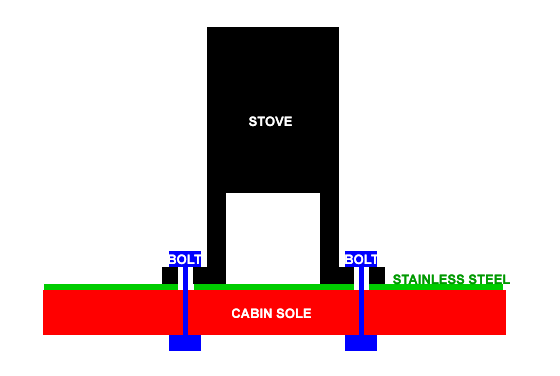
So are you saying that it's OK to bolt the heater direct to the wooden floor, so long as there's some kind of barrier everywhere except where the heater's fixing bolts make contact with the floor?

Like this?....

stoveinstall.png
 
Last edited:
Bolting down a heater

If you are concerned with heat conduction through the bolts. You bolt the heater down to the stainless steel plate. Place this on a layer of insulation. ie a few layers of fibreglass woven roving. Then bolt the stainless steel plate to the floor with some spacing from the stove bolts. Sorry I have no idea if it is necessary though. olewill
 
.... Place this on a layer of insulation. ie a few layers of fibreglass woven roving. .....

If heat is an issue then Sterling Board, not GRP, would be a suitable insulator.
 
There is a code of practice for solid fuel stoves in boats. On inland waterways it is being applied to ensure boats are safe under the Boat Safety Scheme. There is a useful summary here http://www.soliftec.com/Boat Stoves 1-page.pdf which might be of value.

In particular I draw your attention to this bit.

One way of making a good protection panel is
to have: a 10mm air gap (supported on
offcuts), then 25mm thick calcium silicate
board (which can be tiled) then at least a
45mm gap to the stove body, all extending at
least 200mm above the stove. (7) (By the way,
this construction can be used as the hearth
underneath a stove with legs, if topped by a
15mm cement-board panel.
)

Hope this helps.
 
Last edited:
Top