Solent double tides...does anybody have a straightforward explanation?

Greenheart

Well-Known Member
Joined
29 Dec 2010
Messages
10,384
Visit site
Seems very strange to me, and I daresay to others, especially visitors. Here's a web-page detailing high and low water times for Southampton, today: http://www.tidetimes.org.uk/southampton-tide-times-20140824#axzz3B3g6EfeS

...it says this morning's low water time was 01:18...then again at 01:57 (!)...then high water was at 10:45, taking nearly nine hours to rise...then low water was at 14:25, a mere 3 hours 40 minutes later...and then high water tonight will be at 23:00, almost eight-and-a-half hours after low tide, despite rising only two metres...

Seems odd to me!
 
It isn't actually a Solent thing, it is to do with being half way down the English Channel, exaggerated because of some of the features in the Solent - there are similar effects over on the French side. They aren't really double tides, the tide "stands".
 
Wikipedia says:

"Southampton in the United Kingdom has a double high water caused by the interaction between the region's different tidal harmonics, caused primarily by the east/west orientation of the English Channel and the fact that when it is high water at Dover it is low water at Land's End (some 300 nautical miles distant) and vice versa..."
 
I'm not fammilliar with the Solent.
It is a Channel inside an Island with two seperate outlets to the sea a significant distance apart.
I live on the Inside of Vancouver Island. The Tides are odd. sometimes only two a day. sometimes one large and one small. Some times it falls rises a bit then falls a lot.
The reason being the topography of the Island and Islands affect and restrict the flow of water in from the two different directions.
perhalps the Solent has the same effect on a smaller scale.
 
I begin to see the lunar reasoning behind it...but it still seems very remarkable.

It had never occurred to me before, that pretty well the same grimy seawater has presumably been flowing back and forth in a few short miles of the central Channel, for decades?

Is that why it always seems so much clearer and cleaner, down in Cornwall?
 
I always understood that it was because of the Isle of Wight and the positioning of Southampton water. The basic bit is that the first high tide comes in through Hurst Narrows and the second is when the tide comes in through the eastern solent. Due to the the positioning of Southampton water the west flowing tide from the eastern solent effectively pushes water up Southampton water amplifying the IOW effect.
 
The tide tries to retreat from the Solent but the Hurst Narrows acts as a restriction to the flow and water backs up until the volume of water starts to balance out. This causes the 'stand' as it is called. At some places this 'stand' lasts three hours or so at high tide.
 
Even more complex in Poole as the range is smaller (around 2m at springs) and the stand is variable, both in size and duration. The flood is approx 9 hours, but on springs there is an early first high, then a drop to second high then 3 hours ebb. On neaps the second high is higher, but not by much so for 9 hours the level in the harbour changes very little.

Generally we don't time things to high water, but to low as that is the more predictable. However, springs is particularly useful because the first high allows you to float off very quickly after drying out on a low. As the second high is lower it reduces the chance of not floating clear on the next rise. The 3 hour ebb and flood does lead to strong flows around low water, particularly in the harbour entrance.
 
Whilst I have no reason to doubt the explanation provided in the link in L'escargot's earlier post (and, indeed, it all seems very believable), it is interesting to note that the double tides is predominantly a phenomenon on this side of the Channel and not on the other. Whilst Poole and the Solent are both in the middle of the "tank" that is the English Channel, so too are Cherbourg and Le Havre (and St Peter Port too for that matter) and yet they don't display the double tide characteristic.

Granted that the Le Havre curve is a little out of the ordinary, as it appears much more "top heavy", with a long period either side of HW with little change in tidal height.

I deduce from this (in a very unscientific way) that topography does play some significant part in all this.
 
Seems very strange to me, and I daresay to others, especially visitors. Here's a web-page detailing high and low water times for Southampton, today: http://www.tidetimes.org.uk/southampton-tide-times-20140824#axzz3B3g6EfeS

...it says this morning's low water time was 01:18...then again at 01:57 (!)...then high water was at 10:45, taking nearly nine hours to rise...then low water was at 14:25, a mere 3 hours 40 minutes later...and then high water tonight will be at 23:00, almost eight-and-a-half hours after low tide, despite rising only two metres...

Seems odd to me!

Those numbers seem pretty odd to me as well. I think somebody's software algorithm is getting confused and spitting out spurious turns of the tide.

It's much clearer if you look at a curve rather than old-fashioned numerical timetables. Here's yesterday:

5230c1a4-8253-4b29-bb0a-daa41725b523_zps4ddd32a4.png


Being near neaps, it's actually a fairly normal looking curve. There are some tiny wiggles which I guess are what throws your numbers off, but not worth bothering with in practice.

A week later, closer to springs, you can see the Southampton oddities more clearly - the double high water / long stand at the top, and a minor example of the "half-way stand" on the flood. On this curve the rate of rise merely slows for a bit, but on full springs it really does stop for a while:

00c63b05-8d87-4bef-8ab1-2b749b6316bb_zps7ecb9bda.png


Pete
 
Last edited:
The fact that there are two entrances to the Solent must have some effect. By the time the flood is rounding Bembridge, will the flood be complete through the Needles? With less restriction in the Eastern Solent wont the max hight of the tide be reached before the same via the Needles?
 
The fact that there are two entrances to the Solent must have some effect. By the time the flood is rounding Bembridge, will the flood be complete through the Needles? With less restriction in the Eastern Solent wont the max hight of the tide be reached before the same via the Needles?

It seems to be more to do with the different tidal ranges either end of the Solent which also causes the predominantly westerly flow even when the tide is still rising:

"One further tidal feature inside the Isle of Wight waters occurs because the western end of the Solent is nearest to the mid-length or axis of the English Channel, so that the tidal range is only about half that at the eastern end. The times of High Water and Low Water in the two places differ by only an hour or so however, and the rising tide in the eastern end has to rise further in about the same time as the western end. It therefore overtakes it in height about an hour or so before High Water, though in both places the tide is still rising. This difference in level causes the Solent tidal stream to turn to the westward between one and two hours before High Water, and to continue in that direction near the following Low Water, when it again turns to the eastward."
 
I deduce from this (in a very unscientific way) that topography does play some significant part in all this.

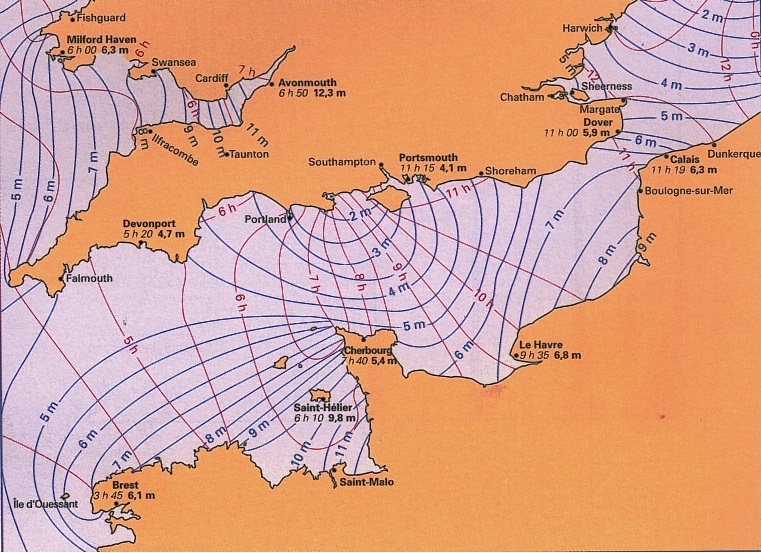
Topography has everything to do with tides. With no land and a constant ocean depth over the whole planet the tidal range would be very small. I've always found this useful for visualising chanel tides:

Channel%20Tides.jpg
 
Topography has everything to do with tides. With no land and a constant ocean depth over the whole planet the tidal range would be very small. I've always found this useful for visualising chanel tides:

Channel%20Tides.jpg

That's very interesting - thanks.

I understand the blue tidal-range contours, but what are the red time ones saying?

Pete
 
DJE, where did you get that graphic?
Some time ago, I saw one similar for the North Sea, which shows two points where the tide apparently does not rise or fall at all.
I think it was in a scientific (ish) paper about satellites.

Thanks for posting that.
 
Topography has everything to do with tides. With no land and a constant ocean depth over the whole planet the tidal range would be very small.

[snip]

My comment about the relevance of topography was solely with reference to the existence or otherwise of the double tide phenomenon, rather than generally regarding the magnitude of tides (which is clearly heavily influenced by topography), but thank you for the chart. I hadn't seen it before.
 
Top