Solar plan sense check

stranded

Well-Known Member
Joined
3 Dec 2012
Messages
2,560
Location
Lympstone
Visit site
Extending our solar and just want to check a couple of things before I press send on my order, which I need to do before I get down to the boat to check things like fuse sizes.

Currently have 2 x 115 Victron mono panels in parallel through a Victron 75/15 smart controller. Has worked perfectly for years so plan on simply replicating that to double up capacity (very tight space means not depth to fit one of the bigger controllers.

Couple of questions:

20 amp fuse ok for 13.2 amp short circuit current? Does blade or glass matter?

I also want to install switchable breakers between panels and controller - in engine compartment 12v planet has some quality waterproof ones but smallest is 50 amp -would that be OK for 6mm2 wires?

Would it be better to keep the old panels as a pair, or put one new and one older on each circuit?

Thanks as ever.
 
I would ask why fit fuses between the solar panel and the controller. Wire size you use should be very capable of carrying 13.4 amps in worst case scenario of short circuit of wiring without getting hot. No harm to panel if output is shorted. Need of course fuses between controller and battery where battery could provide a huge current if wiring is shorted. Re type of fuse, reliability is most important. Balde fuse with spade type crimp connectors would I think be most reliable. Glass fuse tends to be unreliable if holder relies on end pressure. Needs clamp around outside style.
I would suggest you use existing controller with panels in parallel pairs in series. This will give you circa 13amps in to Victron at 40 volts max. (I presume) so still within capabilities of one Victron. ol'will
 
The 75/15 is a little small for 230w, especially if installed in a confined area, although it is only just over the maximum recommended (by Victron) of 220w.

Circuit protection between the solar panels and the controller is only needed if you have a string of 3 or more panels. As you only have two, the circuit protection will do little so a high value is acceptable, but a switch is handy and circuit breakers are often chosen for this role.

Circuit protection between the controller and the batteries is of course essential. The 13.2 A is presumably the combined short circuit current of your panels, but this is not what the wire between the controller and the batteries will carry. The MPPT controller will increase the current, in your case to the maximum 15A that the controller can deliver. Nevertheless a 20A fuse is fine providing this does not conflict with the maximum current rating of the wire.

Glass fuses don’t tend to be super reliable, blade fuses are better, but both of fuse types have a limited interrupt capacity so caution is needed if you are using larger wire gauges. Mount this fuse close to the battery.

Try to feed the two solar panels that receive the same solar conditions to the one solar controller. So, for example, panels on the port side are often fed to one controller and those on the starboard side to the second controller. This is more important than matching age, assuming all four panels are otherwise identical.
 
Thanks guys - very helpful as ever. It is a bit tight where I have the controllers because I have put them as close to the batteries as possible - ie in the battery box. Only other nearby option would be to put them in the engine compartment - more space for them to breath but much hotter environment.

But I have just discovered the Victron smart battery sense, which measures temp and voltage at the battery. I presume with this I could locate the controllers more remotely - perhaps using supersize wire - though I think limited to 6mm2 tails by the terminals?
 
The Smart Battery Sense is a bargain and should be included in most solar systems with Victron controllers.

Without this the solar regulator uses the temperature of the controller at start up to determine the battery temperature. This is not very accurate even if the controllers are mounted next to the batteries.

The Smart Battery Sense also reports to the controllers the battery voltage measured directly at the battery, removing the voltage lost in cables between the batteries and the controller.

It is inexpensive and very easy to fit, as it communicates to the controllers via Bluetooth.

There are a couple of caveats. The Bluetooth range is normally adequate, but not great (perhaps 2-3m). It will only work with the new Smartsolar controllers. Finally, there are two models of the Smart Battery Sense: an older black model and a newer blue model. The older model had very poor Bluetooth range.

When you fit two (or more) controllers it is also helpful to link them together so the charging is synchronised. This is easy to do. There are no wires involved the controllers communicate together via Bluetooth. This can be done without the Smart Battery Sense. It is just a software setting, but the procedure for installing the Smart Battery Sense makes this more obvious.
 
OK, that’s great thank you - so I’ll stick with putting the controllers in the battery box - the current setup has worked fine so should be OK - but get a blue smart battery sense anyway - I was wondering whether the two controllers would play nicely together - that sounds like the answer - and you are right - it’s remarkably inexpensive.
 
I would not put the controller or any other electronics in the battery box for fear of the acid fumes (emitted when charging) damaging sensitive electronic components. ol'will
 
I would not put the controller or any other electronics in the battery box for fear of the acid fumes (emitted when charging) damaging sensitive electronic components. ol'will
Hmmm… I think that is a risk I am prepared to take. The batteries are agm, which hopefully reduces the chance of gas, the box is reasonably ventilated into the engine compartment and the bilge, and the previous solar controller lasted 8 years without issue, so hopefully it should only be an exceptional situation which causes an actual problem.

I do appreciate the heads up though - something else to add to my worry box!
 
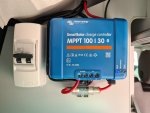
I used one of these between the panels and the controller ....

https://www.amazon.de/-/en/gp/product/B07D28C9CQ

housed in this ....

https://www.amazon.de/gp/product/B08VMR2DWW

Installation (on a VW camper van) looks like this ...

09_MPPTandPanelCircuitBreaker.jpg

Because the solar panels are not like batteries and will not exceed their max current when shorted, there is no need to fuse the wires if the wires are sized correctly to carry the continuous max current from the solar panels (which they should be). You want your controller to be able to draw the max power that the panels can supply, so they must be wired accordingly.

After numerous experiments on my boat in the Adriatic with parallel and series connection, I found no discernable difference in daily yield. So I went with series connection as this lowers the current, and hence the wire gauge for the connection from the panels to the controller.

Parallel = lower voltage, higher current. Serial = higher voltage, lower current.
 
Last edited:
I used one of these between the panels and the controller ....

https://www.amazon.de/-/en/gp/product/B07D28C9CQ

housed in this ....

https://www.amazon.de/gp/product/B08VMR2DWW

Installation (on a VW camper van) looks like this ...

View attachment 151947

Because the solar panels are not like batteries and will not exceed their max current when shorted, there is no need to fuse the wires if the wires are sized correctly to carry the continuous max current from the solar panels (which they should be). You want your controller to be able to draw the max power that the panels can supply, so they must be wired accordingly.

After numerous experiments on my boat in the Adriatic with parallel and series connection, I found no discernable difference in daily yield. So I went with series connection as this lowers the current, and hence the wire gauge for the connection from the panels to the controller.

Parallel = lower voltage, higher current. Serial = higher voltage, lower current.
OK - helpful to be able to visualise. So I just need switches really, though breaker will do no harm so long as they don’t restrict max current. I am going to try parallel first I think because it will be a rare occasion when there is not some shading, even if it’s just the backstay - and 6mm2 cable seems comfortably up to the job.
 
There will minimal voltage drop problems that way especially in the situation where you may have a high voltage from your panels going down to 12v to the battery from the controller.

Agreed, the current from the MPPT to the batteries will be higher, but using heavier cable over comes the problem enabling the MPPT to be mounted in a better location. We have 6mm from the panels to MPPT but 16mm from MPPT to batteries.

Looking at Baggywrinkle's photo above, you can see he has done the same thing.

Pete
 
Agreed, the current from the MPPT to the batteries will be higher, but using heavier cable over comes the problem enabling the MPPT to be mounted in a better location. We have 6mm from the panels to MPPT but 16mm from MPPT to batteries.

Looking at Baggywrinkle's photo above, you can see he has done the same thing.

Pete
Yes, I rehearsed that possibility in earlier posts above but decided on balance that it is best to keep them in the battery box, with the addition of a smart battery sensor to get best feedback on battery voltage and temperature.
 
Agreed, the current from the MPPT to the batteries will be higher, but using heavier cable over comes the problem enabling the MPPT to be mounted in a better location. We have 6mm from the panels to MPPT but 16mm from MPPT to batteries.

Looking at Baggywrinkle's photo above, you can see he has done the same thing.

Pete
Indeed, but as the amps go up as they do in larger installations that becomes impractical. I have to have my controller near the batteries.
 
Top