Solar panels

Laysula

Well-Known Member
Joined
1 Jun 2008
Messages
2,556
Location
Brixham
Visit site
Thinking about buying a solar panel to help the batteries out when at anchor or on a mooring. We don't tend to moor or anchor a great deal so I don't really want to go to the trouble of permanently mounting anything.
I have seen flexible panels and and rigid ones on e-bay with a controller for circa £100 and wondering if they are any good. Has anyone else bought anything similar or have any recommendations?
 
If you want above trickle charging (which you probably do) then you need as much wattage as possible.

MPPT controllers are better than PWM (15% odd). Use thick cables to avoid voltage drop. I use 6mm2 where possible. I would suggest permanently mounting the controller, drawn out to a deck plug to a roving panel. If you can go for a larger controller so that you can increase capacity later. Victron make good kit like the 75/15. Recent ones have bluetooth that allows you to monitor via an App.

Semi/flexible can be a mixed bag quality wise. Easily broken if repeatedly flexed. If you want a roving panel either get a folding system, or semi-flexible on some wood or a rigid panel.

You will find there are lots of different sorts of panels. However they are all measured in watts output, and one factor that changes is the dimensions. For roving panels i doubt you will notice the difference in size much.

Shade is an issue for panels.

So in summary; go big (or many); go MPPT.
 
Have had numerous panels of varying types. For a hundred quid I would get one of these and one of these.
You can pay less for low quality kit or you can pay a lot more for essentially the same stuff from a UK supplier.
I only moved to MPPT last year and don't regret it at all. Anecdotally, I would say the extra charging efficiency is more than 15%.
 
Last edited:
Have had numerous panels of varying types. For a hundred quid I would get one of these and one of these.
You can pay less for low quality kit or you can pay a lot more for essentially the same stuff from a UK supplier.
I only moved to MPPT last year and don't regret it at all. Anecdotally, I would say the extra charging efficiency is more than 15%.

Agree with the above. I said 15% as i have seen numbers upto 20% but i think “it depends”. I think PBO did a good article about MPPT vs PWM a few years back.

If you can, go for a foldable 100W or more.

Watching the amps going in can be addictive.
 
Need a bit more info .... trickle charge a 24 footer or a 40 footer with tons of electronics and a fridge on 24/7? ... How big is the battery bank?

I'd second the MPPT bit, to work out how big it needs to be a bit more info is needed - but in principle any size will help.

Victron is excellent kit with Bluetooth for monitoring/config.

https://www.victronenergy.com/markets/marine
 
We have a roving panel, to complement two mounted permanently on the sprayhood.
We binned a 100w fixed panel as too unwieldy and now the roving panel is a 50w semi flexible panel, that stows in the equivalent of a large pizza box. No backing plate of any form used, as this would just add weight and hassle.
Been used and abused for 3 years so far and all good. If fails after then will just bin and buy another as under £100, and efficiency probably improved since bought originally.
Less weight is much more convenient and hence gets used far more
PS Victron MPPT controller and battery monitor with Bluetooth, Photonic Universe panels
 
I suggest that if you are moored for 3/4 days without running the engine and have even modest current draw, in the UK, then you need to start pretty well with sufficient drawable domestic battery capacity for that kind of stay.Seems your present budget will cover something like a 40w framed panel and PWM rather than MPTT controller.Our weather and the restrictions of being afloat at anchor/mooring means its unlikely that you will keep up with usage unless you are careful with placing the panel and pretty economic with usage.
I see the value of the panel is in charging the battery to bring it back to fully charged as it sits on its normal mooring,in between trip when the average yield over say a week or fortnight does the job.And hopefully either a trot or alongside where you can maximise the normal orientation and are unencumbered as to placing.
 
Sorry. A bit more info. We sail a 25 year old 36 yacht with led lighting throughout and a fridge. Domestic battery bank is 2 x 110 amp leisure batteries.We normally switch the fridge off overnight and find that we are ok for one night and usually switch the fridge off altogether if we are staying a second. We are berthed normally in a marina so have access to shorepower so we were just looking for something to boost the batteries a bit.
 
As an absolute guess I would have said around 200W would do it. It is so easy to under spec., but obvioulsy it does depend on how power greedy you are. I have 880W, and in the UK in the Summer with a reasonable amount of sun during the day it keeps up with everything and will bring the batteries back to 100%. No sun, and its way behind the curve, with all the permutations in between. We do run a fridge and freezer 24/7 and a Sat TV in the evening which amounts to a significant power drain. I was amazed just how much you can find you would like and of course just how much the output falls off without sun. In an ideal world in the UK for spending a lot of time without mains power, then I think you need to supplement with wind generation as well. I resort to the Genset for a few hours a day when the conditions are poor for solar and thats fine, but it would be great to be self sufficient all the time. I guess even then there will be windless cloudy days - oh well.
 
Sorry. A bit more info. We sail a 25 year old 36 yacht with led lighting throughout and a fridge. Domestic battery bank is 2 x 110 amp leisure batteries.We normally switch the fridge off overnight and find that we are ok for one night and usually switch the fridge off altogether if we are staying a second. We are berthed normally in a marina so have access to shorepower so we were just looking for something to boost the batteries a bit.

I also have a 20 year old 36 foot yacht with all LED lighting. It is in the Adriatic. I wanted to be self-sufficient (solar) so no generator, shore-power or engine. I also wanted to run the fridge 24/7. After doing all the calculations I ended up with 300W solar, an MPPT controller and 370Ah of batteries. Solar panels are on the bimini with very little boom overlap.

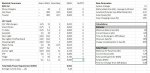
At anchor, the normal pattern is around 5/6 pm the solar can't keep up and I start using battery power and by the following morning I've drained about 8-10% of capacity which is recovered by the solar panels by around noon to 1pm the following day - all afternoon the batteries sit at 100% and then the cycle repeats. I could probably scrape by with 200W but 300W gives me a bit of leeway for dull days. I need about 0,9kWh per day at anchor, worst case.

Calculations below .... they are a little out as the solar panels power everything and charge the batteries during daylight, so I never see a 20% discharge. The most the panels have generated in one day is 1,5kWh which I also very rarely see because I can't store it all, normal yield is about 0,75 to 1kWh per day.

calc.JPG

Any motoring, even 30 mins in/out of anchorages or harbours makes a massive difference to the reliance on solar.

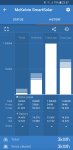
I put a huge load on the battery while testing to see what I could produce ... MPPT spent the whole day on Bulk charge and delivered 1,5kWh ... see pic below from the Victron App.

Solar300W.jpg
 
I think the first thing to decide is location of the panel and hence the max size you can cope with. Obviously the bigger the better in terms of supplementing engine charge and almost anything will help maintain the batteries in your absence.
Cost is not so huge as I hope to be a factor. If you do buy a small one and find you want more then additional panels are quite OK. ol'will
 
Buy the biggest panel(s) you can fit on the boat and fit a solar MPPT; I have found that solar panel quality varies a lot; German made panels are very good. The femi flexible panels are very convenient but they seem to deteriorate quicker.
 
Last edited:
I think there's a cost:benefit question here, also a question of how much you want solar panels to dominate the appearance and utility of your boat.
If the OP's sole aim is to keep some food fresh for a couple of days, then buying some ice packs or ice from Tesco or even crafty planning of frozen food is possibly more cost effective.
You need a lot of panels to reliably keep upwith a fridge 24/7 in overcast UK Spring and Autumn. OTOH a few panels can help significantly on those hot summer days where you really appreciate the fridge.
An extra battery is another approach.

Everybody's piece of string is a different length and thickness....
 
I've been experimenting this summer with my solar setup, with the goal of being able to run the fridge for longer. I've got a 33' boat, all LED, with a fridge that draws up to 6A.
I've got 2x50Wsemi-flexible solar panels, and a Victron 75/15 MPPT controller. I haven't yet hard-wired anything as I wanted to see what worked best.
Conclusions so far:
1. Panels mounted vertically (hanging from the lifelines) aren't efficient. Canting them even 20 degrees towards the horizontal makes a huge difference.
2. Panels mounted off the lifelines will mostly be on the wrong side of the boat, when on a mooring or anchored. Even if you move them to the sunny side, the boat will soon swing.
2. The Victron controller doesn't start working until the panels are generating >=5V more than battery voltage. If your batteries are at 12.8V, that means your panel needs to be generating 17.8V for the controller to start. This won't happen unless it's actually sunny, bright light won't do it. Unless...
3. ...you connect two panels in series, at which point you get > 30V all the time. Victron actually recommend that you use an array of at least 2 solar panels with the 75/15 MPPT controller, in order to get the higher voltage.
4. In low light conditions, I get nearly as much input from my 20W panel on the hatch garage, connected through a cheap PWM controller, as this doesn't need the +5V startup difference.
5. However, once the sun really starts shining, even a single 50W panel via MPPT controller can fully recharge a 10% discharged 100Ah battery in a few hours.


I'm now planning to permanently mount the two 50W panels on the coachroof, as on balance that seems to be the best position. However, I'm going to wire them in such a way that I can easily switch between series and parallel, so that I can either mitigate shading effect or low light as needed.
 
Has anyone else bought anything similar or have any recommendations?
I bought a folding rigid 100W suitcase type a few years back. I bought mine from the chinese company Lensun but have seen identical ones marketed as "Bosch" and the ones Photonic universe are currently flogging as "German" seem identical. It has an integrated pwm controller. They seem to be about twice your suggested budget. My battery monitor says it pumps out 6Amps when properly oriented on a sunny day. That's nowhere near independence level for me but it does help. I connect it up to a driplug near the companionway which is connected to the batteries via a fuse.

Downsides? it's a bit bulky to store: on passage it lives on the floor of the aft cabin. Not being chained down, it's stealable so you might not want to leave it out in some places. It does require moving around and the angle changing for decent efficiency. I'd worry about leaving it up when not on board without a lot of faff tying it down as a speedboat passing too close might make it slide down the deck. Having a 12m centre cockpit boat I have plenty of room to move it around on the aft deck: other folks may not have that convenience.

The newer thin folding panels look nice and more stowable. I like my panel but I'd probably investigate the thin ones if buying now
 
...
2. The Victron controller doesn't start working until the panels are generating >=5V more than battery voltage. If your batteries are at 12.8V, that means your panel needs to be generating 17.8V for the controller to start. This won't happen unless it's actually sunny, bright light won't do it. Unless...
3. ...you connect two panels in series, at which point you get > 30V all the time. Victron actually recommend that you use an array of at least 2 solar panels with the 75/15 MPPT controller, in order to get the higher voltage...
Can you please point me to this information as I have not seen anything mentioning it whilst researching a solar panel set up for myself?

Thanks
 
2. The Victron controller doesn't start working until the panels are generating >=5V more than battery voltage. If your batteries are at 12.8V, that means your panel needs to be generating 17.8V for the controller to start. This won't happen unless it's actually sunny, bright light won't do it. Unless...

The panel open circuit voltage needs to be 5v above the battery voltage, if there isn't enough light to do that then there won't be enough to do any charging .

Below is data with the batts on mains charger float, 06.47 in March it was light enough to turn the victron on. No need for series panels on that front, based on a 36 cell , VOC ~21v, VMP ~17v.

lnQSwJ7.png
 
2. The Victron controller doesn't start working until the panels are generating >=5V more than battery voltage. If your batteries are at 12.8V, that means your panel needs to be generating 17.8V for the controller to start. This won't happen unless it's actually sunny, bright light won't do it. Unless...
3. ...you connect two panels in series, at which point you get > 30V all the time. Victron actually recommend that you use an array of at least 2 solar panels with the 75/15 MPPT controller, in order to get the higher voltage.

With 2 x 160 in parallel, mounted on gantry and clear of close obstructions, we have no problem with the MPPT 100/30 charging on overcast days, maybe your problem is the smaller semi-flexible panels not generating enough voltage in low light.

I've tried series connection which can be more efficient but, even mast shadow kills output far more than when in parallel. Have a look at this video - https://www.youtube.com/watch?v=1qD3mN8VotQ
 
Turning the fridge off at night is a false economy, the fridge is going to have to work at least as hard to get the contents down to 4degrees as it would have done maintaining that temperature overnight. (Unless your fridge insulation is truly awful!)
 
Turning the fridge off at night is a false economy, the fridge is going to have to work at least as hard to get the contents down to 4degrees as it would have done maintaining that temperature overnight. (Unless your fridge insulation is truly awful!)
I think it depends on where you are and what the overnight temperature is like. It worked well for us in Port at Louis in May. If your insulation is good, the inside temperature doesn't rise significantly overnight. In the UK in a typical summer it's got to be a winner.
 
Top