Solar panels and compound curves

AngusMcDoon

Well-Known Member
Joined
20 Oct 2004
Messages
9,051
Location
Up some Hebridean loch
Visit site
I'm looking at solar panels for a new boat delivered later this year. It's a catamaran and there's bags of space on the coachroof that doesn't ever need to be walked on so makes a good space for solar panels. The problem is that this space has a very slight compound curve, and I am assuming that flexible solar panels won't lie flat on a compound curve, but one of the curves really is very small. Here's an above view showing the space where 2 panels in green could be fitted. There's room for 2 175 Watt panels if I use a single panel on each side...
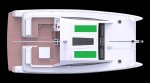
7.jpg

This area has a significant curve lengthways but within the radius of flexible solar panels. It's between the 2 red arrows here...
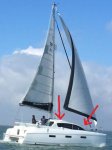
3.jpg

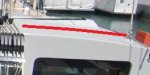
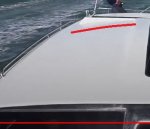
The crossways curve is only just discernible marked in red here...
2.jpg

and here...

4.jpg

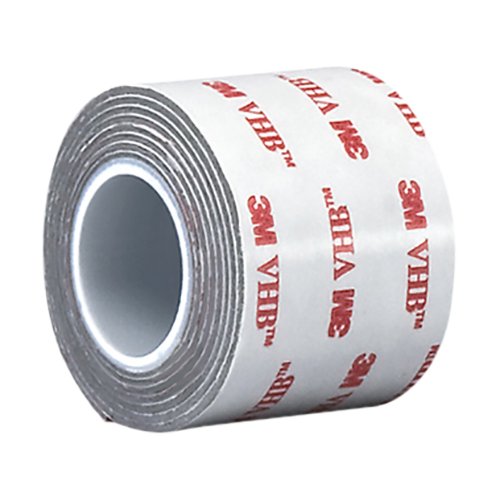
My plan is to attach the panels using 3M VHB tape or 3M Dual Lock, but would that be impossible with these curves, or will the crossway curve be so slight that it will be absorbed by the flexibility of the mounting system?

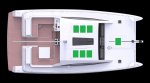
Alternatives are I could use 6 smaller 50 Watt panels, but that will decrease output (unless I add a 7th on the foredeck) and increase wiring faff and expense...
8.jpg
or use rigid panels and these mounts, but the installation will be heavy and ugly...

Fitting a solar panel to a narrowboat with a curved deck.
 
As I understand it (and I fully accept this is not my area of expertise) - it is preferable to have the panels raised a bit to allow airflow, as they operate more efficiently when cooler?
So maybe the solution presents itself as a way to make the panels more effective at the same time.
TBH (and again - limited knowledge) - I think I'd be tempted to go with solid panels for maximum efficiency and have custom mounts made from teak/starboard, etc at each corner. A bit of a a 'faff' to do, but it's not like these will need changing often....
Could even paint/coat the frames white to match the gelcoat for extra bling :cool:
 
Dual lock will eliminate any worries about the cross curve, i think. But, the panels will only be supported here and there and there will be a small gap under the panel. I think this gap will get crap underneath it and be a constant pain with dirty streak running out from under the panel.

The tape will also not fully support the panels, although if you go all the way round you won't get dirt under the panels. But, any areas that are not supported will sag and flex, which can't be a good thing.

Some panels come with a sheet of self adhesive "tape" covering the whole panel, which seem to work OK, it's a bit like applying contact adhesive, you'd need to make sure you position them accurately.

I'd be inclined to stick them down with CT1. I've done several that way, a few wavy lines of CT1 the full length of the panel, a good bead all the way around. Position the panels, weigh them down, mask around them, lift them up and apply the CT1, weigh them down again. When the CT1 is cured trim it off with a Stanley knife, remove the masking tape,

If the panel doesn't quite take up the cross curve the CT1 will more or less hide it.
 
As I understand it (and I fully accept this is not my area of expertise) - it is preferable to have the panels raised a bit to allow airflow, as they operate more efficiently when cooler?

While that is true, I suspect that it's more of a problem on RV's baking in the heat in Arizona than at sea at 60 degrees North in soggy Scotland, where any appearance of the sun after May is worth an entry in the logbook. It's a good point though.
 
Dual lock will eliminate any worries about the cross curve, i think. But, the panels will only be supported here and there and there will be a small gap under the panel. I think this gap will get crap underneath it and be a constant pain with dirty streak running out from under the panel.

If I used Dual Lock I'd go all the way round despite the price of it. :eek:

The tape will also not fully support the panels, although if you go all the way round you won't get dirt under the panels. But, any areas that are not supported will sag and flex, which can't be a good thing.

Youtube vids showing its use put bands across the middle as well, but that won't eliminate sag and flex entirely.

Some panels come with a sheet of self adhesive "tape" covering the whole panel, which seem to work OK, it's a bit like applying contact adhesive, you'd need to make sure you position them accurately.

There don't seem to many available, especially in larger sizes. However, it's possible to buy sheets of 3M stuff to do the same thing. I used it successfully to lay replacement fake teak and holly flooring. Like all 3M stuff, it's good but expensive. This method would give me most concern about the compound curve as there would be no give compared to foam tape of Dual Lock.

I'd be inclined to stick them down with CT1. I've done several that way, a few wavy lines of CT1 the full length of the panel, a good bead all the way around. Position the panels, weigh them down, mask around them, lift them up and apply the CT1, weigh them down again. When the CT1 is cured trim it off with a Stanley knife, remove the masking tape,

If the panel doesn't quite take up the cross curve the CT1 will more or less hide it.

That's another idea, but I always seem to get in a horrible mess whenever I deal with anything stickish. :ROFLMAO:
 
Last edited:
An answer to my own thread : the boat builder has replied and said that although there is a compound curve, it's minimal, and it's possible to mount a panel there of the size I intend.
That’s great. I had been going to reply that you should be OK with semi flexible panels - and also that good idea to make removable, as ours are 5 years old and fine, but they do have a finite life.
Fixed panels on brackets would look horrific there IMHO.
 
That’s great. I had been going to reply that you should be OK with semi flexible panels - and also that good idea to make removable, as ours are 5 years old and fine, but they do have a finite life.
Fixed panels on brackets would look horrific there IMHO.

I don't think rigid panels on brackets would be a great idea there either. There might be some jib or reacher headsails interaction with them as an additional problem. If know that flexers have a shorter life but if I used Dual Lock I might be able to remove them during the months I don't sail to prolong their life. On the other hand, trying to get Dual Lock separated might dramatically end their life instantly! I've heard that it can be a bit tricksome to prise apart.
 
Last edited:
I don't think rigid panels on brackets would be a great idea there either. There might be some jib or reacher headsails interaction with them as an additional problem. If know that flexers have a shorter life but if I used Dual Lock I might be able to remove them during the months I don't sail to prolong their life. On the other hand, trying to get Dual Lock separated might dramatically end their life instantly! I've heard that it can be a bit tricksome to prise apart.
Personally I would leave well along and not try to remove when not sailing. Certainly our panels are held on to the sprayhood with 2 inch wide velcro style, so can be removed but suspect does more damage doing so than leaving on 24x365.
Check the seals where the wires go into panels. We added a bit of the mouldable plastic stuff to improve the seal
 
I don't think rigid panels on brackets would be a great idea there either. There might be some jib or reacher headsails interaction with them as an additional problem. If know that flexers have a shorter life but if I used Dual Lock I might be able to remove them during the months I don't sail to prolong their life. On the other hand, trying to get Dual Lock separated might dramatically end their life instantly! I've heard that it can be a bit tricksome to prise apart.

If you put dual lock all the way round you will likely damage the panel or the boat if you try to take the panels off. Dual lock is usually used in 25mm or so squares. Putting it all the way round is a bad idea, IMO. My last boat had some interior seating fixed in place with 25mm squares, about 18" apart, was very hard to get the seats apart.
 
I don't think rigid panels on brackets would be a great idea there either. There might be some jib or reacher headsails interaction with them as an additional problem. If know that flexers have a shorter life but if I used Dual Lock I might be able to remove them during the months I don't sail to prolong their life. On the other hand, trying to get Dual Lock separated might dramatically end their life instantly! I've heard that it can be a bit tricksome to prise apart.
I think fitting covers would be a better idea than having them removable.
 
I had a flexible fail very soon after installation on top of a bimini. The manufacturer showed pictures of that type of installation and replaced the panel after I sent pictures of my setup. The replacement lasted a bit longer but output dropped suddenly.

I checked the adverts a year later and discovered the had included warning not to fit panels in a concave curve. It caused micro-fractures due to compression forces.

It was obviously aggravated by flexing with the first panel but replacement still failed with a more rigid setup (but still slightly concave). Probably worth asking about suitability for convex and concave curcature.
 
An alternative idea I've had from seeing what RV dwellers do is to use 6 of these stainless standoffs...

970_630x540.jpg


through the already existing holes in the edges of the panels secured with a washer and a wingnut. The standoffs can be attached to the deck with 3M VHB RP25 tape which is only 0.8mm thick...

https://www.3m.com/3M/en_US/p/d/b40071688/

41HGXdnKbFL.jpg


which would give a tensile strength per standoff of 50 kg.

The RV'ers stick the panels on the roof and drive around like that so this method seems pretty wind proof.

In future if the panels get too hot (not likely in Scotland) I could intersperse a layer of this stuff...

as4c1_01g.jpg


A few people seem to have done this combination successfully. No holes required and the standoffs can be removed from the deck if needed in the future by sticking an oscillating saw through the 3M tape under the standoff. If the slight compound curve causes problems then some of the standoffs could have packing washers installed under the panel to raise them up a bit.

Then when I park the boat up for the season, undo the wingnuts, lift the panels off and take them home for a winter of coddling.
 
Top