solar panels and batteries

Seastoke

Well-Known Member
Joined
20 Sep 2011
Messages
13,372
Visit site
I have a raggie mate ,I know , he has a mooring on the dart he has two batteries in parallel he thinks the panel is not topping up both batteries should it not have a relay so when one is charged then it does the next ,also the panel is a 200w version and he is expecting 9/10 amps out of it does all this sound possible thanks for the replies
 
I have a raggie mate ,I know , he has a mooring on the dart he has two batteries in parallel he thinks the panel is not topping up both batteries should it not have a relay so when one is charged then it does the next ,also the panel is a 200w version and he is expecting 9/10 amps out of it does all this sound possible thanks for the replies

If the batteries are permanently connected in parallel then the solar panel should be charging both.

If they are not permanently connected in parallel then only one will be charged until they are linked by a paralleling switch

This can be overcome with a voltage sensitive relay ( VSR ) which will close to charge the second once the first is charged .

Alternatively using a dual output controller will charge both although only PWM , not MPPT, controllers are available with dual outputs. You do not say what controller he has

He should be able get 9 or 10 amps from a 12 volt panel, or even a little more.

The manufacturer's spec should give both max ( short circuit) current and the current at max power.

Your Raggie mate should post his question on the Reader to Reader forum where he will find lots of knowledge and experience of solar panels
 
Last edited:
I have a raggie mate ,I know , he has a mooring on the dart he has two batteries in parallel he thinks the panel is not topping up both batteries should it not have a relay so when one is charged then it does the next ,also the panel is a 200w version and he is expecting 9/10 amps out of it does all this sound possible thanks for the replies

All of the 200w panels we have looked at only seem to be capable of generating about 5 amps per hour. An example here:

http://www.photonicuniverse.com/en/...7SSJSaEtGAVaIlngbRtcenDWuqf1HcbwaAlXhEALw_wcB

But that will only be on very sunny days in the middle of summer. At this time of year he may as well forget them as they will hardly generate anything.
 
That's an interesting take on the physics of PV panels, CX54.

There will be some losses due to less than optimum Alt and Az orientation, shading, and wiring losses, but where does your "5 amps per hour" (which is a non-standard measurement, anyway) come from please ?


As for the comment about panels only working in summer, I have a small 40W Kyocera which keeps a fencer unit and some LED shed light well topped up; and it's in current, daily use.
 
All of the 200w panels we have looked at only seem to be capable of generating about 5 amps per hour. An example here:

http://www.photonicuniverse.com/en/...7SSJSaEtGAVaIlngbRtcenDWuqf1HcbwaAlXhEALw_wcB

But that will only be on very sunny days in the middle of summer. At this time of year he may as well forget them as they will hardly generate anything.

You have made the mistake that I nearly did .

The panel in your link is a 45 open circuit volts, and 38.8 volts at Pmax when it will deliver 5.1 amps 38.8 volts which equates to 200watts.

It is only really suitable for use on 12 volt systems if it is is used with an MPPT controller otherwise the max current will be 5.8 amps. Alternatively it can be used on 24 volt systems

Here is a 200w panel for 12 volt systems

http://www.ebay.co.uk/itm/200W-12V-...er-caravan-boat-200-watt-module-/112587737529

Note the OC volts is only 23.9 , the max ( short circuit ) current is 10.5 amps and the max power point is 9.9 amps at 20.2 volts
 
Last edited:
Just connecting solar panels to batteries isn't a working solution.
You need at put a controller in between - think of it as a battery charger.
Essentially, there are two types of solar panel controllers.
The cheaper ones (PWM controllers) simply adjust the voltage that the panel(s) produce to the voltage that is required to charge the batteries.
A much better controller would be an MPPT controller that works out the maximum charge for a given solar situation.

I use the Victron range of MPPT controllers.
Victron controllers require the voltage from the solar panels to be (at least) 5v more than the battery voltage before the MPPT will start.
This needs to be considered carefully when selecting the correct panels for your installation.

Also, you need to ensure that the wires are big enough to carry the current without loosing too much in the wiring.
You can often get away with smaller wires between the panels and the MPPT than the wires between the MPPT and the batteries.

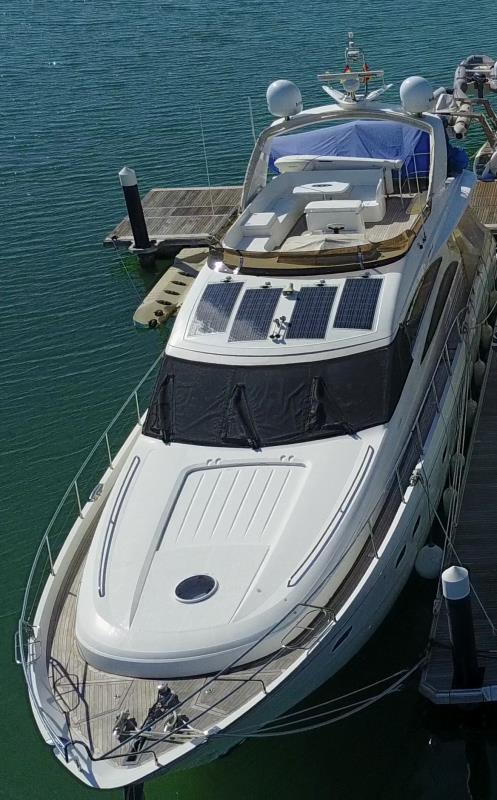
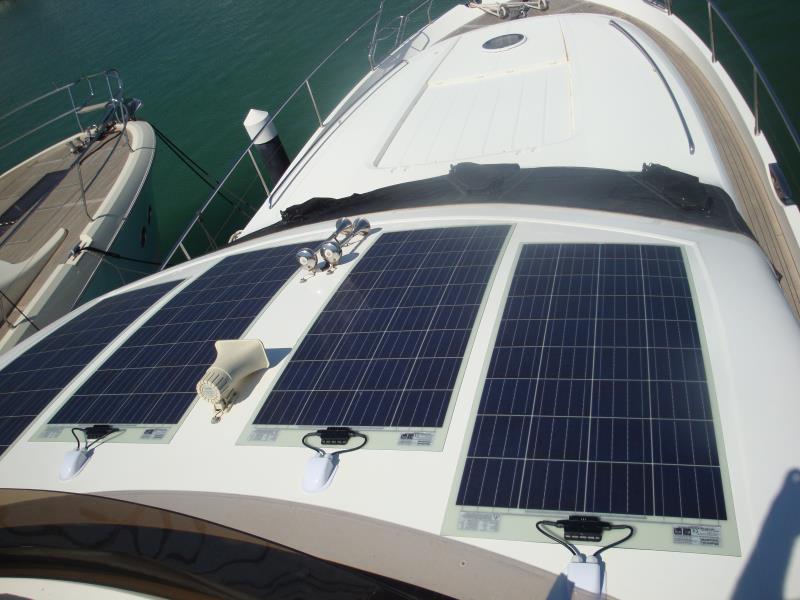
Here is my installation

DJI_0013.MOV.Still001e_Small_zpsozeh9u4s.jpg


DSC07620_Small_zpsacdlu8nd.jpg

The Vicrton MPPT controllers have an optional module that outputs to a mobile phone.
Here are a couple of mobile phone screen dumps from my system

Instantaneous display

serve.php


And a history display

serve.php


And anchoring like this helps to keep the sun in the right place.

serve.php


We installed this system earlier this year and it was a huge success last summer.
If you get time, there is a full write up on this system in the December copy of Motorboat and Yachting.

I hope this helps.
 
Every bit helps him. Running the beer fridge for 5 days at anchor was fun. The sixth under candle power wasn't:p
 
Top