Solar and Battery advice please

kevsbox

Well-Known Member
Joined
10 Jun 2020
Messages
212
Location
Portsmouth, UK
www.kevsbox.com
HI
I am fairly new to this and about to add a second 50w Solar Panel and also replace my 2 batteries which are both 12 years old and tired. Below is my proposed setup, does this look ok. 2 solar panels in serial going to the controller which has 2 battery outputs. The way the batteries are connected together and to the engine and isolator is as it is now, is this efficient?
Also I am looking at 2 potential sources for batteries as per these links, has anyone got any feedback for these batteries?
Powermax Sealed Batteries | Marine Super Store (110ah model)
SuperBatt AGM1100 12V 120AH (100AH & 110AH) Heavy Duty Ultra Deep Cycle VRLA AGM Leisure Marine Battery - SAFE & SPILL PROOF - Caravan Motorhome Boat Motor Mover: Amazon.co.uk: Car & Motorbike

Thanks
Kev
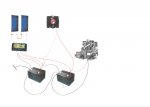

yacht.jpg
 
Need info on the controller!

If your solar controller is a PWM type your solar panels should be connected in parallel , not series.

Connection in series would be acceptable if you had a MPPT controller ( and the panels were the same) but generally agreed that best overall performance still commes from parallel connection

Cannot comment on battery/ engine installation without full details and wiring diagram. What you have shown falls pretty much "short of the mark"
 
Need info on the
Looks the same as one I have .pwm. great little controller for the money and 8 years of use. Can alter what percentage charge goes to each battery bank. mppt are generally larger but nowadays many of the pwm type are advertised as mppt on ebay ?
 
That is a PWM controller (I have the same one). You want to put the two panels in parallel, not series. Otherwise, all good.
 
I've used Battery Megastore and found that they give good prices and next day delivery(delivered when stuck in Limehouse basin with a failed battery). Your links don't show the weight, I understood that the heavier the battery the better the better it is?
 
I have basically the same setup, except that the panels should as mentioned above, be in parallel. The engine, including starter electrics are connected to the common on the 1-2-both switch, and the starter and domestic batteries to one and two respectively, as are the outputs from the solar controller. Add a VSR to charge both banks from the alternator when the engine's running and you're good to go.

FWIW, I set my controller to charge the engine battery first, then the domestic, on the basis that
1. It won't normally take long to top up the engine battery, so not a lot of loss to the domestic
2. A flat engine battery is far more of a pain, and potentially a safety issue if you need the engine in a hurry, than dim lights; as long as you can start the engine, you can easily top up the domestic to brighten the lights
 
Thanks for the feedback, I will switch to parallel as you all say. What i did not show in the diagram is the fact they are charged from the alternator also.
Cheers
Kev
 
What i did not show in the diagram is the fact they are charged from the alternator also.

How does this work? Do you have a VSR or a diode splitter? Or do you use the 1-2-both switch?

Is one of the batteries dedicated to engine starting? If so, you just need an ordinary starter battery, not a deep cycle battery.
 
I use Tayna batteries if you are near one of their depot collect yourself as prices cheaper than their ebay prices.
 
I would consider going for an MMPT controller such as the Victron. I had a similar (parallel) sets up in the Med with a PWM Steka controller. I found that over winter the batteries were buggered as the Steka was not clever enough to know that the battery was fully charged and so every morning it would charge until the voltages rose to 14.5 (or what ever you set) before falling back to float - this finished off 2 sets (4 batteries) in a year (note we never discharge more than 60%). If you do use one, Bosch insisted that an overnight drain, such as a small array of leds connected to the Dusk Dawn connection. This was much better for the batteries. I now have the victron controller and it is far superior and never overcharges the batteries - ie it knows where they are.
 
With my Victron MPPT, I’ve found that running my two panels in series provides a noticeable increase in daily output compared to parallel, although I’m sure there are plenty of others with the opposite experience.
A dual sensing VSR ensures that both batteries get charged from either alternator or solar.
 
Around here a "Marine " battery as sold by chandlers is optimised for rugged construction for use in small run about motor boats with a lot of banging in waves and also of course for engine starting. Assuming you have a heavy displacement mobo or sail boat you don't need this kind of marine battery but rather a purely deep cycle battery. Not even the "leisure" type with compromise between deep cycle and cold cranking amps for engine starting. ol'will
 
The Amazon battery in the OP is not AGM, neither is it CRLA, neither is it deep cycle, the description is utter nonsense and illegal. It is simply a leisure battery.

Same battery here: 12V 110AH SuperBatt LM110 Deep Cycle Leisure Battery Caravan Motorhome Marine Boat: Amazon.co.uk: Car & Motorbike £45 cheaper and almost described correctly, except it isn't deep cycle.

Regarding marine batteries, there is no such thing. They are, at best, a leisure battery with a marine label stuck to them.

"Hybrid" batteries are another fictional battery. It's either deep cycle or it's a starter battery, you can't make something that does both. It's a nonsense label that seems less common now, it used to be stuck on a lot of leisure batteries.

Leisure batteries are usually built to be more robust internally than a standard automotive battery.

I fit a lot of these and find them to be good value: Hankook XL31 Dual Purpose Leisure Battery - Battery Megastore I'm disappointed to see that they refer to them as "heavy duty deep cycle", they are not deep cycle, but they are decent quality SLA batteries.
 
With my Victron MPPT, I’ve found that running my two panels in series provides a noticeable increase in daily output compared to parallel, although I’m sure there are plenty of others with the opposite experience.
A dual sensing VSR ensures that both batteries get charged from either alternator or solar.
I have se mine up in parallel. I was told that with serial shading on one had a bad effect. Shading on one is a regular event.... myth or true?

Pain in arse to change the wiring now.
 
I have se mine up in parallel. I was told that with serial shading on one had a bad effect. Shading on one is a regular event.... myth or true?

Pain in arse to change the wiring now.

Use parallel if one is often shaded, serial if not, as a rule of thumb. Noting that serial requires a MPPT controller.
 
With a PWM controller, I’d leave it parallel. The reason behind my opting for series is that the adding of voltages, means that the combined voltage results in an earlier start and later finish to the solar charging day - panel voltage needs to be at least 5v greater than battery voltage for charging to occur (at least with my Victron MPPT). I find that this is particularly important during winter.

With regard to shading, my boat is only 23’ so I had little choice where I could put my 2x40W panels. There is always some kind of shadow on at least one panel. Stays, ropes, pushpit/pulpit etc. Regardless, I’ve seen 70+ watts out of my total 80w recently and these are fairly cheap flexible panels, one of which is now 3 years old and has gone ‘milky’. It’s only when the mast or furled Genoa casts a shadow, that there is a noticeable decrease in output, but that soon passes. MPPT controllers are pretty good at squeezing the most possible amps into the battery.

Other people’s experience may differ ?
 
Top