
SOF anchoring

What’s the issue with this ? I mean builders and designers surly work closely , look at them and take necessary professional advice before embarking on a boat that might be close ?
It’s pretty std .
Are there examples whereby a hull #1 at a launch show say Cannes that’s touted as under the 24 LLL rule ( ie plugged as a owner driver , sans pro skipper ticket job ) then by say hull #3/4 some officialdom turns up and it turns out the boat tips over effectively bowling some like JFM out .Forcing him to go down pro skipper ticket route or hire one .With all with all that entails ?

A pics for those who are wondering what a nose cone is .
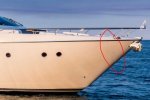
70317616-1C3F-4D3F-9E2B-8B9C3C9E24D3.jpeg
I see similarities with the U.K. 7.5 ton hire rule on a std driving licence .Horse boxes , large RV are under .

There has to be a cut off .Yes in motor yachts it convoluted .But 90 ftrs with 10-14 pax at 25 knots 24/7 …….??

Bering in mind some Pershing/ Itama / Otam et al can do in excess of 4O knots .Basically unregulated.
 
it’s a complete ban on anchoring of boats with LOA +20/24m within the restricted zones … not a time limit or a restriction on overnight stays. Enforcement is not particularly rigorous, but if they decide to make an example of you the penalties for non-compliance are significant.
so can boats smaller than 24m anchor where they like in these zones, including in the posidonia?

Sounds better than in the balearics where in a lot of calas (and the number of calas subject to these rules keeps increasing each year) regardless of length of boat you're not allowed to drop anchor in (or have your chain touching) the posidonia - you have to only anchor in sand. I've been moved on a couple of times now (LOA 9.2m) .
 
On the contrary MCA para 5.1 seems quite clear to me
Any addition or arrangement on the bow or stern of the vessel, the effect of which is to change the calculation of the Load Line Length (L) and which is normally in position during navigation will be taken into account in the calculation of L.

Cut-outs in the stem or stern, an example of which is shown in Figure 7 above, which serve no functional purpose and exist solely to circumvent the requirement for vessels with L of 24 metres and above to comply with the 1966 International Load Line Convention (as amended) will be treated as if they do not exist for the determination of L.

And it sounds like these measures by your own statements do indeed “exist solely to circumvent” the 24m regulations.
Perhaps the MCA and others should be clearer in their enforcement of the rules
That wording is ridiculous, it is trying to make you measure something that exists but not used for the LL purposes but then tells you to treat it as if it doesn't exist! As JFM says wouldn't stand up in court :)
 
  • Like
Reactions: jfm
so can boats smaller than 24m anchor where they like in these zones, including in the posidonia?

Sounds better than in the balearics where in a lot of calas (and the number of calas subject to these rules keeps increasing each year) regardless of length of boat you're not allowed to drop anchor in (or have your chain touching) the posidonia - you have to only anchor in sand. I've been moved on a couple of times now (LOA 9.2m) .

In principle, yes, you can anchor without restriction if you have LOA less than 24m. There are no go zones close to public beaches which are protected for swimming, and a small number of areas which are restricted for scientific or safety reasons, but these don’t really cause any problems.

I can vaguely remember some of the reports in the local news when the regulations were introduced. It was a very controversial topic and an attempt was made to balance the demands of the environmentalists (who wanted complete bans similar to those introduced in the Balearics) with the views of politicians, businesses and tourist authorities who didn’t want to jeopardise revenues or upset local voters, etc.

The justification for the measures was never fully disclosed, but somehow they reached the conclusion that it was the chains of the larger yachts which were causing the most damage … perhaps due to a combination of heavier chain, longer scope and longer stays in more changeable conditions resulting in more swinging which is what really tears up the bottom. Most of the smaller boats (<24m) anchor for a few hours only, generally in calm conditions and with relatively short scope to reduce the possibility of fouling of chains in congested anchorages. Apparently Posidonia grows mostly in depths of less than 25-30m which is why the 20-30m depth contour has been followed.

The measures are a fudge between politics, environment and economics without much scientific basis. However, for the vast majority of boaters, they have had no impact and so life continues much as before.
 
Are the laws to decide if the skipper needs a commercial endorsement equally clear? For example, if you only take non paying guests then obviously it’s a pleasure craft...but if you also take a paid crew are you still a pleasure craft...even if the owner is the operator ?
 
On the contrary MCA para 5.1 seems quite clear to me
Any addition or arrangement on the bow or stern of the vessel, the effect of which is to change the calculation of the Load Line Length (L) and which is normally in position during navigation will be taken into account in the calculation of L.

Cut-outs in the stem or stern, an example of which is shown in Figure 7 above, which serve no functional purpose and exist solely to circumvent the requirement for vessels with L of 24 metres and above to comply with the 1966 International Load Line Convention (as amended) will be treated as if they do not exist for the determination of L.

And it sounds like these measures by your own statements do indeed “exist solely to circumvent” the 24m regulations.
Perhaps the MCA and others should be clearer in their enforcement of the rules
With respect, I think you may have at least one foot in the elephant trap. MGN 645(M) is not the legislation itself; it’s an agency’s statement of policy with regard to the legislation.

Imho the courts would be unlikely to accept the MCA view of the legislation (as set out in MGN 645(M) ) strictly as stated.
 
With respect, I think you may have at least one foot in the elephant trap. MGN 645(M) is not the legislation itself; it’s an agency’s statement of policy with regard to the legislation.

Imho the courts would be unlikely to accept the MCA view of the legislation (as set out in MGN 645(M) ) strictly as stated.
Sounds a bit like the HMRC principle well accepted by the Courts - if something is designed purely to avoid tax, with no other reasonable purpose, then it can be set aside.
But it has already been stated these are pure wheezes to try to pretend to be under 24m.
 
Are the laws to decide if the skipper needs a commercial endorsement equally clear? For example, if you only take non paying guests then obviously it’s a pleasure craft...but if you also take a paid crew are you still a pleasure craft...even if the owner is the operator ?

Based on my own experience, I think the rules are relatively clear but they are complex and not easy to follow unless you invest the time to do your own research or engage someone who knows what they are doing.

The concept of "pleasure craft" can include vessels in both commercial and non-commercial use. Commercial status is not determined solely by whether you take paying guests or have paid crew, but is linked to factors such as the size of the vessel, where it is registered, what part of the register it's on, its VAT paid status, and how and where it will be used. Each registry/national flag has its own rules you have to comply with, and then you also have to consider how these interact with the rules of the territories where the boat will be used.

For example ...

Some flag states and countries require a vessel that will be chartered (even if only occasionally) to be commercially registered. Most then require crew on commercially registered vessels to have commercial endorsements, including during periods when the vessel is not being used for commercial purposes (e.g. in use by the owner). This usually applies irrespective of size. Some states allow vessels to be moved between commercial and non-commercial registers (e.g. to permit an owner without a commercial licence to act as the captain), others do not. Some allow it, but make it difficult, time-consuming and expensive.

Some states require commercial endorsement for vessels over a certain size, even when used exclusively for private use with no chartering.

Some states insist that non-VAT paid boats are registered on the commercial sections of their registers, with knock-on effects for captain and crewing requirements.

The list of permutations is endless, so you need to analyse your own situation starting from the choice of flag state, choice of cruising grounds and intended use.
 
Sounds a bit like the HMRC principle well accepted by the Courts - if something is designed purely to avoid tax, with no other reasonable purpose, then it can be set aside.
But it has already been stated these are pure wheezes to try to pretend to be under 24m.
I’m much too old and tired to get into a debate about Furniss v Dawson et al save to say that that was a decision of our highest court which favoured a taxation principle espoused by HMRC over a contrary principle. I would not be confident that a separate agency’s wishes would automatically be endorsed simply because they’ve issued a policy paper that, on its face, seeks to introduce matters not contemplated by the relevant legislation.
 
  • Like
Reactions: jfm
On the contrary MCA para 5.1 seems quite clear to me
Any addition or arrangement on the bow or stern of the vessel, the effect of which is to change the calculation of the Load Line Length (L) and which is normally in position during navigation will be taken into account in the calculation of L.

Cut-outs in the stem or stern, an example of which is shown in Figure 7 above, which serve no functional purpose and exist solely to circumvent the requirement for vessels with L of 24 metres and above to comply with the 1966 International Load Line Convention (as amended) will be treated as if they do not exist for the determination of L.

And it sounds like these measures by your own statements do indeed “exist solely to circumvent” the 24m regulations.
Perhaps the MCA and others should be clearer in their enforcement of the rules
If you think 5.1 is clear then I'd suggest you read it very carefully. This is a set of rules the breach of which involves punishment for citizens, and it is not good enough for that. The sentence contains a clear circularity and doesn't have any logical meaning when read with the precision that courts (rightly) apply. That's quite aside from the fact that the MCA has no power to say something is this or that when the law doesn't say it.

The second sentence you have quoted creates a motive test: something whose purpose is to circumvent will be treated as if it does not exist. MCA have no power to do that and no such motive test exist in the law. The rules contain a complex formula for measuring a boat and that formula should be applied, regardless of whether the boat builder intend this or that feature to get the boat under the 24m limit. On a hull that is close to 24m, you can be 23.9m or 24.1 under the rules just by nudging the rudder forward or backwards - if the designer nudges the rudder forward to get 23.9m, a change that has no functional purpose and was made solely to circumvent the 24m rules, should the boat be deemed to be 24.1m? That would be absurd. And so this second sentence from MCA is absurd, and is also hugely outside their powers.

Yes indeed, these things are done solely to circumvent. Should a driver who is running late but does 70mph on the motorway solely to circumvent a speeding ticket get one anyway? Should the commuter who takes the 19h05 train home solely to avoid the peak fare that applies to the 18h55 train pay the higher fare? What's wrong with putting yourself on one side of a line that has been clearly/scientifically defined, on a non moralistic matters such as the speed of your car, the time of your train, or the length of your boat? Why is it ok to say that amounts to "circumventing" (a pejorative word) and then punish the person as if they were the other side of the line? What a horrible world that would be to live in.

Certainly the MCA should be "clearer" = we are agreed on that :)
 
Last edited:
  • Like
Reactions: DAW
Are the laws to decide if the skipper needs a commercial endorsement equally clear? For example, if you only take non paying guests then obviously it’s a pleasure craft...but if you also take a paid crew are you still a pleasure craft...even if the owner is the operator ?
Yup those laws are clear. As are the 24m length rules. Only the MCA is creating a mess by purporting to change them.
 
Sounds a bit like the HMRC principle well accepted by the Courts - if something is designed purely to avoid tax, with no other reasonable purpose, then it can be set aside.
But it has already been stated these are pure wheezes to try to pretend to be under 24m.
That comparison doesn't stand up. With tax there is a moral starting position that the man on the Clapham omnibus can understand - that folks should pay an amount of tax if they make an amount of income. There is nothing moral/immoral about a boat being 23.9m or 24.1m, just as there is nothing moral/immoral about catching a 1905 train instead of the 1855 in my example above.

Moreover, the tax law you're referring to does not operate as you describe it. If you apply the principles of tax avoidance law to a boat that is 23.9m minus its nosecone and 24.1m with its nosecone, then the boat would be measured at 23.9m under the law, ie the nosecone design element would be successful. Same with the other boat I hypothesised above, whose rudder stock is nudged forward 10cm.
 
Don’t they ( court arguments) in 50/50 opaque areas look @ “ what was the intention “ .

If this proves with the train example to encourage folks to move to less busy cheaper times with a lower fair .Then that’s ok .
With the motor away 70 mph guy to encourage safe driving .Why he’s on there is irrelevant.His arguments “ I am late and it’s empty so I thought 85 mph was ok - perfectly safe “ does not count as he has clearly broken the law .

With this LoA vs LLL and getting under so to market them easily ( to owner / drivers of larger yachts ) …..what was the intention of the 24 M L restriction ?

Was it coming from a safety pov? Was it intended to be manipulated because it’s archaic formula can be used to increase a 70 ft boat without further licences into a 90+ ftr ?

I realise the formula of calculation of LLL is historic with roots in commercial maritime transportation , but in the private leisure sector it wasn’t intended at some future date to max L a boat to increase sale volumes of boat builders in the 21C .

So Again “ what was the LLL calc intended for ? “

Anybody !

I don’t think it introduced so in some future date due to gen increased affluence of society, to enable none professional skippers to drive 92 ft leisure craft .

I think that’s how tax evasion law sorting works .Well it did with the 182 day thingy.
 
Don’t they ( court arguments) in 50/50 opaque areas look @ “ what was the intention “ .
...
I think that’s how tax evasion law sorting works.
Apples and oranges.
Happy to be corrected by jfm or anyone else more familiar with UK law than myself, but my understanding is that for tax avoidance (not evasion, that's always illegal by definition), the "motive test" is specifically included in the letter of the law - and BTW, not always: not in the US as I recall, for instance.
But there's no such thing in the boat length rule, and MCA has no authority to enforce an addition to that rule which could only be valid if specified by the letter of the law.

So, even without having read all the docs referenced above, I don't think there's any "opaque area" here, in principle.
Still, you might well not want to embark in a legal fight on this topic even knowing to have a solid case, of course (I wouldn't!), but that's another matter altogether.
 
An aircraft carrier a thousand foot long, and any big ship, is made of many small sections that are brought together in the dry dock and welded together.....I should be allowed to drive an aircraft carrier
 
An aircraft carrier a thousand foot long, and any big ship, is made of many small sections that are brought together in the dry dock and welded together.....I should be allowed to drive an aircraft carrier
When Tesla gets around to aircraft carriers I’m sure Elon will give you a call…👍🤣
 
What’s the issue with this ? I mean builders and designers surly work closely , look at them and take necessary professional advice before embarking on a boat that might be close ?
It’s pretty std .
Are there examples whereby a hull #1 at a launch show say Cannes that’s touted as under the 24 LLL rule ( ie plugged as a owner driver , sans pro skipper ticket job ) then by say hull #3/4 some officialdom turns up and it turns out the boat tips over effectively bowling some like JFM out .Forcing him to go down pro skipper ticket route or hire one .With all with all that entails ?

A pics for those who are wondering what a nose cone is .
View attachment 153091
I see similarities with the U.K. 7.5 ton hire rule on a std driving licence .Horse boxes , large RV are under .

There has to be a cut off .Yes in motor yachts it convoluted .But 90 ftrs with 10-14 pax at 25 knots 24/7 …….??

Bering in mind some Pershing/ Itama / Otam et al can do in excess of 4O knots .Basically unregulated.
You see those bolt on bows in all the photos and documentaries....I often wonder if it’s more for navigating a congested and undersized builders yard...but my main thought is why ?....there is very little utility in a pointy bit....it might be a chain locker ...but little else...it seems a lot of extra berthing fees just for a pointy end
 
Apples and oranges.
Happy to be corrected by jfm or anyone else more familiar with UK law than myself, but my understanding is that for tax avoidance (not evasion, that's always illegal by definition), the "motive test" is specifically included in the letter of the law - and BTW, not always: not in the US as I recall, for instance.
But there's no such thing in the boat length rule, and MCA has no authority to enforce an addition to that rule which could only be valid if specified by the letter of the law.

So, even without having read all the docs referenced above, I don't think there's any "opaque area" here, in principle.
Still, you might well not want to embark in a legal fight on this topic even knowing to have a solid case, of course (I wouldn't!), but that's another matter altogether.
100% correct Mapism in UK law. Hence my rant that MCA needs to get back in its box and not impose restrictions that law doesn't impose.

Actually MCA is doing two things wrong. First it is creating new restrictions out of the blue, as per above (the motive test). Second it is seemingly failing to read properly what the law (specifically the ISO8666 definition they quote in 7.1c) actually says, and based on that mistake MCA is creating a new restriction (in para 7.2) that the law hasn't created.

Admittedly that paragraph in 7.1c is a surprisingly complex piece of English and you need to read it very carefully (on the buoyancy point) to see what it actually says. I'm happy to dissect it if anyone wants, but it would be a boring post!
 
Last edited:
Several points made above and a few quick thoughts:

1. Yes in most of SoF and also N and S corsica there are new laws banning anchoring of 24m+ boats inshore of a defined red line that basically follows the 20m contour. The zones around Cap Ferrat also have a 20m+ boat no go zone but in most other places its 24m. Good info here

2. Enforcement varies and has been light, except if you're one of the ones caught and get a big fine. Some enforcement has been done via AIS (solution = "off" switch), and some is done by police RIBs. I have seen 28m boats anchored in no-go zones and watched police RIBs drive by without caring, but I know of specific fines and have had one myself from a police RIB in the 20m zone in villefranche (in 2019, a week after the law was passed, with no publicity, so I didn't know it existed. I have anchored in that spot maybe 100 times).

3. The law is based on LOA not LLL, as DAW says above

4. Reason for law is to protect posidonia seagrass, they say. Objectively that isn't 100% plausible as the real reason, and some green policies (green as in envy) might be operating too - who knows? Posidonia is important to oxygenate the sea, but these policies should come down to how much seagrass is destroyed versus how much human pleasure and economic benefit islost when these boats clear off. The posidonia pressure group's website refers to a study on a busy anchorage that concluded 9% of posidonia seagrass in that anchorage was lost due to anchors. But that is, imho, pure denominator cheating to get a number as big as 9%. If you take 100 miles of South of France boating coast, only about 5% (my ballpark estimate) of that 100 miles is bays where you can anchor. The rest is coast that all boats drive by, never stopping. The pressure group has chosen just that 5% as their denominator for the 9% statement, so the true loss of posidonia over the 100 miles is more like 0.45%, which is in effect zero. So it's an irrational horrible law in my opinion, but it exists.

5. By the way, they seem to ignore posidonia loss caused by run off of chemicals etc from the land.

6. Some very small reliefs from these laws are that Cap Ferrat is ok ish, there is a good enough place you can anchor in the Lerin Islands, and in Corsica they have drawn boxes within the 24m no go zones where 24.1-30m boats are allowed to anchor in quite nice locations (one at Saleccia beach, one at Loto beach, for example). Also the chase boat will help a bit..

7. I'm going to spend less time in SofF because of this. Antibes is great for winter, but with the bigger boat I'll spend more time in Sardinia, Formentera, Italy generally, and maybe on to Adriatic and Greece.

8. You can skyhook anchor for up to 2 hours. Not exactly a peaceful thing to do with two v16s gurgling away, and will kill swimmers, but that's the law they have passed. I'm contemplating one of those Xenta joysticks on new boat just for this purpose, but not really sure there is any point.

9. I considered for a while buying a Sunreef 80 because it's massive and still 24m, but there's so much not to like about them including ugliness (imho), build quality (imho), you can't stabilise them (pysics) and you can't easily get an away-from-home berth. So I dropped that idea.

10. Corsica is confusing. These laws exist at top and bottom of the important west coast, but not in the middle (which is stunningly beautiful). East coast is irrelevant for boating. But the link I posted above shows a red line indicating the whole W coast of Corsica now has these laws, but it doesn't state the reference number (it just says "xxx/2023"). That might mean a law is coming soon for that location.

As you can probably tell I hate these new laws.
The Communists are very clever with their approach - until there is no income left to steal !!!
 
Why doesn't someone come up with a system based around a couple of electric motors attached to the prop shafts?

Surely 100HP each side would be enough to keep a large yacht relatively stationary in the typical conditions you'd wanted to be anchored in? The average power required would probably be a fraction of that and easily covered by silenced genset maybe with a battery bank attached to smooth out the load.

Then you could 'anchor' anywhere and stick to fingers up to the police boat.
 
Top