
Snubbers, bridles - dog bone things, springs and an apology

Neeves

Well-Known Member
Joined
20 Nov 2011
Messages
14,075
Location
Sydney, Australia.
Visit site
I sometimes liken snubbers to the suspension on a car - they make the experience (ride) more comfortable, and safer.

In order to make the ride of a car more comfortable there are a host of devices that have been developed or used including springs, shock absorbers, tyres, foam (in the upholstery). We would notice if any of these various components were missing - a wooden seat, a steel wheel. We also think all of these devices as normal, or common - and don't give them a moments thought. The combination has been developed over years - and we enjoy any new developments (without question)

Historically we have relied on catenary of the chain to smooth out the ride (at anchor) on our yachts. More recently there has been a flurry of interest in snubbers, in the form of elastic cordage (primarily nylon). Now none of this is for everyone, heavy chain might negate the need for the elasticity of cordage, heavier displacement yachts may not be sensitive to yawing nor chop - horses for courses.

But considering my analogy of 'snubbing' to the suspension in a car then possibly using a dog bone thing (or a metal spring) might have a place in the rode in addition to catenary and elastic cordage. I have discounted dog bone things as testing shows they are as useful as 3m of elastic cordage. My conclusion has been - just buy 3m of extra length of cordage, its cheaper, lighter and easier to store. Maybe I have been rash, ,maybe they offer a different way, quicker or slower, to manage snatch loads. I don't know (and I don't think anyone else knows either - of if they do - they have not expressed an opinion). Possibly the combination of rubber, nylon AND catenary offers something that has been missed.

So an apology to those who have expressed support for dog bone things (and maybe springs) and whose usage I rejected out of hand. I might have been bigoted and intolerant. I have just installed dog bone things on our 2 x 30m x 10mm nylon snubbers (a bridle, one on each arm,) and will be testing over the coming months.

In the meantime

Take care, stay safe
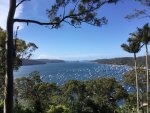
IMG_9393.jpeg

Merry Xmas from a gloriously sunny Sydney with a developing sea breeze

However the forecast for the Sydney Hobart might be a bit more taxing than today.

Jonathan
 
I used a dog bone on the snubber for my 3 tonne, 24 footer as there was limited space for a long line. The whole snubber was no more than 3 m, so the bone doubled its effective length. Made from 10mm 3-strand nylon, it was entirely adequate for the anchoring I did, which did not include sitting out hurricanes. I had a mixed rode, with 17m of chain, so I only used the snubber in shallow water, when I could attach it to the chain. In any sort of blow, I'd have more scope out, so the rope would do its own snubbing. The snubber was also very useful when sleeping aboard on our mooring, as it would stop the graunching of the chain in the bow roller as the boat swung to wind and tide.

Jazzcat's a good deal bigger and heavier, and has more chain in the rode, so I rather think I'll be going down to our local climbing wall to get some retired climbing rope for a long snubber/bridle arrangement, which I reckon will also help her sit nicely to a buoy. I won't need it for the mooring, as I've got a polysteel bridle on that now.
 
I did some (not exhaustive) testing of rope rodes of different diameters vs. tension. In gusty conditions, too much stretch increases yawing with then increases both sailing and tension. I'm quite sure the critical amount of stretch is boat and condition specific, but my conclusion was that there is a maximum beneficial length for snubbers, and that rope rodes can be a little bigger than the minimum.

The other place this comes up is sea anchors and drogues.
  • Too much stretch with a drogue and it does not "bite" in time to prevent surfing or capsize. Too little and it is easier to shock load and pull out of the water. The right answer is polyester, not nylon or Dyneema.
  • Too much stretch with a sea anchor rode and the boat gets diseways in the lulls between waves. The rode gets slack and there is snatching. Bad.
The solution to both is controling strech and keeping a steady load on the rode via a V-riding sail or similar. Some portion of a sea acnchor roe should probably be polyester. But very little work has been done because drogues need testing in gale conditions, and sea anchors in worse than that. No fun.

---

Like suspention, part of the problem is rebound. For springs on vehicles we use dampers. On boats we rely on water friction on the hull. A JSD has friction all along the rode.
 
Even on a monohull, a bridle would help with yawing - one line thought each bow fairlead. Even if they're closer together than the ideal, they'll provide some correcting force as soon as a yaw starts.
Not nearly as much as a riding sail though.
 
It surely depends on why the yawing might be occurring.

Yawing can be caused by too much windage forward (or can be reduced by removing some windage forward). Drop a furled sail (a real faff if the wind is up) remove the dinghy from the foredeck - and maybe use a riding sail.

Some yawing is caused by the topography (which you cannot change - though you could move) or by wind shear - its the wind that is yawing causing the yacht to yaw - and under these latter condition to me, in my ignorance, a riding sail will only make things worse (or at least not make it any better). The best visual examples of wind shear are watching aircraft land in strong wind. The wind seems stable from where you observe the action but the planes come in to land in varying directions as the autopilot or pilot react to the varying gusts. Airports tend to be built on flat land but this does not stop wind gusting for quite radically different directions and aircraft landing in a spectacular manner.

Both anchoring in a 'V' or a bridle and (in my experience) a decent snubber/bridle would help manage wind veering because of shear.

The idea that rebound or yo-yoing is an issue, again based on my experience, is not a factor. We have 30m snubbers - lots of potential rebound - its not a negative. It is much talked about - but historically yachts used mixed rodes with lots of nylon, and many still do, I don't recall anyone complaining of rebound (its a marine myth). There is rebound - but its slow

However this thread is about using different types of elasticity (and catenary - as there is always some catenary, unless you are using an all rope rode). Elasticity of nylon (the stretch, which is the transfer of kinetic energy of the moving yacht to potential energy in the rope) occurs roughly linearly. Catenary develops inversely, more initially and then diminishes as the chain straightens. I don't know how rubber reacts (need to check) but it will be different.

I suspect that catenary reacts more quickly than nylon (of the right size) stretches but as the chain straightens the nylon increasingly offers more stretch than the chain offers more catenary. In fact at a certain point the chain offers nothing (but a snatch load) and the nylon would continue to stretch (roughly) linearly (until it fails - and if it offers elasticity it will fail long before the chain is stressed.

Its where does the dog bone thing fit into catenary and elasticity - and does it offer a benefit that is undocumented.

I do know that members here, a few, do use (and swear by) dog bone things - so airing it seems sensible. At least one member championed steel springs.

If dog bone things stretch more early on as winds develop then they may extend the life of the nylon snubber.


It merits note - if your yacht is yawing and or if you are experiencing snatch loads then your anchor is subject to similar (actually identical) stress - particularly if all your chain is lifted off the seabed. A sntach load as your bow is lifted in chop or swell will lift the anchor shank. The chain constantly moving left and right will tension the shank from side to side - neither seem very conducive to a good hold. If you are in a busy or tight anchorage the ability to deploy more chain may not exist - and I can think of a few, apparently, tranquil but small anchorages that suffer from wind shear. I mentioned, (I know boringly repetitively) that I think anchors dragging is not through a lack of straight line hold (and ignoring operator error and bad luck) but tensioning the anchor at an angle, veering or from chop/swell lifting the rode.


I have noticed that owners do understand they need elasticity in their snubber (or bridle) and reading reports from people who have suffered under storm conditions (the storm this year in the Scillies) there is repetitive mention of snubbers (and/or their hooks) failing and that adding a new or 'stronger' snubber has been a nightmare. This was one reason for me to develop our 30m bridle system (you can deploy more quite comfortably and you can deploy a second snubber quite easily). It would be nice to think the issues in the Scillies could be used as a lesson - to us all. There is a thread here on YBW on the Scilly storm - which makes depressing reading of those that suffered (snubbers should not fail, hooks should not fail etc and uplifting for those who sensibly - took note and moved out of harms way.

Take care, stay safe

Jonathan


I've offered this link previously and hope some might have links to the Scilly Island storm

Safety at Sea: Surviving a Powerful Storm in the Med

J
 
Last edited:
We'll I do have some experience with a riding sail, and I have never found it to make things worse. Maybe try one?
 
Norman - point taken

But then I have never had a problem with too much elasticity. Maybe try some

I have been in an anchorage during storm force winds out in the open sea where bullets came down through the trees and valleys forcing us and another yacht at anchor to yaw through almost 180 degrees. The gusts were sufficient to lift water off the still sea surface. I cannot think a riding sail would help. It was a tight anchorage and the answer was for us to move closer to shore and tie a shore line to a tree and deploy 2 anchor from the stern, at roughly 45 degrees to each other. The yacht. kept its bower anchor set and simply took shore lines to rocks off starboard side and an anchor aft off the port side. Basically they used what would be unremarkable in Patagonia.

Interesting that in Patagonia shore lines and extra anchors are de rigour - you don't see riding sails.

Just look at Novak's 'Pelagic' - 4 drums of shore lines. I don't recall him mentioning use of a riding sail in his video of storm anchoring

What was interesting, at least to me, was that it was quite possible to hold either yacht steady using shore lines - strength of a man was enough - but the developed snatch loads were frightening.

YoYoing

If 'X' amount of energy pushes your yacht back and you have either all chain or a decent snubber then that energy is 'stored' in the rode as a straightening of catenary or stretch of a snubber (plus some straightening of the catenary). When the gust dies back that energy is released and the yacht moves forward.

I have never heard of anyone mentioning yo-yoing of an all chain rode - but its the exact same amount of energy - simply 'stored' in a different way but when it is transferred back to the yacht pulling it forward the impact, the reaction, will be exactly the same. Same yacht, same energy release. Now the release may be different slower faster - but given water resistance etc it is difficult to imagine (but prove me wrong) that anyone would notice the difference.

If yo-yoing was a real issue people would mention it of all chain rodes.

Jonathan
 
Last edited:
Thanks Neeves, a good post that I agree with.
My experiences with both dog-bone and 3 metres of 3 strand nylon compared to using 10+ metres of 12mm climbing rope is that the climbing rope gives a better result. Whilst not a fair test due to the different lengths of the two snubbers it’s based on several hundred nights at anchor on both types.

Current system on a 15m 16000kg mono sailing boat is: the climbing rope runs from the midships cleat through the bow roller to and through a chain hook and back to the same midship cleat. This gives a run of two lines , approx 10+m each. If my physics is right the two lines reduce the force each line is subject to but the stretch is the same as for a single line.
This is a redundant climbing rope of mine which has/had a max static load of about 2,000/2,500 kg. In winds of 30 knts, at a point on the deck, I see the rope stretch 500mm or so but this is an underestimation of the total elongation as I cannot measure it at the chain hook (located 3m ahead of the bow roller) where the maximum stretch occurs.
I don’t know the load that different wind/ wave combinations will subject the snubber to but it’s not broken so far. The anchor chain is 8mm with a break load of around 6,000-7,000 kg.
Incidentally, I have tried numerous materials to protect the two snubber lines as they exit the cheeks either side of the bow roller and found that a piece of builders plastic conduit o/d60mm and i/d5 0mm is able to flex as the boat yaws and offers a smooth internal surface. As I anchor most nights, I leave the snubber permanently rigged just hanging the chain hook on the pulpit when sailing.
 
We'll I do have some experience with a riding sail, and I have never found it to make things worse. Maybe try one?

I have. I have tried many riding sail types. (Not on the boat in my avitar; cats with big cabins are better served by a bridle, and there is so much windage aft a riding sail doesn't do much. A trimaran with no encosure aft, and not rigged with a bridle.)

If the direction fluctuations are bad enough to get on the reverse side of a single luff riding sail, the boat will tack somewhat violently. In these conditions, I was much better off without a single luff riding sail.

This does not happen with V-type riding sails (Fin Delta or V-Delta). Do they make things better or worse in fluctuating conditions? They made it better by reducing the extent to which a boat would turn even farther away from the wind and sail off. I did not test in strong fulctuations (about 20 degrees), but I believe the effect would be the same in larger fluctuations.

a. I encourage others to test. I published my results, but I never said they were definative; they were the results for one boat tested in generally similar conditions, varying only the wind strength (regular ~20 degree oscillations). Every boat is different and different riding sails work on different principles (setting the boat at an angle vs. providing drag aft and a consistent correcting force). Testing in these conditions will be frustrating, because the wind will be changing a lot. It will take patience.
b. There are 3 effects to consider. Jerking. Maximum rode tension. Pull angles.

A V-riding sail does increase the drag, but I found it to be several to many times less than the increase in drag caused by the wind seeing a yawing boat from the side.
 
Yo-yoing is generally only a factor with rope rodes and >150 feet out. Then it can be pretty alarming in gusty conditions. It seems unlikely anyone would use a snubber long enough to experience this.

For this reason, I use a heavier than recomended nylon rode on my tri. It reduces yo-yo but still stretches more than enough. Polyester would be too unyielding for my tastes (shallow water).
 
This is interesting. Something we know but do not always say.

"I suspect that catenary reacts more quickly than nylon (of the right size) stretches but as the chain straightens the nylon increasingly offers more stretch than the chain offers more catenary. In fact at a certain point the chain offers nothing (but a snatch load) and the nylon would continue to stretch (roughly) linearly (until it fails - and if it offers elasticity it will fail long before the chain is stressed.

Its where does the dog bone thing fit into catenary and elasticity - and does it offer a benefit that is undocumented."

I've pondered whether a rode could be led to some manner of compound bow snubbing mechanism, perhaps below decks. The sky is the limit, and the construction could be of many different materials (not nylon). The snubbing effect does not need to be linear and could be damped. But this is super yacht stuff.

A Dyneema snubber could lead to a captive reel with variable damping characteristics. It could be computer controlled. This is, of course, done on many drill rigs.
 
I'm trying to conjure a compound rode, chain, nylon, rubber or whatever that is simple. To me deploying an anchor and chain, adding some form of snubber using a hook (or soft shackle) where the snubber might be 2 separate components (ours is nylon rope with a dog bone thing) is simple. If needed I can extend the snubber from 15m to 30m at the cockpit (if I anticipate the need). The snubber (bridle) never extends beyond the bow more than 10m.\

The question is - do the experience as defined by the summaries of anchoring under storm conditions, my link above and the Scillies storm, need something more and might the compound rode/snubber offer any advantage.

Jonathan
 
Thanks Neeves, a good post that I agree with.
My experiences with both dog-bone and 3 metres of 3 strand nylon compared to using 10+ metres of 12mm climbing rope is that the climbing rope gives a better result. Whilst not a fair test due to the different lengths of the two snubbers it’s based on several hundred nights at anchor on both types.

Current system on a 15m 16000kg mono sailing boat is: the climbing rope runs from the midships cleat through the bow roller to and through a chain hook and back to the same midship cleat. This gives a run of two lines , approx 10+m each. If my physics is right the two lines reduce the force each line is subject to but the stretch is the same as for a single line.
This is a redundant climbing rope of mine which has/had a max static load of about 2,000/2,500 kg. In winds of 30 knts, at a point on the deck, I see the rope stretch 500mm or so but this is an underestimation of the total elongation as I cannot measure it at the chain hook (located 3m ahead of the bow roller) where the maximum stretch occurs.
I don’t know the load that different wind/ wave combinations will subject the snubber to but it’s not broken so far. The anchor chain is 8mm with a break load of around 6,000-7,000 kg.
Incidentally, I have tried numerous materials to protect the two snubber lines as they exit the cheeks either side of the bow roller and found that a piece of builders plastic conduit o/d60mm and i/d5 0mm is able to flex as the boat yaws and offers a smooth internal surface. As I anchor most nights, I leave the snubber permanently rigged just hanging the chain hook on the pulpit when sailing.

Dave,

I agree with what you say and find commonality with your conclusions.

I'm not suggesting that dog bone things would replace a decent length of climbing rope (though it anyone insists on a 3mm snubber (which to me is not an elastic snubber - then please add a dog bone thing). Dog bone things are expensive (in terms of a redundant length of climbing rope) and as they only offer the elasticity of 3m of climbing rope - the dog bone things are, surprisingly, heavy. My thought is that like a car suspension maybe different forms of energy absorption (with different characteristics to catenary and nylon elasticity) might offer a noticeable advantage - and dog bone things are easy to fit and are easily available.

The rode is 'stressed', or the anchor at the end of the rode is stressed by different actions thrown at it by nature, the windage of the yacht and speed of wind, chop, swell and then yawing. Each of these forces may benefit from being managed, or not, by different materials.

To measure your total stretch - simply measure the extension of a fixed length - anywhere that it is easy - and then extrapolate for the total length being used. Its crude as friction will alter the simple maths - but its 'good enough'

We too leave our snubbers (its for a cat, so a bridle, 2 x 30m x 10mm climbing rope) permanently deployed (commencing at the transom) and take each arm 'outboard' at a dedicated turning block. I added a couple of days ago a dog bone thing to each arm. To me, being lazy, simply dropping a hook onto the chain rode with all the bridle already laid out and this takes seconds - and I'd need really strong motivation to set up a riding sail (it would need to be really good).

Jonathan
 
Norman - point taken

But then I have never had a problem with too much elasticity. Maybe try some

I have been in an anchorage during storm force winds out in the open sea where bullets came down through the trees and valleys forcing us and another yacht at anchor to yaw through almost 180 degrees. The gusts were sufficient to lift water off the still sea surface. I cannot think a riding sail would help. It was a tight anchorage and the answer was for us to move closer to shore and tie a shore line to a tree and deploy 2 anchor from the stern, at roughly 45 degrees to each other. The yacht. kept its bower anchor set and simply took shore lines to rocks off starboard side and an anchor aft off the port side. Basically they used what would be unremarkable in Patagonia.

Interesting that in Patagonia shore lines and extra anchors are de rigour - you don't see riding sails.

Just look at Novak's 'Pelagic' - 4 drums of shore lines. I don't recall him mentioning use of a riding sail in his video of storm anchoring

What was interesting, at least to me, was that it was quite possible to hold either yacht steady using shore lines - strength of a man was enough - but the developed snatch loads were frightening.

YoYoing

If 'X' amount of energy pushes your yacht back and you have either all chain or a decent snubber then that energy is 'stored' in the rode as a straightening of catenary or stretch of a snubber (plus some straightening of the catenary). When the gust dies back that energy is released and the yacht moves forward.

I have never heard of anyone mentioning yo-yoing of an all chain rode - but its the exact same amount of energy - simply 'stored' in a different way but when it is transferred back to the yacht pulling it forward the impact, the reaction, will be exactly the same. Same yacht, same energy release. Now the release may be different slower faster - but given water resistance etc it is difficult to imagine (but prove me wrong) that anyone would notice the difference.

If yo-yoing was a real issue people would mention it of all chain rodes.

Jonathan
The main reason, apart from generally strong winds, why boats cruising in the Patagonian Channels, use shore lines is the great prevalence of kelp. No anchoring arrangement can give security in kelp. A few of the anchorages in the West Coast of Scotland have kelp in parts, but with the use of a fish finder, clear patches can generally be found. Climatic conditions dictate that in the Outer Isles, there simply aren't trees to tie to. I always prefer to lie head to wind, which is more difficult to achieve with shore lines. I have, on occasion, run lines ashore to rocks, but prefer not to.
 
Top