Snubber/bridle revisted

Magnum

RIP
Joined
14 Jan 2004
Messages
2,706
Location
Jersey
Visit site
I'm sure I said in an earlier thread that due to the hassle factor of installation I've given up on the idea of a chain stopper on Magnum. So it's back to a snubber using the Ultra chain grab.

Easiest solution would be to splice to lines onto the chain grab and fix each to the bow cleats via the fairleads. Only problem there is that due to the sharp angle down to the water the lines will be constantly rubbing on the bow section forward of the cleats (Hurricane you are lucky that your P67 won't suffer from this issue).

So how about a Y section snubber like this?

P68_FGA1.jpg


Load direction off the cleats should be OK but the angle of the Y section is too great for a conventional splice. Maybe a simple stainless O ring?

Any other comments?
 
I have a concern that the wide included angle between the two arms will create an extra load on the join of the Y, and on the cleats.


The figures for a span lifting1 tonne are :-

45o - 1/2 tonne in each leg

120o - 1 tonne in each leg

150o - 2 tonnes in each leg.


EDIT

Just checked. for a 50ft sailboat in 60 kts, anchor strain on a 10:1 scope is just over 2000 lbs-force. I have no figs for mobos, sorry.


Fastening the legs to cleats amidship would reduce the load considerably. (Where 'considerably' is an undefined figure owing to lack of data)
 
Last edited:
It looks like a good option - but though I can't do the sums, won't the load on the two lines to the cleats be rather large due to the angles?
 
I am struggling with this. How can the load increase by four fold? Surely all that will change is the angle of the cleats loading. On Sarabande's example as the angle decreases below 45 degrees then the total load on both cleats combined with be less than the load on the chain. Indeed if you had only one central cleat i.e. a Samson post, then there would be no load at all?
Instead of a central stainless steel ring, try a rubber donut and that will help balance the cleat loads as the chain shifts
 
Assuming the angle between the two ropes and athwartships-ness of the boat is 30 degrees (a rough guess from pic) then the load on the cleats is 2x the tension in the chain because Sine30 degrees is 0.5. However, you are using 2 cleats, so the load on each of them is 1x the tension in the anchor chain, so not too bad I suppose, if the cleats are well fastened. That said, the load on the cleats is a bit sideways and generally you prefer it to be longways, but it will be ok for any anchoring you're likely to do (as opposed to get the hell out of).

As you know, I wouldn't bother. In my book a key ingredient of anchoring is to get the hell out fast when you need to.
 
Easiest solution would be to splice to lines onto the chain grab and fix each to the bow cleats via the fairleads. Only problem there is that due to the sharp angle down to the water the lines will be constantly rubbing on the bow section forward of the cleats (Hurricane you are lucky that your P67 won't suffer from this issue).

I understand what you mean about the lines rubbing.
How about some nice stainless steel (half round in section) strips (perhaps 10mm dia and as long as 800mm) fitted to the angled gunwale.
I've seen this done on a Sunseeker.
The idea is that ropes will slide over the stainless rather than rub on the GRP.
They would have a double use - could be used when securing alongside.
Maybe you could then have a conventional bridle with the centre join under the bow.
 
I'm sure I said in an earlier thread that due to the hassle factor of installation I've given up on the idea of a chain stopper on Magnum. So it's back to a snubber using the Ultra chain grab.

Easiest solution would be to splice to lines onto the chain grab and fix each to the bow cleats via the fairleads. Only problem there is that due to the sharp angle down to the water the lines will be constantly rubbing on the bow section forward of the cleats (Hurricane you are lucky that your P67 won't suffer from this issue).

So how about a Y section snubber like this?

P68_FGA1.jpg


Load direction off the cleats should be OK but the angle of the Y section is too great for a conventional splice. Maybe a simple stainless O ring?

Any other comments?

Thinking about it, I can see an operational problem with this arrangement.
Where/how is the windlass operated.
If you remember, the P67 is controlled from a switch on a curly wire which is stowed in the port locker.
With a bridle attached like your diagram, both forward hatches would have to be closed thus obstructing access to the windlass control.
I suppose you could add a wireless remote - I did a couple of months ago if you would like details.
 
I understand what you mean about the lines rubbing.
How about some nice stainless steel (half round in section) strips (perhaps 10mm dia and as long as 800mm) fitted to the angled gunwale.
I've seen this done on a Sunseeker.
The idea is that ropes will slide over the stainless rather than rub on the GRP.
They would have a double use - could be used when securing alongside.
Maybe you could then have a conventional bridle with the centre join under the bow.
These things... https://www.seascrew.com/browse.cfm...NG-STRAKE-AND-KEEL-BAND---STRIP-&l=0000001127
 
Thinking about it, I can see an operational problem with this arrangement.
Where/how is the windlass operated.
If you remember, the P67 is controlled from a switch on a curly wire which is stowed in the port locker.
With a bridle attached like your diagram, both forward hatches would have to be closed thus obstructing access to the windlass control.
I suppose you could add a wireless remote - I did a couple of months ago if you would like details.
You'd just un-cleat the snubber, then open the locker to get the curly remote. Still a bit of a faff not being able to use the locker any time you want though - we store full bin sacks from the galley in the anchor locker, for example
 
I understand what you mean about the lines rubbing.
Since nobody asked, I guess also anyone else understood that, so I'm a bit embarrassed to admit that I didn't.
Isn't that problem eliminated by passing the snubber lines through the fairleads?
 
Since nobody asked, I guess also anyone else understood that, so I'm a bit embarrassed to admit that I didn't.
Isn't that problem eliminated by passing the snubber lines through the fairleads?
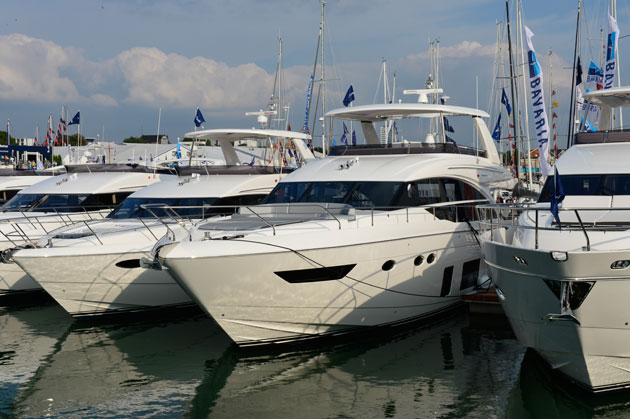
Nope. The prin 68 has a sharply reverse angled deck moulding, which is much easier to make (hence a considerable cost cut) than the "flared all the way to the top" bow of Prin 67 and 72, and Sq65 and 78, for example. A side effect is that snubber lines and also ground lines in a med berth rub on the gelcoat, and the fairlead doesn't offer any help. So you need the little s/s anti-chafe strips. You can see the two moulding types side by side in this pic (centre boat is prin 68; right boat is I think a 72)
Princess_68.jpg
 
So you need the little s/s anti-chafe strips.
Yup, that's what I meant.
Actually I cant see them in the pic you posted, but I assumed the presence of these strips right under the fairleads, otherwise in Med mooring the ground lines could rub on the gelcoat, potentially even more strongly than the anchor snubber, depending on their length/angle.
So, based on this assumption, I was guessing that the strips would have worked equally well also with the snubber...

PS: doh! I only just noticed that Hurricane suggested to fit those strips, so I guess they don't come as standard. Is Princess unaware of how boats are moored in the Med?!? :eek:
 
Last edited:
Thinking about it, I can see an operational problem with this arrangement.
Where/how is the windlass operated.
If you remember, the P67 is controlled from a switch on a curly wire which is stowed in the port locker.
With a bridle attached like your diagram, both forward hatches would have to be closed thus obstructing access to the windlass control.
I suppose you could add a wireless remote - I did a couple of months ago if you would like details.

I think this is what is referred to as a D'oh! moment. You are totally correct, especially as the plan was to used spliced loops on the cleats making it impossible to remove under load without taking up the slack in the anchor chain.
 
I understand what you mean about the lines rubbing.
How about some nice stainless steel (half round in section) strips (perhaps 10mm dia and as long as 800mm) fitted to the angled gunwale.
I've seen this done on a Sunseeker.
The idea is that ropes will slide over the stainless rather than rub on the GRP.
They would have a double use - could be used when securing alongside.
Maybe you could then have a conventional bridle with the centre join under the bow.
I had these on my Pred 72. They work great for med bow lines as the angle is quite shallow. My concern with using them for a dual snubber is that the angle of lines from the rubbing strakes down to the anchor chain is much sharper, which means rubbing on the rubber section of hull rubbing strake. Yes I know that's what it's meant for but days at anchor will take its toll on the rubber, unless the stainless strips are quite deep and fitted right next to the rubbing strake, which given its curvature might be tricky.

EDIT: I need to check that the standard hull rubbing strake is actually rubber in stainless and not stainless in rubber. If the latter then that would work with some additional stainless protection strips.
 
Last edited:
You would need a chain stopper to hold the chain while it was setup and also de rigged
The " crew" need a way of de tensioning it - to make it easy esp retrieval in a dark , wind , wet bug out.
 
Last edited:
You would need a chain stopper to hold the chain while it was setup and also de rigged
The " crew" need a way of de tensioning it - to make it easy esp retrieval in a dark , wind , wet bug out.

We are using the Ultra chain grabber - https://www.ultramarine-anchors.com/chain-grab

"The Ultra Marine Chain Grab protects the windlass from constant chain pull, and is easily attachable to a loaded anchor chain, disengaging automatically from the chain upon retrieval."

So maybe a little bit of a faff to deploy, but disengaging (the important bit) doesn't sound like a problem.
 
Top