
Small Jib Sheet Issue (Corribee)

Corto

Member
Joined
31 Oct 2010
Messages
41
Location
Florence
www.simonepierotti.com
Hi there from Italy,

My 1980 Corribee "Tamatino" needs some fine tuning on his small jib. Since I've bought her I always used the furling jib. This year I would like to install a dyneema forestay for the smaller jib. The problem is that the lower shrouds are on the way and is impossible to close the sail enough for close hauled.
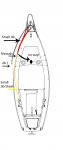
tamatino-deck.jpgThere is a attachment file that hopefully could fix my "ita-nglish" language mistakes.
I would like to have an opinion from other Corribee owners.
Thanks

Simone Pierotti
 
I am not a Corribee owner but one way around the problem is to have an extra pair of sheets that are permanently attached to the sail. These are routed inside the shrouds for close hauled work. You could also do that with your larger jib. This method is used on the Working Boats that race here in Falmouth.
 
Last edited:
I usually use a 150% furling genoa with padded luff to maintain the shape even when part-rolled, but do use a smaller jib for serious upwind work. With no dedicated forestay, I have to remove the genoa from the roller which is a pain, and so it doesn't happen too often.

I have the same problem as you with the sheeting angles. The tracks don't go far enough back for the genoa and have the effect of pulling the leach downward, so I've improved the angle by attaching a pulley on the deadeye with a short lanyard which raises it off the deck. This also means that I can haul it inward to the centreline of the boat using a barber-hauler, and can improve the sheeting angle. The problem is there's nothing much to attach the barber-hauler to- I don't trust the coachroof grab handles.

I was considering putting permanent 'upwind' sheet pulleys closer to the mast, fixed to the coachroof with backing pads, to allow close sheeting of a small jib without it snagging the forward lower shrouds, but it's never seemed that urgent to actually get round to it!

If you find an (easy) solution, let me know!
 
One way of doing it is to put the foot of the small jib on a boom that is pivoted near the base of your new inner forestay. The jib would then become self-tacking with one sheet going from the clew of the sail (= the free end of boom) to a block in front of the mast.

I am not a Corribee owner but that is how I would address the problem.

Something like this:-

IMG_0539.jpg
 
Last edited:
One way of doing it is to put the foot of the small jib on a boom that is pivoted near the base of your new inner forestay. The jib would then become self-tacking with one sheet going from the clew of the sail (= the free end of boom) to a block in front of the mast.

I am not a Corribee owner but that is how I would address the problem.

The successful self-tacking arrangements I've seen have a curved track that allows some downward force on the clew, otherwise, it's likely to lift and twist the sail unless it's sheeted in too far. If you can manage this, I reckon it has to be favourite.

An alternative would be to attach blocks to the aft lower shroud bases. You may need strops to allow the block to rise so you can get the right angle to the sail, but it would be easy to experiment with to see what sort of sheeting angle you can get without spending any money. If you can't get the sheeting angle from the shroud base, you might need to come further inboard and mount a block on the side-deck. If you do, I'd use a U bolt, put a ply backing plate under the deck and use penny washers (like a €0.50 coin with a hole in the middle) to spread the load.
 
The successful self-tacking arrangements I've seen have a curved track that allows some downward force on the clew, otherwise, it's likely to lift and twist the sail unless it's sheeted in too far. If you can manage this, I reckon it has to be favourite.

.

The jib boom can be made to only rotate around one inclined axis, thus preventing any uncontrolled rising when the sheet is eased. The clew end of the jib boom is at its lowest when close hauled but will rise when the sheet is eased. The amount by which it rises is a function of the angle that the 'axis' makes with the deck. This gives the idea:

jibboominfo2_med.jpeg
 
My boat has two sets of sheet tracks - one, outside the shrouds for overlappers and one on the forecabin roof for the 65%, (working jib) 100% (Non-furl solent) and 110% (roller-furling) genoas.
They overlap at the shrouds and the inner ones are half the distance apart of the side-deck genoa tracks.
 
The jib boom can be made to only rotate around one inclined axis, thus preventing any uncontrolled rising when the sheet is eased. The clew end of the jib boom is at its lowest when close hauled but will rise when the sheet is eased. The amount by which it rises is a function of the angle that the 'axis' makes with the deck. This gives the idea:

jibboominfo2_med.jpeg

Interesting concept Puff. Is the joint really strong enough to provide downward pressure needed to counteract the tendency for the boom to rise from wind pressure.?
I have toyed with the idea of self tacking jib on a boom. I have discounted the idea of loose footed jib as being to tricky to set the sail properly. ie with foot and leach tension.
I had resigned to the idea of having a central sheet like yours but with auxilliary sheet come vang from the gunwhale pulling downward one each side. Yes this would make it not self tacking although I see it as just a tweaking function and the jib setting fairly well with thse not tensioned. These aux sheets/vang could also facilitate backing the jib.
Just a thought. I would love to hear how yours works. olewill
 
Interesting concept Puff. Is the joint really strong enough to provide downward pressure needed to counteract the tendency for the boom to rise from wind pressure.?
I have toyed with the idea of self tacking jib on a boom. I have discounted the idea of loose footed jib as being to tricky to set the sail properly. ie with foot and leach tension.
I had resigned to the idea of having a central sheet like yours but with auxilliary sheet come vang from the gunwhale pulling downward one each side. Yes this would make it not self tacking although I see it as just a tweaking function and the jib setting fairly well with thse not tensioned. These aux sheets/vang could also facilitate backing the jib.
Just a thought. I would love to hear how yours works. olewill

Will, it is not 'what I have' but more 'what I would do' if I were the OP. (On my 1973 boat I have a 150% furling Genoa!)

The upwards pull is not really as dramatic as some people tend to believe. Compare the pull on the kicking strap or vang that is under the main boom with the pull that is on the mainsheet. I have not tested this empirically but I would bet that the pull on the mainsheet would be much greater.

Back to the jib. I think that you would agree with me that sheet tension would be lower when the sail is eased for a broad reach or for running. Holding the jib-boom down under those conditions would not require much force; remember that we are talking about a jib and not an intrinsically lifting sail like a spinnaker.

What I am trying to say is that the 'elbow' does not need to be massively strong because the forces, IMHO, are not that great.

If you wish to observe jib-booms and how they behave, excellent examples may be found wherever R/C boats are sailed.

Edit: Re loose-footed jib. By careful placement of the pivoting axis distance aft of the forestay one can pre-determine the amount of 'belly' when the sheet is eased; he further aft, the greater the camber when the sail is eased. It is a matter of experimenting before deciding on the final position.
 
Last edited:
Not quite what is asked here, but my uncle in the US, sailed his 27ft drop keeler on the Chesapeake. Getting on in age, he needed to drop the sails quickly from the cockpit if a sudden squall arrived.
Now, he was using a windsurfer type wishbone on the self tacking jib. This kept the shape of the sail with the sheet to a point on the mast step. Problem was, the sail could not come down until the tension was off the clew . I suggested running a line from the jib head, down inside the hanks until it reached the fore end of the wishbone, where it went round a block and back through the hanks to the deck. Round another block then back to the handling cleats on the aft end of the cabin roof. In effect a snotter. When one released the halyard, the tension was off the snotter, allowing the sail to be pulled down rapidly with a downhaul. Worked first time and he used to get a lot of questions about it. Now, at 95, he has just given away the boat, but can still go for the odd sail with the new owner. The system is still on it.
 
Top