
You are using an out of date browser. It may not display this or other websites correctly.
You should upgrade or use an alternative browser.
You should upgrade or use an alternative browser.
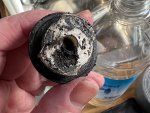
Sludge on Battery Caps - Is this bad news?
- Thread starter KeelsonGraham
- Start date

vyv_cox
Well-Known Member
Have your batteries boiled? The only caps I have seen like that was after mine did.

vas
Well-Known Member
FWIW, I let mine dry (each one took almost a litre of distilled water!) and they weren't like that. They were black as in smoked, this looks different.
BTW, how old are the batteries and how do you charge them?
BTW, how old are the batteries and how do you charge them?
KeelsonGraham
Well-Known Member
I hope they didn’t boil but who knows. They’re about 5-6 years old I think. The PO installed them. I’ve only had the boat for 7 months. I usually charge them for about 4 hours each time I go down to the boat every 2-3 weeks. I certainly don’t leave them charging.

Malish
Well-Known Member
doesn't look good, any testing kit available? a multimeter and / or hydrometer, even a voltmeter?

ChromeDome
Well-Known Member
What kind of charger (Amps and type) do you use? The battery apparently is 225 Ah so depending on state 4 hours might not get it fully charged.

KompetentKrew
Well-Known Member
The only way to know the condition of your batteries is to measure the voltage - measure it when fully charged and then after discharging for an hour or two with a known load. Previous threads have discussed at great length the precisely correct way to accurately test, but the short version is to fully charge the battery and switch off the charger - after 20 or 30 minutes (??) you should see about 12.7v; turn the radio on and play music for a couple of hours and you should see 12.4v or above.
As said, 4 hours may not be long enough to fully charge them - a smart charger is better as it maintains a float charge once the bulk and absorption stages have been completed. Looks like this typically takes 10+ hours.
As said, 4 hours may not be long enough to fully charge them - a smart charger is better as it maintains a float charge once the bulk and absorption stages have been completed. Looks like this typically takes 10+ hours.
KeelsonGraham
Well-Known Member
Battery SOC isn’t the issue I’m worried about. It’s the cause of the black sludge I’m seeing that worries me.
KompetentKrew
Well-Known Member
I'm sorry that I don't know what the black gunk is, but they're not in terminal decline if they hold a good charge.
Holding a good charge is all that's important - if they do that then the black gunk doesn't matter.
Since sulfation is the build-up of crystals on the surface and in the pores of the active material of the batteries' lead plates, I doubt it's sulfation though.
Holding a good charge is all that's important - if they do that then the black gunk doesn't matter.
Since sulfation is the build-up of crystals on the surface and in the pores of the active material of the batteries' lead plates, I doubt it's sulfation though.

Rappey
Well-Known Member
I had a google and most i read suggested it was overcharging
Is there an eggy smell ?
Is there an eggy smell ?
ChromeDome
Well-Known Member
The only way to know the condition of your batteries is to measure the voltage - measure it when fully charged and then after discharging for an hour or two with a known load. Previous threads have discussed at great length the precisely correct way to accurately test, but the short version is to fully charge the battery and switch off the charger - after 20 or 30 minutes (??) you should see about 12.7v; turn the radio on and play music for a couple of hours and you should see 12.4v or above.
As said, 4 hours may not be long enough to fully charge them - a smart charger is better as it maintains a float charge once the bulk and absorption stages have been completed. Looks like this typically takes 10+ hours.
Testing and monitoring, also the load, is important. However your stated voltages won't really work for the OP as he stated it is a 6 volt battery.
Topped up my 6v T105s ..
KompetentKrew
Well-Known Member
I interpreted the "s" in "T105s" to mean plural - two wired in series for 12v total.Testing and monitoring, also the load, is important. However your stated voltages won't really work for the OP as he stated it is a 6 volt battery.
I think that's much more likely than someone running a 6v house bank.

thinwater
Well-Known Member
Lead dioxide, along with some impurities from the water, breakdown products from seals or the case, or perhaps some trace of grease from when it was manufactured. Common and harmless, so long as it is minor. Might be related to over charging, but possibly not.
ChromeDome
Well-Known Member
I interpreted the "s" in "T105s" to mean plural - two wired in series for 12v total.
I think that's much more likely than someone running a 6v house bank.
But for a thorough analysis they should be tested individually, without being connected to anything but the testing gear.
vyv_cox
Well-Known Member
But some mechanism is needed to deposit a dense corrosion product upwards onto the caps. Boiling or at the least overcharging would be very likely.Lead dioxide, along with some impurities from the water, breakdown products from seals or the case, or perhaps some trace of grease from when it was manufactured. Common and harmless, so long as it is minor. Might be related to over charging, but possibly not.

savageseadog
Well-Known Member
Some battery companies will test one's batteries for free. Overall though, is it worth bothering? Lack of battery power can result in rescue or loss of boat so buy a new one.
Last edited:
ChromeDome
Well-Known Member
Overall though, is it worth bothering?
To me, yes!
I'm happy to pay for new and actually am a bit anal about testing/monitoring them, but need valid justification for forking out my hard earned..
Malish
Well-Known Member
The ultimate problem may not lie with the battery but with the charging system, replacement without further investigation may be expensiveSome battery companies will test one's batteries for free. Overall though, is it worth bothering? Lack of battery power can result in rescue or loss of boat so buy a new one.

Poey50
Well-Known Member
But some mechanism is needed to deposit a dense corrosion product upwards onto the caps. Boiling or at the least overcharging would be very likely.
This is from Yuasa who produce good information on batteries.
"If [charging is] left unchecked the battery will overheat and will start to evaporate the electrolyte. The overcharging will accelerate the break up of the active material and grids and the battery will lose performance. Examination of the battery will typically show low acid level and usually a black coating on filler plugs and a strong smell."
KeelsonGraham
Well-Known Member
Thank you all for your responses, very useful. Yes, the T105s are paralleled to make a 12v system. There’s been absolutely no smell during charging which is one of the things puzzling me. I’m going to go through the whole system thoroughly to see what is and what isn’t performing. I’ve got a pretty sophisticated charger, nevertheless, my money is on boiled batteries.
