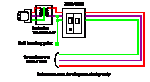
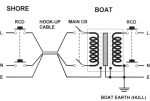
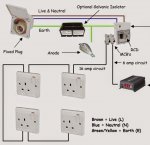
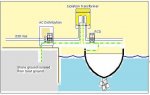
Sizing and characterisctics of RCBOs & MBCs for 230V installation

Any reason you prefer half a ton of copper and iron instead of a galvanic isolator?

My impression is that isolation transformers are "better" than galvanic isolators (diodes), both in terms of function (GIs allow 0.7V galvanic charge) and reliability (diodes die). Weight is not an issue on my boat; she weighs in at 12t and has almost a ton of ballast (in 60kg steel billets). The 3600W Victron weighs a mere 23kg, and will share room with a Perkins 6.354 diesel engine which weighs 600kg, and a 500L diesel tank. I will also carry something like 700L of freshwater, and 1000Ah of flooded lead acid batteries. Basically, what I'm trying to say is that the isolation transformer is actually one of the lightest objects aboard :D
 
Last edited:
You clearly think you know better than everyone else, industry pros, ISOs etc, so crack on. I'll be sure to ignore your future questions.

The responsibility for providing protection on the 16A pontoon outlets does not lie with me, and my question was not about how to wire up my boat (thank you), but whether the sizing and type of devices chosen would be appropriate. You can pontificate about questions not asked as much as you like. And this talk about lawsuits, you're having a laugh I think - have you ever been aboard an actual live-aboard boat before? My electrical system will be head and shoulders above 90% of what I've seen (the old system on my boat was just an intake, straight to unfused Euro sockets via an RCD - no overload protection, no isolation!). Compared to the awful bodge-jobs that seem to be de rigeur I'm going to quite extreme lengths to do this properly, even using tinned and screened mains cabling throughout. I am also quite capable of reading the technical installation material provided by the manufacturers, and will follow their recommendations.
 

It's AC, you have to worry about the imaginary parts as much as the real. :-)

It's like nobody believes it's necessary to earth bond domestic plumbing, until they get a shock drinking from a tap. Been there, didn't like it!
 
The responsibility for providing protection on the 16A pontoon outlets does not lie with me, and my question was not about how to wire up my boat (thank you), but whether the sizing and type of devices chosen would be appropriate. You can pontificate about questions not asked as much as you like. And this talk about lawsuits, you're having a laugh I think - have you ever been aboard an actual live-aboard boat before? My electrical system will be head and shoulders above 90% of what I've seen (the old system on my boat was just an intake, straight to unfused Euro sockets via an RCD - no overload protection, no isolation!). Compared to the awful bodge-jobs that seem to be de rigeur I'm going to quite extreme lengths to do this properly, even using tinned and screened mains cabling throughout. I am also quite capable of reading the technical installation material provided by the manufacturers, and will follow their recommendations.

The question you actually asked was, "As I'm about to order the consumer cabinet parts for this, at considerable cost, I thought I'd check with the forum if anyone can see any obvious problem with this layout?

Now you don't like it when the people who know about these things tell you problems they can see with the layout!
 
Now you don't like it when the people who know about these things tell you problems they can see with the layout!

No. What I don't like is people who insist on perfection, and following the letter of the law, when anyone who's worked on building/fitting out their own boat knows that without cutting one or two corners literally NOTHING will ever get done. Pragmatism. Facing reality and understanding which corners can "safely" be cut and which ones cannot (and I do have an electrical engineering background by the way, albeit only for SELV applications, so I'm not entirely in the dark). It's not that I don't understand the issue raised, it's that I feel confident to put it firmly in the "cuttable corners" category. YMMV.

Edit: I mean, think about it for a second, what @lw395, @PaulRainbow and @matthewriches are worrying about (as is the ISO standard they're referring to) is the possibility that the "virtual" earth potential aboard my boat would be sufficiently different to the "real" earth potential of the jetty (which must lack appropriate and REQUIRED safety equipment, such as an RCD) that holding one hand on an exposed metal part of my boat and an exposed metal part of the jetty in the other hand would expose me (or someone else) to a shock powerful enough to be dangerous. This without tripping my (post transformer) RCBO. I'm sorry, but that's just a ridiculous proposal; for one thing both the boat and the jetty are (partilly) submerged in a (partially) conductive liquid. Just ain't gonna happen. Now I can understand that there are rules, guidelines and standards which have to take such unlikely events into account, but the rest of us really don't.
 
Last edited:
No. What I don't like is people who insist on perfection, and following the letter of the law,

I absolutely do insist on perfection when it comes to safe installations.

when anyone who's worked on building/fitting out their own boat knows that without cutting one or two corners literally NOTHING will ever get done.

That's utter nonsense. I've re-fitted a couple of my own boats, i've carried out electrical work on many customers boats, in addition to all of my normal, smaller jobs, i have this year rewired a 50+ft 1964 classic motor cruiser and a 60ft 1920 classic motor cruiser, so i know a little about wiring. I don't cut corners when it comes to cable sizing, circuit protection or people protection, amongst other things. There are a million ways i could do my job and put peoples boats and lives at risk, i don't cut corners.

To answer one of your previous comments, i've seen onboard plenty of liveaboards. I've seen onboard plenty of average cruisers, some of each have some appalling wiring, so what ? Just because some have rubbish wiring doesn't mean we should cut corners on safety issues.

Your are not cutting corners so the job can get done, no matter how you try to dress it up, you are penny pinching at the expense of safe practice, all for about £30.
 
Your are not cutting corners so the job can get done, no matter how you try to dress it up, you are penny pinching at the expense of safe practice, all for about £30.

Nah. I just refuse to spend money on nonsense. Give me a credible scenario where a pre-transformer RCD would save someone's life. I'm genuinely curious. How would you get a lethal current flowing through that circuit without tripping my post transformer (hull earthed) RCBO, or the jetty's RCD?
 
Nah. I just refuse to spend money on nonsense. Give me a credible scenario where a pre-transformer RCD would save someone's life. I'm genuinely curious. How would you get a lethal current flowing through that circuit without tripping my post transformer (hull earthed) RCBO, or the jetty's RCD?

You have no circuit protection or people protection between the isolation transformer and the shore power supply. Never mind the scanty Victron diagram (i like Victron equipment, i use a lot of it), if a builder followed the Victron diagram they would fall foul of the regulations. You are under no legal obligation to comply with the ISO, but common sense would suggest it might be a good idea, especially as we are only talking <£30.
 
You have no circuit protection or people protection between the isolation transformer and the shore power supply.

Sure there is. It is a legal requirement for this to be fitted.

IET Guide Note 7.png

For SELV applications it is drummed into us that "the fuse is there to protect the cable" - that is fusing should always be done as close to the power source as possible. This is the only way to protect against cable breaks or damage. Putting the fuse at the other end would not protect the cable - and in this case we are talking about a pretty long cable carrying lethal voltage in close proximity to water.

As for the £30 you keep going on about, a quality RCBO costs £50-100, and you have to add to that the cost of an additional enclosure etc, not to mention the extra work required to install it. But you know what, I might do this anyway - I just realised I will need to fit some kind of enclosure to cover the rear of the shore inlet; it currently exits inside a bench which I plan to remove, and it is completely naked(!) - I might as well use a small DIN rail enclosure as cover. Yes, you read that right: any unsuspecting individual rummaging around for tools or whatever inside this bench will have their hands perilously close to live mains voltage. Told you the old system is atrocious.

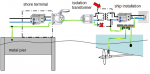
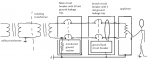
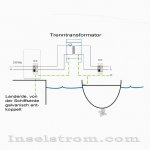
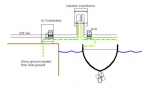
And not to flog a dead horse, but since you were unhappy with the quality of Victron's diagram, here are a few others turned up by a Google Images search:

1.gif 2.png 3.jpg 4.jpeg 5.png 6.png 6.jpg

Spot any which shows an RCD before the isolation transformer? Me neither.
 
That illustration forms no part of any installation instructions!

Ooops, you got me there! How embarrassing. However this diagram is present in the PDF datasheet:

Screenshot_2018-05-05_14-09-12.png

And the installation manual, while not having any such diagrams, contains the following paragraph:

Screenshot_2018-05-05_14-08-56.png

Are we done here?
 
You’ll be fine Lomax. I am an industrial electrician and agree the marina that you plug into in the UK have to provide RCD protection on their sockets and this will be checked in both the installation certification and any periodic check that they are legally required to have done.

Obviously if you go abroad or to a marina that is not fulfilling its legal obligations, you may not have this protection between shoreside and your incommer on the vessel, but you are aware of that.

You are not building a new boat, nor are you a charter or commercial vessel so if you’re happy and are aware of the risks, whilst minimal then you’re good to go.

You could afterall just flop an extension lead over the side and plug in with no further protection between the shoreside and vessel.
 
You’ll be fine Lomax. I am an industrial electrician and agree the marina that you plug into in the UK have to provide RCD protection on their sockets and this will be checked in both the installation certification and any periodic check that they are legally required to have done.

Obviously if you go abroad or to a marina that is not fulfilling its legal obligations, you may not have this protection between shoreside and your incommer on the vessel, but you are aware of that.

You are not building a new boat, nor are you a charter or commercial vessel so if you’re happy and are aware of the risks, whilst minimal then you’re good to go.

You could afterall just flop an extension lead over the side and plug in with no further protection between the shoreside and vessel.

How many isolation transformers have you fitted, without the RCD on the primary ?
 
You’ll be fine Lomax. I am an industrial electrician and agree the marina that you plug into in the UK have to provide RCD protection on their sockets...................

Electrics & electronics Suffolk & Southwold Boatyard
Custom Panels + Eberspacher/Webasto

Well that's identified one boatyard to steer clear of if you want a decent job done of any electrical work.
 
The advice given is from a qualified electrical contractor, the o/p is dissing the advice, take the answer in context!

The representative of the boatyard mentioned appears to be agreeing with the OP and his penny pinching corner cutting of electrical safety
 
Last edited:
Top