Siting solar panel

Frank mellin

Well-Known Member
Joined
17 Dec 2016
Messages
164
Visit site
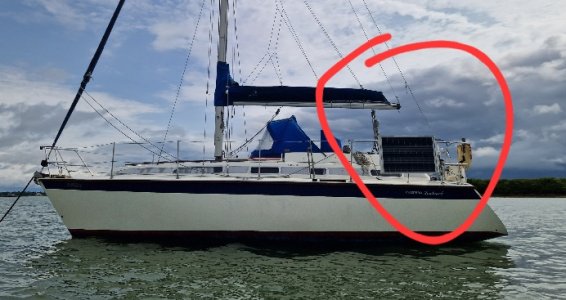
Have a 26 ft freeman cruiser and am looking to put a solar panel on the canvas canopy roof at back of boat.
Panel is 4ft x 2ft.
The front edge of panel will be secured to the back of the fibre glass roof so will not be any real weight on canvas roof.
Have I missed anything?
 
Even if there's no weight, any movement in the wind could rub through the canvas fairly quickly. It might be worth adding some protection.
 
Have a 26 ft freeman cruiser and am looking to put a solar panel on the canvas canopy roof at back of boat.
Panel is 4ft x 2ft.
The front edge of panel will be secured to the back of the fibre glass roof so will not be any real weight on canvas roof.
Have I missed anything?
Photos.

Flexible panels require rigid support (they don't like even limited repeated flexing). A rigid panel can support itself.
 
Photos.

Flexible panels require rigid support (they don't like even limited repeated flexing). A rigid panel can support itself.
So how come our semi-flexible panels have worked for 8 years on top of a canvas sprayhood, including several F10 storms)
Attaching via “industrial” style 2 inch wide Velcro holds firm and avoids any chafe.
Another semi-flexible panel sits on the dinghy seat and gets regularly bent as put in and out. Also been fine, though replaced at 7 years as precaution.
 
Sort of agree with both sides. They work on canvas just fine but if you have a stainless frame and can mount it more robustly then do that. Raise it up with a spacer and have a little frame to make it more rigid and it’ll also get some cooling from air beneath it. Even better, replace the canvas with something harder to mount solar to if the canvas never gets lowered.
 
If the flexi panel has grommets at the corners for screws, bolt through them to 4 neodymium magnets and then use another 4 under the hood to secure it in place magnetically . I've done several boats like this and they have been tested to 30 knots or more with zero problems over (for the longest one) 4 years . if you use a long cable it means in heavy wether you can quickly dismount it and put it on the cockpit floor etc out of the wind without disconnecting . Very quick and easy to do with about £10 outlay from Amazon for the magnets
 
So how come our semi-flexible panels have worked for 8 years on top of a canvas sprayhood, including several F10 storms)
Attaching via “industrial” style 2 inch wide Velcro holds firm and avoids any chafe.
Another semi-flexible panel sits on the dinghy seat and gets regularly bent as put in and out. Also been fine, though replaced at 7 years as precaution.
Not everyone gets cancer from smoking. However, expereince has revealed it to be a risk factor. Same with bending semi-flexible panels. It's right in the manual. Firm support is required to avoid fracturing cells.

In this case, the quality of the panels helps; good panels better tolerate rough use.
 
If the flexi panel has grommets at the corners for screws, bolt through them to 4 neodymium magnets and then use another 4 under the hood to secure it in place magnetically . I've done several boats like this and they have been tested to 30 knots or more with zero problems over (for the longest one) 4 years . if you use a long cable it means in heavy wether you can quickly dismount it and put it on the cockpit floor etc out of the wind without disconnecting . Very quick and easy to do with about £10 outlay from Amazon for the magnets
I tried magnets. It didn't work for us. Caribbean has some windy weather.
Flexi panels failed from micro cracking, probably from the windy weather flexing them on the suncover.
We now have framed panels that are far more robust.
My new framed panels far exceed the performance we achieved from flexible panels, even when they were brand new
 
If the flexi panel has grommets at the corners for screws, bolt through them to 4 neodymium magnets and then use another 4 under the hood to secure it in place magnetically . I've done several boats like this and they have been tested to 30 knots or more with zero problems over (for the longest one) 4 years . if you use a long cable it means in heavy wether you can quickly dismount it and put it on the cockpit floor etc out of the wind without disconnecting . Very quick and easy to do with about £10 outlay from Amazon for the magnets
What's the compass safe distance for a neodymium magnet 🤔😂
 
One problem with a permanent mounting on the canopy is that you will no longer be able to fold it away on a nice day.

Assuming it's one of these,
1971-freeman-26-power-9448910-20240629080958164-1_XLARGE.jpg

Could you get creative on the cabin top, forward of the mast?
 
If the flexi panel has grommets at the corners for screws, bolt through them to 4 neodymium magnets and then use another 4 under the hood to secure it in place magnetically . I've done several boats like this and they have been tested to 30 knots or more with zero problems over (for the longest one) 4 years . if you use a long cable it means in heavy wether you can quickly dismount it and put it on the cockpit floor etc out of the wind without disconnecting . Very quick and easy to do with about £10 outlay from Amazon for the magnets
I forgot to mention that neodymium magnets are ferrous and rust for fun. They stain fabric with rust and mark the deck. Absolutely not appropriate for a marine environment.
 
I'm going to replace this knackered solar panel on my new to me boat. The space overall is 1500 by 540mm. The bit of stainless going across the space is 150mm wide. There is a 25mm gap between the existing solar panel and stainless.
I can get a 150w panel that will fit the space but will always have some shade under the stainless. The other option is a smaller panel, 850 by 540mm below the stainless and then another one above the stainless of 500 by 540mm. I haven't yet looked at smaller panels but assume that a couple of 50 watts will fit without be shaded.
Would the bigger panel (150 watt, slightly shaded) still produce more power than two smaller unshaded ones ? The 150 watt one is a SpectraLite SemiFlex Pro 150W. Not cheap, but I had one on my last boat and the panel was quite happily producing 130 watt just laying on a flat surface. The boom will eventually be swung over to the right so reducing shading.
There will be a blue tooth victron mppt controller sorting out the power to the batteries.

1000016439.jpg
 
It depends upon exactly how the panel is wired (larger ones generally have a few strings of cells in parallel) but as a rule, you want to avoid any shade at all. The string will only produce power in relation to its lowest output cell, so one shaded cell can kill a whole panel.

You may well be better off with two smaller panels, although it's likely to cost more.

What is that stainless thing? Could you mount a panel above it?
 
I'm going to replace this knackered solar panel on my new to me boat. The space overall is 1500 by 540mm. The bit of stainless going across the space is 150mm wide. There is a 25mm gap between the existing solar panel and stainless.
I can get a 150w panel that will fit the space but will always have some shade under the stainless. The other option is a smaller panel, 850 by 540mm below the stainless and then another one above the stainless of 500 by 540mm. I haven't yet looked at smaller panels but assume that a couple of 50 watts will fit without be shaded.
Would the bigger panel (150 watt, slightly shaded) still produce more power than two smaller unshaded ones ? The 150 watt one is a SpectraLite SemiFlex Pro 150W. Not cheap, but I had one on my last boat and the panel was quite happily producing 130 watt just laying on a flat surface. The boom will eventually be swung over to the right so reducing shading.
There will be a blue tooth victron mppt controller sorting out the power to the batteries.
The output from one panel with that stainless steel creating a hard shadow will be poor.

Two smaller panels would be a much better solution.

An alternative is one of the shade tolerant CIGS panels. A single CIGS panel would still produce a reasonable output with the shadow from the stainless steel. However, CIGS panels have other significant drawbacks, such as low efficiency and high cost.
 
I forgot to mention that neodymium magnets are ferrous and rust for fun. They stain fabric with rust and mark the deck. Absolutely not appropriate for a marine environment.
First ones I fitted were on a Broad Blue cat (it was the customer's idea) and he reports no rust or stains after almost 5 years now and I know for a fact that a couple of boats have seen out 40 knots without anything coming awry . It does depend on the quality of flexi panel how well they last. Obviously fixed panels are better when there is room for them but that's not always the case as with the OP

I have both on my own boat - with the Renogy flexes still working perfectly after 6 years now and outputting huge amounts of power .. 5x 175w panels in series through Victron MPPT output as much as the 680w glass panels which are in a much better spot vis a vis shading as with the mast and boom etc the flexi panels are always shaded somewhere at all times of day and angles .. obviously 875w is more than 680w but given some people's comments about glass being so much better isn't really showing on my own boat. The flexes are just stuck to the cockpit roof by the way, nothing done to reduce heat. They have not yet been to the Caribbean but have coped with Med, French and UK summers with no signs of cracking or loss of power output and are walked on daily when sailing (they have to be to open the sail bag) and often used by the cat as a scratch pad!!
 
I didnt want to fit an arch as it makes me feel enclosed. I also hate the idea of slippery panels on deck, and even a small shadow drops the output a lot. My solution was to mount them on the rail near the push pit. I replaced the guard wires with stainless tubing. I made mounting boards out of 5mm ply. I bought a couple of hydraulic rams so they just swing out. They can be stored vertically when manoeuvring but wing out when under way or at anchor. Several seasons in and they are still working well. Mppt controller is worth the extra £.1000014692.jpg
 
I didnt want to fit an arch as it makes me feel enclosed. I also hate the idea of slippery panels on deck, and even a small shadow drops the output a lot. My solution was to mount them on the rail near the push pit. I replaced the guard wires with stainless tubing. I made mounting boards out of 5mm ply. I bought a couple of hydraulic rams so they just swing out. They can be stored vertically when manoeuvring but wing out when under way or at anchor. Several seasons in and they are still working well. Mppt controller is worth the extra £.View attachment 204112
We have 2x250w bifacial panels per side, mounted in a similar fashion. I wouldn't do it any other way
 
I didnt want to fit an arch as it makes me feel enclosed. I also hate the idea of slippery panels on deck, and even a small shadow drops the output a lot. My solution was to mount them on the rail near the push pit. I replaced the guard wires with stainless tubing. I made mounting boards out of 5mm ply. I bought a couple of hydraulic rams so they just swing out. They can be stored vertically when manoeuvring but wing out when under way or at anchor. Several seasons in and they are still working well. Mppt controller is worth the extra £.View attachment 204112
We did the same with a 100w rigid panel on either side. Sailed about 10k miles like that including an Atlantic crossing. Occasionally folded them down when coming alongside, but left them up at all times on passage.
 
Top