Hi!
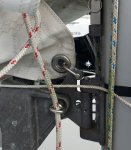
I am about to make a single reefing line system but not sure whether the pad eyes should go on the mast or the boom. On the mast, the pulling angle should be much better but thinking it might stress on tacks. Opinions, please? I d like to do something as in the pic.
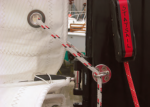
View attachment 110987
Why a fiddle block and not just a small normal block?What you need, instead of the padeye is a cheek block, but if it were me, I would use a fiddle block, shackled to the padeye. This would reduce the friction and provide a little more articulation to deal with what happens when the sail is well out on starboard tack, and also position the grommet better in relation to the spars.
That looks interesting. I have a couple of blocks sewn into the sail and that arrangement would stop "overeager" crew from pulling too much reefing line in!Here's another idea. I've replaced the gooseneck's horizontal pivot bolt with an eye-bolt sleeved by a piece of stainless steel tube to make up the diameter (both cheap on ebay).
View attachment 111003
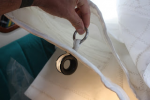
Take a short length of webbing & on one end sew a large ss ring. On the other end sew a loop to take the pin of a large shackle. Put the ring on the opposite side of the sail to the reef line side. pass the webbing through the cringle of the sail & then shackle a ball bearing pulley to it. The ring stops the webbing pulling through the hole. ( commonly called spectacles) You now have less friction at the sail luff plus the block will swing slightly forward in line with the lead of the reef line to the mast.
Look on line for a proper reef line lead ( item 4320 5508 124 scroll downpage). An alternative would be a friction ring spliced to dynema & the other end of the dynema fitted to a lacing eye(lacing eye) pop riveted to the mast.This gives the option for experiment of position
The idea is to pull the sail forward & down & to avoid friction
When you get to reef No 2 you may find that the webbing between ss ring & shackle could be longer so that it fits lower down towards the gooseneck where the sail is forming a stack on the mast above the boom.
When reefing--May i suggest that you do not just let all the halyard off in one go to a mark on the halyard. If you do this you get a big bunch of loose reef line everywhere that does not come in easily. If you ease the halyard as you go & use the reef line to pull the sail down it all comes in without kinks & tangles in the cordage. if you have a fully battened main put a piece of tape on the mast level with the point where the lower batten should be when reefed. As you see the sail approach that point,( you soon learn at what point) Lock the halyard & pull the reef line in thus pulling the sail down to the mark & everything nice & tight.

Good to hear no blocks used and it's functional! I like the simplicity of just using pad eyes, I'll try that and add blocks if the friction is too much.Definitely on the mast, to avoid the luff being pulled back. Yes the angle looks wrong in that photo, but that looks to be because the eye is too high up. We have fixed eyes like that on the mast, but a good 15cm or so down from where the reef cringe will pull down onto.
No pulley blocks on our sail, but dog bone type s/s eye at the front, and no issue with friction at all on 40 foot boat (with cruising dyneema lines)
If you are going to do that then may i suggest that you put a shackle in place of a ring. Then you can turn it round & try a block to compare fairly quickly without making a new webbing piece. The reef line will remain on the same side of the sail.Good thanks for the detailed design and the reefing process advice! As for the luff cringle setup, I understand something like on the pic but with a block instead of the low friction ring?
View attachment 111030
Thank you all for your replies, really helpful to know several setups! If we first lose the main halyard and the main simply drops to the desired level, then pulling the reefing line should not have much friction (assuming the sail has no pressure and flaps). Are you referring to friction problems in the scenario we want to reef without losing the main sheet? Last year I had to reef a Bali catamaran in the Bay of Biscay sailing downwind...Of course, reefing the main downwind is not a good practice- it won't come down because of friction...well I had no other choice and very slowly eased the halyard while pulling in the reef line with the winch.