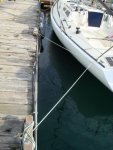
Single handed marina mooring

In our harbour things are a bit tight, so accepted protocol is leaving or departing boats are fendered both sides, so if you contact another boat no harm is done. Then once moored you remove the outside fenders so there's nothing to snag another passing boat doing the same.

Another +1 to ready made lines with spliced loops. These remain tied to the pontoon all season. I come into my berth, step off with a centre line to hold the boat, then loop my mooring lines over the cleats on the boat. Exiting is the reverse, hold the boat on the centre line, unhook my mooring lines from the boat and lay them neatly on the pontoon, step on and depart.

If it's too windy or rough to do that in the shelter of the harbour, then it's probably too rough (for us) to go sailing.
 
A word of caution about using lines with spliced loops on the end. My neighbour uses these, even has poles on the pontoon with hooks to hold the lines, and when the wind is blowing off the pontoon he finds it impossible to get any purchase on the lines to pull himself in, because the lines are short he is usually leaning outboard. It's only a matter of time before he falls in.
I have similar lines on the pontoon, but I always use a line with a loop on it, rigged outboard and coming back through a central fairlead back to a cockpit winch. The loop goes over the pontoon cleat, and use of the engine and or winch allows me to position the boat where I want. I can then step ashore and secure the prepared mooring lines.
Single handed on a 39 foot AWB.
 
Last edited:
Another vote for Duncan Wells and his excellent book. It links to some great videos as well to show how his plans work in practise. Crowblack mentions a very useful method for leaving the pontoon by using a long line. We used it today very successfully to leave a pontoon, with a boat in the next berth, and the wind blowing us off the pontoon.
 
I have similar lines on the pontoon, but I always use a line with a loop on it, rigged outboard and coming back through a central fairlead back to a cockpit winch. The loop goes over the pontoon cleat, and use of the engine and or winch allows me to position the boat where I want. I can then step ashore and secure the prepared mooring lines.
Single handed on a 39 foot AWB.

Same here, the line can pass ahead or astern of the cleat, depending on whether i'm coming in ahead or astern, the ends of the line are made fast to a sheet winch.

Single handing a 10m Westerly.
 
Yep, that's the way I do it too. If it's really windy, I have a loop held open with some garden hose, just the right length to stop my bow hitting the walkway pontoon.
 
I use a mid cleat spring line with a bit of flexible plastic pipe over the end to keep the loop open.
As you approach. drop / throw the loop over the pontoon end cleat, and use the tiller / engine / drift ( depending on conditions ) to let the spring bring you into the pontoon.
Then just step off and set bow and stern warps and your done.
Not my invention, I've got an article I can send you if you want?

I use the same on my 37 footer. With the mooring warp connected through the mid-ship fairlead I lean over the side with the open loop and let it catch the first cleat on the finger. Once on drive forward with rudder turning stern of boat to finger, similar to a spring. It will allow time to step off boat to secure front and back. Practice on a calm day to build up confidence.
 
Now that I'm living it up in Pwllheli Marina, I need to learn new skills compared with my swinging mooring. What's the best way of leaving a finger pontoon single handed (and returning). My boat's a 20' bilge Keeler with outboard in a well so not exactly The Queen Mary.

marinas are very easy single handed, its fore and aft trot moorings in 26knt winds (like last evening) which are a PITA when the stern wants to constantly swing out with the wind. (extra lines and the winch, but a faff when compared to marinas)

although for me I found doing it is the best learning of all, as it all depends on the wind conditions which is never the same as what you've just watched or read, but springing the boat off, using the boats shape to your advantage is what I find works best.

as for mooring up, don't be afraid of motoring right up to the mooring, looking where the cleats are, go back out and sort your lines to suit and simply drop them over when you return, if its your mooring some people leave a pole midship with their lines attached to make grabbing them easier - but ultimately I can watch 100 people moor up and they all do it different, so you will find something that works better for you than others.
 
A word of caution about using lines with spliced loops on the end. My neighbour uses these, even has poles on the pontoon with hooks to hold the lines, and when the wind is blowing off the pontoon he finds it impossible to get any purchase on the lines to pull himself in, because the lines are short he is usually leaning outboard. It's only a matter of time before he falls in.
I have similar lines on the pontoon, but I always use a line with a loop on it, rigged outboard and coming back through a central fairlead back to a cockpit winch. The loop goes over the pontoon cleat, and use of the engine and or winch allows me to position the boat where I want. I can then step ashore and secure the prepared mooring lines.
Single handed on a 39 foot AWB.

Wind blowing off the pontoon is always a problem, and this is where having a bow thruster helps (particularly if you have a remote). I moor stern to , so it is the bow that can get blown out first, and this is where the bow thruster helps. A quick blast brings the bow in (I will already have a stern line on). My berth is E/W and wind is usually between S and W and finger on the port side, so only a problem on the rare days when wind is from the north. I also have 2 springs one going forward and the other aft, both to the midships cleat. Those go on first and are usually enough to stop the bow drifting out too far.

While the principles are common the detailed application depends on the specifics of the berth and boat. Inevitably there is some experimentation before you settle on a system that works for you.
 
Now you just have to choose which of the above methods is going to work for you. Every time will be different....
 
All very interesting but my 20 footer doesn't have a now thruster.
Wind blowing off the pontoon is always a problem, and this is where having a bow thruster helps (particularly if you have a remote). I moor stern to , so it is the bow that can get blown out first, and this is where the bow thruster helps. A quick blast brings the bow in (I will already have a stern line on). My berth is E/W and wind is usually between S and W and finger on the port side, so only a problem on the rare days when wind is from the north. I also have 2 springs one going forward and the other aft, both to the midships cleat. Those go on first and are usually enough to stop the bow drifting out too far.

While the principles are common the detailed application depends on the specifics of the berth and boat. Inevitably there is some experimentation before you settle on a system that works for you.
 
All very interesting but my 20 footer doesn't have a now thruster.

Appreciate that, but your boat is easily manhandled!

The reason for mentioning it is because inevitably some contributions talk about the problems with bigger boats which mean different potential solutions and a bow thruster is one that will help deal with being blown off a pontoon.
 
Tranona, I was only being facetious. In practice I can easily apply my boot to the pontoon to get sideways thrust.
All the answers so far have been very helpful and I'll try them out and see which works best. I'll certainly make up up some bespoke docklines for my home berth.
 
A 20' boat? Step off with bow and stern line in hand and tie up, what's the problem?

Put the fenders on when you are tied up.

It's only a dinghy and will stop if you pull it, the forces involved aren't much, my lady could and has done it.
 
A 20' boat? Step off with bow and stern line in hand and tie up, what's the problem?

Put the fenders on when you are tied up.

It's only a dinghy and will stop if you pull it, the forces involved aren't much, my lady could and has done it.
You're right, maybe I'm overthinking the situation.
 
Tie your fenders and all lines on the finger dock all the time and just leave them there. There is no reason at all to take them on your boat every time you pull away. Tie the dock lines in a V shape, with a loop big enough to go over the cleat on your boat. Put one V near the bow cleat of the boat and another V near the stern cleat of the boat. The stern V must be of a length that will stop the boat completely before you crash into anything ahead.

15 V Dock Lines (480x640).jpg
When you pull in, just reach over (perhaps with your boat hook) grab the stern line and slip it over your cleat. Then casually step onto the dock while your boat stops in perfect position, and slip the bow line over the bow cleat. I've done this a thousand times and never once had a failure in any wind conditions. The V lines act as both dock lines and spring lines, so you don't need anything else, ever. And the fenders are always exactly where you need them.
All described in the free book here; http://sfbaysss.org/main/resources/
 
Last edited:
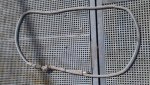
I use this device to hook onto the cleat at the end of the finger once it’s caught engage forward and use a spring. Wrapped around one of the plastic tubes would be a warp let back through the centre fairlead and onto one of the jib winches. The rope is 3 strand 20mm nylon, the plastic tube is about 60cm long at each end.Pickup comp.jpg
 
A 20' boat? Step off with bow and stern line in hand and tie up, what's the problem?

Put the fenders on when you are tied up.

It's only a dinghy and will stop if you pull it, the forces involved aren't much, my lady could and has done it.
Mayhap, but why leave fenders off till docked? If it goes tits up and you hit your neighbour or the dock, no one will thank you for being unfendered.

Fwiw, my old boat was 18ft, I just motored in, bow lines lead back outside everything to cockpit, on both sides, stern lines on aft cleats, on both sides, and lines on midships cleats, on both sides. Then just slip the midship line over a cleat, push the tiller over, engine already down to low revs, and the boat was held alongside without bow blowing out. Step off and secure bow line, walk back and secure sternline. The both sides meant there was no faff at all about getting on one side of a finger or another, I could take any side I want. Ok, you may have a your own permanent berth but often your coming into a strange marina.
 
Top