
Silicone antifoul - mid season update

toothless

Active Member
Joined
19 Sep 2024
Messages
64
Visit site
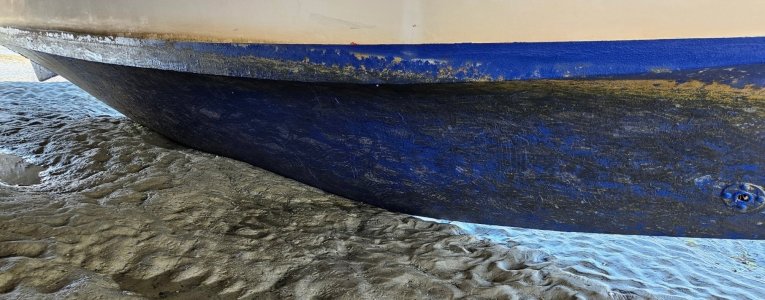
My cat has been in the water, not scrubbing or drying out, since November. I dried her out on ryde sands last weekend (intentionally... ) and checked out the state of fouling. There is some slime that wipes off but no weed or hard fouling at all. So not totally clean but better than my eroding tiger xtra on the contessa 26 has been in the past. Pretty good I feel.

My fender that has been dipping in the water a month has a heap of weed and wiggly critters dangling from it, so despite the lack of biocide the silicone certainly seems to be working. If I get two years from this as advertised I'll be very happy.
 

Attachments

  • Screenshot_20250718_213720_Photos.jpg
    Screenshot_20250718_213720_Photos.jpg
    381.1 KB · Views: 45
To be useful :) you need to define the waters in which you keep your cat, how often you use her and what sort of cat she is (so that we can ascertain how fast she might sail).
 
Silicones work if used on 'high speed' surfaces (which explains the success of Propspeed). Though even some high speed vessels, container ships and cruise ships have reverted to conventional AF.

Usually leisure sailing yachts simply do not acheive a speed sufficient to wash the hull surface (and as with container ships) some high speed yachts have not found silicones successful.

Most usage on leisure yachts has been singularly unsuccessful. If you try to use a conventional AF on a surface that has had a silicone coating - the AF does not adhere - unless you are very careful at removing the last vestiges of silicone.

There is much work to be done.

Jonathan
 
Silicones work if used on 'high speed' surfaces (which explains the success of Propspeed). Though even some high speed vessels, container ships and cruise ships have reverted to conventional AF.

Usually leisure sailing yachts simply do not acheive a speed sufficient to wash the hull surface (and as with container ships) some high speed yachts have not found silicones successful.

Most usage on leisure yachts has been singularly unsuccessful. If you try to use a conventional AF on a surface that has had a silicone coating - the AF does not adhere - unless you are very careful at removing the last vestiges of silicone.

There is much work to be done.

Jonathan
Just wondering how the Silicone antifouling stands up to regular scrubbing.

If it does, and works well on shell fouling , it might be worth a try.
 
Just wondering how the Silicone antifouling stands up to regular scrubbing.

If it does, and works well on shell fouling , it might be worth a try.

I don't "scrub" the coating as that will introduce scratches which will attract fouling.

A microfibre cloth is all that's needed around waterline.

If there's a slime coating a VERY gentle pressure wash removes it.

Despite the naysayers, it works for me, I'm on my 3rd boat with it and Superheat6k of this parish was suitably impressed to apply it to his grand banks with good results.

Oh because it's very slippery I got 1.5 knots extra speed ( or better fuel consumption if desired).
 
Last edited:
Despite the naysayers, it works for me, I'm on my 3rd boat with it and Superheat6k of this parish was suitably impressed to apply it to his grand banks with good results.

No-one is denying your success nor that of Superheat, but MoBos tend to move faster and consistently faster through the water than many, most sailing, yachts.

If the sweet spot is a vessel speed greater than, say, 7 knots, then many sailing boats will never achieve theat speed even for short periods of time - and any fouling will not be washed off. The philosophy of silicone coatings is that any fouling is removed by vessel movement through the water - the fact that you need a gentle power wash to remove slime suggests that even my, nominal, 7 knot speed is insufficient.

Maybe expectations, that a gentle wash is unnecessary, are too high. But to complete a gentle wash to remove slime means a lift out and many owners cannot afford the time, nor cost.


My subjective comment is very simple - if silicone coatings were a resounding success then the manufacturers of same would hav a considerably more effective marketing campaigns. Prop Speed works, so the 'theory' is correct - but no-one is using Prop Speed on their hull.

Jonathan
 
My boat lives afloat on the Hamble. Yup silic one - it was a pain to apply - the multiple primers etc have very rigid overcoating timings so it took a full weekend.

I do keep hearing people say it won't work on a sailing boat due to slow speed - but it seems to be working fine. Time will tell.
 
It’s also very difficult to remove and if you don’t get it all off, conventional antifoul won’t stick to the hull again. Absolute no for any displacement speed yacht imo.
We took about a mm of wood off, below the epoxy primer. Then re primed with epoxy, a/f primer and hard racing to finish. We won her first race back in the water, just like magic. The growth had got into the coating, taken root in it.
 
It’s also very difficult to remove and if you don’t get it all off, conventional antifoul won’t stick to the hull again. Absolute no for any displacement speed yacht imo.

I would agree.

But for planing hulls capable of 20 plus knots it's brilliant.

My boat is out of the water for 2 hrs a year for outboard maintenance.

Whilst the application process is more complex than traditional AF, it has lasted over 3 years.

At that point it's a lift out to apply just a single topcoat for another 3 years protection.

Much more cost effective over the long term.
 
And it seems to be working fine on my low performance sailing cat. So definitely some inconsistent views/experiences. Rather like coppercoat it seems
 
And it seems to be working fine on my low performance sailing cat. So definitely some inconsistent views/experiences. Rather like coppercoat it seems

It may be a mixture of expectations and use of the product.

It IS quite soft and can be easily damaged by external objects (I had a log jam against the side of my side on mooring which abraded some of the coating). BUT for the performance and longevity it gives me I can live with minor scuffs.

These coatings are the future so we'd better get used to living with them!
 
I tried it out just on Trim Tabs and PropShafts in April, Cant see the Propshafts but its all come off on the tabs. and yes i did do the tie coat and follow the timing instructions.
 
I tried it out just on Trim Tabs and PropShafts in April, Cant see the Propshafts but its all come off on the tabs. and yes i did do the tie coat and follow the timing instructions.

It doesnt work on Tabs or prop shafts, nor any prop.

Hull only despite the claims...
 
Top